

- The quick comparison
- Difficulty and fitness
- Poon Hill: easy (3/10)
- Mardi Himal: moderate (5/10)
- Annapurna Base Camp: moderate to hard (6/10)
- Mountain views
- Poon Hill: the panorama
- Mardi Himal: the close-up
- Annapurna Base Camp: the amphitheater
- The verdict on views
- Cost
- Accommodation and food
- Teahouse quality
- Food variety
- Connectivity
- Best time to trek
- Who should choose which
- Choose Poon Hill if you are:
- Choose Mardi Himal if you are:
- Choose Annapurna Base Camp if you are:
- Can you combine them?
- Poon Hill plus ABC (12-16 days)
- Mardi Himal plus Poon Hill (8-10 days)
- All three (18-22 days)
- The honest recommendation
Three treks. All in the Annapurna region. All starting from Pokhara. All requiring the same permits and the same mandatory guide. The question every trekker planning a trip to Nepal eventually asks: which one should I do?
This is the only side-by-side comparison of all three. Not two of three. All three, across every dimension that matters, with real numbers from the trails.
For detailed individual guides, see the Poon Hill complete guide, the Mardi Himal complete guide, and the Annapurna Base Camp complete guide.
The quick comparison
| Factor | Poon Hill | Mardi Himal | ABC |
|---|---|---|---|
| Duration | 4-5 days | 5-7 days | 10-12 days |
| Max altitude | 3,210m | 4,500m | 4,130m |
| Highest sleeping altitude | 2,860m (Ghorepani) | 3,580m (High Camp) | 4,130m (ABC) |
| Total distance | ~50 km | ~45 km | ~110 km |
| Difficulty | Easy (3/10) | Moderate (5/10) | Moderate-hard (6/10) |
| AMS risk | Near zero | Moderate | Moderate |
| Permits | ACAP + TIMS (~USD 38) | ACAP + TIMS (~USD 38) | ACAP + TIMS (~USD 38) |
| Budget cost | USD 360-480 | USD 400-550 | USD 700-800 |
| Guided package | [USD 675](/tours/trekking-in-nepal/annapurna-region/ghorepani-poon-hill-trek) | [USD 625](/tours/trekking-in-nepal/annapurna-region/mardi-himal-trek) | [USD 1,275](/tours/trekking-in-nepal/annapurna-region/annapurna-base-camp-trek) |
| Teahouse quality | Best | Basic at altitude | Good, basic above Deurali |
| Crowds (peak season) | High | Low-moderate | High |
| Best for | Beginners, couples, budget | Photographers, solitude, altitude | Full experience, culture |
| Signature moment | Sunrise panorama with 12+ peaks | Ridge walk above the clouds | 360-degree amphitheater |
Difficulty and fitness
Poon Hill: easy (3/10)
If you can walk 4-5 hours a day on hilly terrain, you can do Poon Hill. The trail is well-maintained, the altitude stays below the AMS threshold, and the teahouse infrastructure is the best in the Annapurna region.
The hardest section is the climb from Tikhedhunga to Ulleri: 3,200 stone steps, roughly 700m of elevation gain in one sustained push. It is the steepest section of all three treks packed into a single morning. After Ulleri, the trail levels out through rhododendron forest to Ghorepani.
The pre-dawn climb to the Poon Hill viewpoint (45 minutes from Ghorepani, 400m gain) is steep but short. You do it in the dark with a headlamp and adrenaline.
Mardi Himal: moderate (5/10)
Mardi Himal asks more of your legs and your nerves. The daily elevation gains can exceed 1,000m. The trail narrows above Forest Camp into a ridge walk that is less than a meter wide in places, with long drops on both sides. Above 4,000m, thin air makes every step heavier.
The hardest day is High Camp (3,580m) to Base Camp (4,500m): 900m of elevation gain before noon on an exposed rocky ridge. Wind, altitude, and the psychological challenge of narrow trail with steep fall-lines on both sides combine into the most intense single day of any of these three treks.
The trek rewards 4-6 weeks of cardio preparation. Stair climbs, hill walks with a loaded pack, and interval training all translate directly.
Annapurna Base Camp: moderate to hard (6/10)
ABC is not the hardest single day. It is the hardest cumulative experience. Ten to twelve days of sustained walking, with daily gains of 600-1,100m, means fatigue compounds. The trail passes through terraced farmland, bamboo forest, rhododendron groves, alpine meadows, and glacial moraine. Your legs adapt to one terrain and then the surface changes.
Two days stand out. The climb from Bamboo to Chhomrong (1,000m gain, 7-8 hours) is the single hardest day for leg strength. The push from Machhapuchhre Base Camp to ABC (4,130m, loose scree, thin air) is the hardest for morale because you are already exhausted from a week on the trail.
Can a beginner do ABC? Yes, with honest preparation. The gradual altitude profile helps. The duration is the real barrier: 10-12 days requires endurance that short treks do not.
Mountain views
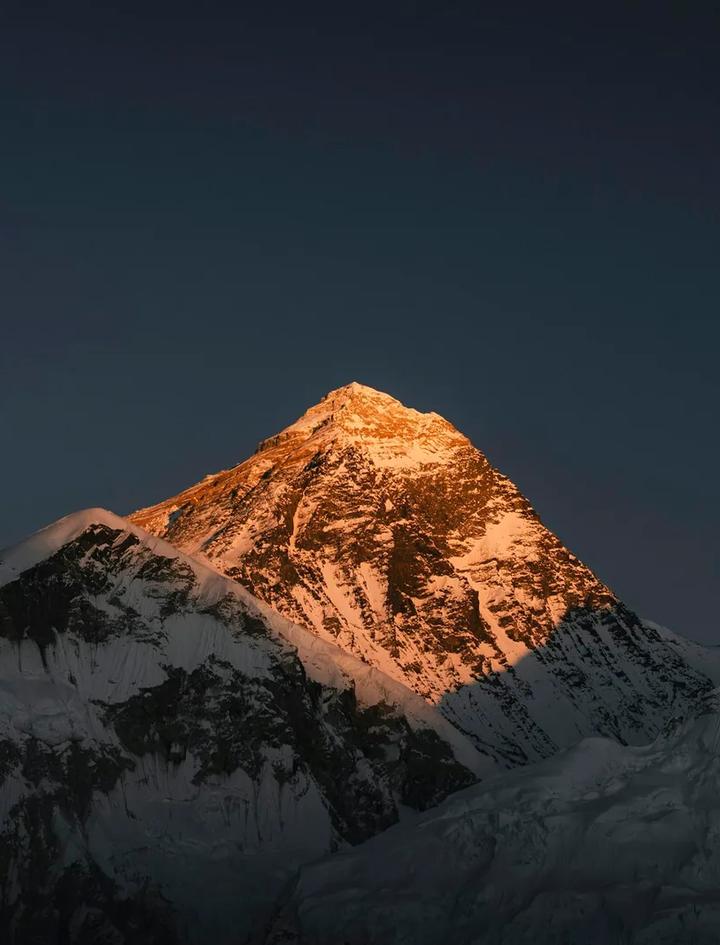
All three treks deliver world-class Himalayan views. The character of those views is completely different.
Poon Hill: the panorama
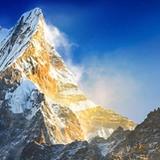
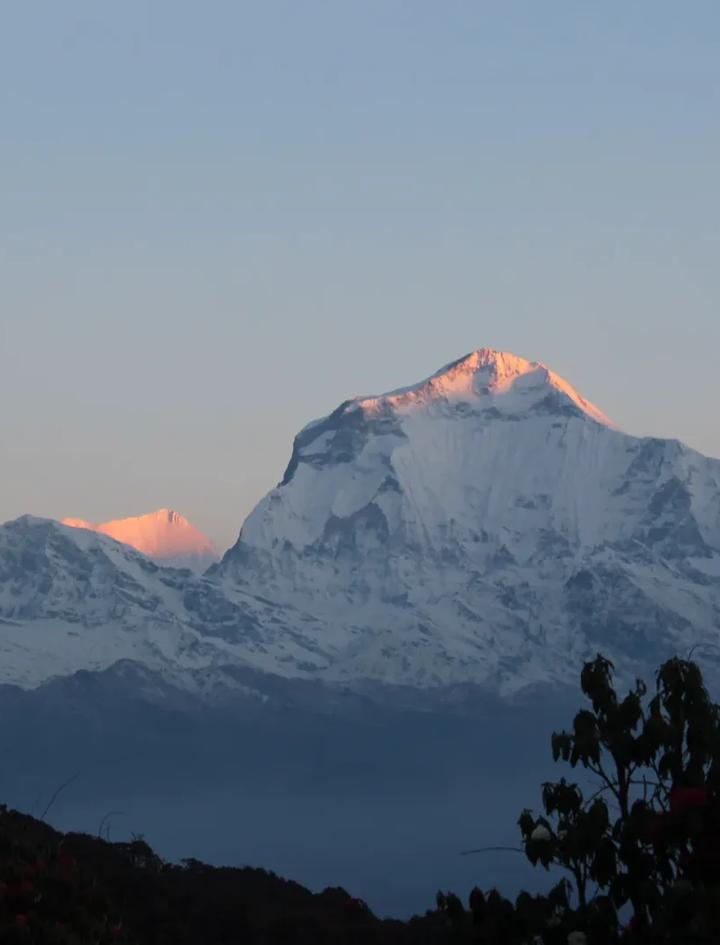
The Poon Hill viewpoint (3,210m) offers a 180-degree sweep of the Annapurna and Dhaulagiri ranges. You see two of the world's fourteen 8,000m peaks simultaneously: Dhaulagiri (8,167m, the 7th highest) and Annapurna I (8,091m, the 10th highest). Between and around them: Annapurna South (7,219m), Machhapuchhre (6,993m), Nilgiri (7,061m), Tukuche Peak (6,920m), Himchuli (6,441m), Lamjung Himal (6,983m), and at least six more named peaks above 6,000m. On a clear morning, the Manaslu range is visible to the east.
The sunrise is the signature moment. Golden light hits the snow, the sky shifts from purple to orange to blue, and for about 15 minutes the entire range glows. It is Nepal's most photographed dawn.
Mardi Himal: the close-up
Mardi Himal does not give you breadth. It gives you proximity. From the ridge above High Camp, Machhapuchhre (6,993m) towers directly above you, close enough that the summit detail is visible without binoculars. Annapurna South (7,219m) fills the sky to the west. Mardi Himal itself (5,587m) is right there, not a distant shape but a wall of ice and rock.
The signature visual is the cloud sea. On clear mornings, the valleys below the ridge fill with white cloud while you stand above it in sunlight. The effect at Badal Danda (Cloud Ridge) is the single most dramatic landscape shot available on any of these three treks.
Fourteen peaks are visible from Base Camp. The views are more intimate than Poon Hill and less enclosed than ABC.
Annapurna Base Camp: the amphitheater
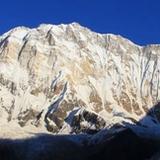
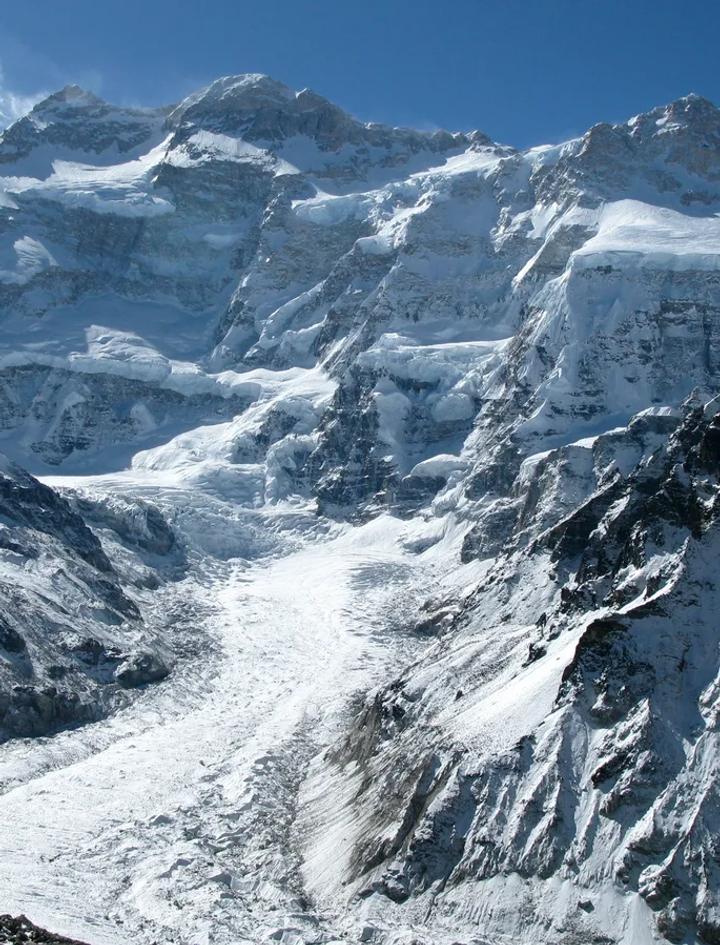
ABC is the only place in the world where you stand inside a 360-degree ring of peaks above 6,000m without technical climbing. Annapurna I (8,091m) reveals its massive north wall, a face visible only from this basin and from the air. Machhapuchhre, Hiunchuli, Gangapurna, Tent Peak, Baraha Shikhar, and Singu Chuli complete the circle.
The experience is not a viewpoint you visit and leave. You sleep in the amphitheater. You eat dinner watching the sunset paint the north wall orange. You wake at 4 AM and watch starlight on the glaciers. The immersion is what separates ABC from a viewpoint trek.
The verdict on views
For breadth: Poon Hill. For intimacy: Mardi Himal. For total immersion: ABC. There is no wrong answer. The question is whether you want to observe the mountains, stand face to face with them, or sleep among them.
Cost
All three treks require the same permits: ACAP (NPR 3,000, approximately USD 23) and TIMS (NPR 1,000-2,000, approximately USD 8-15). All three require a mandatory licensed guide. The cost difference is almost entirely driven by duration.
| Category | Poon Hill (5 days) | Mardi Himal (6 days) | ABC (11 days) |
|---|---|---|---|
| Permits | USD 38 | USD 38 | USD 38 |
| Transport (Pokhara to trailhead return) | USD 4-46 | USD 6-20 | USD 4-46 |
| Guide (porter-guide) | USD 100-175 | USD 150-240 | USD 275-385 |
| Food | USD 75-150 | USD 105-210 | USD 220-385 |
| Accommodation | USD 12-48 | USD 18-60 | USD 55-132 |
| Tips | USD 40-75 | USD 48-96 | USD 80-140 |
| Gear rental | USD 5-25 | USD 8-30 | USD 15-40 |
| Hidden costs | USD 20-40 | USD 25-50 | USD 40-80 |
| Insurance | USD 30-60 | USD 30-60 | USD 40-80 |
| **Budget total** | **USD 360-480** | **USD 400-550** | **USD 700-800** |
| **Mid-range total** | **USD 500-750** | **USD 600-900** | **USD 1,000-1,300** |
| **Guided package** | **USD 675** | **USD 625** | **USD 1,275** |
For detailed cost breakdowns, see the Poon Hill cost guide and the ABC cost guide.
The cheapest option is Poon Hill by a clear margin. The best value per day (experience relative to cost) is Mardi Himal: you reach 4,500m, walk a ridge above the clouds, and see 14 peaks for roughly USD 70-90 per trail day on a budget. ABC costs the most in absolute terms but delivers 10-12 days of varied terrain and the deepest cultural immersion of the three.
Accommodation and food
Teahouse quality
Poon Hill has the best teahouse infrastructure. The road reaches Ghorepani (2,860m), so supplies arrive by vehicle. Fire stoves warm the dining halls. Some rooms have attached bathrooms. The standard is closer to a basic guesthouse than a mountain hut.
Mardi Himal is the most basic. Below Forest Camp, lodges are comfortable. Above, the trail was only opened to trekkers in 2012 and infrastructure is still catching up. High Camp and Base Camp teahouses are simple: no heating, shared squat toilets, thin mattresses. In peak season (October-November), you may share a room with five to eight other trekkers or sleep on benches in the dining hall.
ABC falls between the two. Chhomrong has the best facilities on the trail (some rooms with attached bathrooms, reliable hot water). Above Deurali, rooms become basic. MBC and ABC teahouses are functional but cold.
Food variety
| Menu item | Poon Hill | Mardi Himal | ABC |
|---|---|---|---|
| Dal bhat | All stops | All stops | All stops |
| Momos | All stops | Most stops | All stops |
| Pasta/pizza | Most stops | Lower camps only | Chhomrong and below |
| Pancakes/eggs | All stops | Most stops | All stops |
| Beer | All stops | Lower camps | Chhomrong and below |
| Menu variety | Widest | Narrowest at altitude | Wide below, narrow above |
Dal bhat (unlimited refills) is available everywhere and is the best value meal on all three trails.
Connectivity
| Factor | Poon Hill | Mardi Himal | ABC |
|---|---|---|---|
| Wi-Fi | Most teahouses | Unreliable above Forest Camp | Lower stops only |
| Phone charging | NPR 100-200 | NPR 200-400, limited above | NPR 100-400 |
| Mobile signal | Good throughout | Spotty above High Camp | Spotty above Deurali |
Bring a power bank on all three treks. It is essential for Mardi Himal and ABC.
Best time to trek
| Month | Poon Hill | Mardi Himal | ABC |
|---|---|---|---|
| October | Best (clear skies, peak season) | Best | Best |
| November | Excellent (colder, less crowded) | Excellent | Excellent |
| March | Good (warming, pre-bloom) | Good | Good |
| April | Excellent (rhododendrons peak) | Good (lower forests bloom) | Good (mid-altitude bloom) |
| May | Hot at low altitude | Hot, pre-monsoon haze | Hot, pre-monsoon haze |
| Jun-Aug | Not recommended (monsoon) | Not recommended | Possible but challenging |
| Dec-Feb | Good for winter (3,210m manageable) | Experienced trekkers only (-15C) | Experienced trekkers only (-15C) |
For rhododendrons: Poon Hill wins by a wide margin. The Ghorepani-Ghandruk corridor passes through the world's largest rhododendron forest. Peak bloom is mid-April. The tunnel of red, pink, and white flowers along the trail is the most famous flower trek in Nepal.
For winter: Poon Hill is the only one of the three that is comfortable in December through February without specialized cold-weather gear. Its maximum altitude (3,210m) keeps temperatures manageable. Mardi Himal and ABC both drop to -15C at their highest camps in January.
Who should choose which
Choose Poon Hill if you are:
A first-time trekker who wants the classic Nepal sunrise. On a tight budget. Short on time (5 days or less). Trekking with a non-hiker partner. Over 60 and looking for a manageable altitude. Visiting Nepal in winter. Interested in Gurung village culture. Looking for the most comfortable teahouse experience.
Poon Hill is the safest recommendation for anyone asking "which trek should I do?" because it has the lowest barrier to entry, the highest teahouse quality, and it still delivers the iconic sunrise panorama that defines Himalayan trekking.
Choose Mardi Himal if you are:
A photographer chasing the cloud sea and close-up Machhapuchhre shots. Someone who values solitude over infrastructure. Fit enough for 4,500m and comfortable with exposed ridges. Looking for the best altitude-to-time ratio (4,500m in 5 days). Someone who has already done Poon Hill and wants the next step up. Interested in a trail that still feels like a discovery rather than a tourist circuit.
Mardi Himal is the best value trek in the Annapurna region: moderate cost, high altitude, dramatic scenery, genuine wilderness feel.
Choose Annapurna Base Camp if you are:
Seeking the full Himalayan immersion (sleeping inside the amphitheater). Available for 10-14 days. Interested in cultural villages and diverse terrain. Wanting the journey as much as the destination. Planning a once-in-a-lifetime trek and willing to invest the time and money. Fit enough for 10+ days of sustained walking.
ABC is the most rewarding of the three for trekkers with the time and fitness to do it. The variety of landscapes, cultures, and mountain perspectives over 10-12 days builds an experience that a shorter trek cannot match.
Can you combine them?
Poon Hill plus ABC (12-16 days)
The most popular combination. Trek to Ghorepani and Poon Hill first (2-3 days), then continue via Tadapani to join the ABC trail at Chhomrong. You get the sunrise panorama and the base camp amphitheater in one trip. The extra 2-3 days also serve as altitude acclimatization before the ABC push.
Mardi Himal plus Poon Hill (8-10 days)
Possible but requires backtracking through Pokhara between the two trails (different starting points). Not a natural combination. Better to pick one and save the other for a return trip.
All three (18-22 days)
Logistically possible but physically demanding and not cost-efficient. Mardi Himal starts from a different trailhead than the other two, requiring a return to Pokhara between treks. Most trekkers who have three weeks in Nepal are better served by ABC plus a side trip to Poon Hill (which is the same trail network) rather than adding Mardi Himal as well.
The honest recommendation
If you are visiting Nepal for the first time and can only do one trek, the decision tree is straightforward:
Do you have 5 days or fewer? Poon Hill.
Do you have 5-7 days and want altitude? Mardi Himal.
Do you have 10-14 days and want the full experience? Annapurna Base Camp.
Do you have 14+ days and want everything? Poon Hill plus ABC.
None of these is a bad choice. The Annapurna region is the most accessible, most varied, and most well-served trekking region in Nepal. Whichever trail you choose, you will be walking through some of the most dramatic mountain scenery on earth.
For a detailed cost breakdown of each trek, see the Poon Hill cost guide, the ABC cost guide, and the EBC cost guide if you are also considering Everest. For route specifics, difficulty assessments, and packing advice, see each trek's complete guide linked above.
To discuss which trek fits your schedule, fitness, and budget, reach out through our contact page.