
- The three passes and the order we cross them
- The shape of the 22 days
- Where the rest days sit, and ten nights above 4,000m
- Pass by pass: hours, height and ground
- Cho La and what goes on your feet
- How hard it is against Everest Base Camp
- The quiet side: Thame, Gokyo and the lodges
- Lukla flights and the Ramechhap question
- Permits in one paragraph
- When to go
- What it costs at our price
- Frequently Asked Questions
- Do I need crampons?
- Is it harder than the Base Camp trek?
- Which pass is hardest?
- What if a pass cannot be crossed?
- What if my Lukla flight is cancelled?
- Can I do it without high-altitude experience?
On our 22 day Everest Three Passes trek the passes fall on days 10, 13 and 16. One every third day, with two days between each. You sleep ten nights in a row above 4,000m.
That arithmetic is the real shape of the trek, and most pages skip it. They list the three names, argue about which pass is hardest, and move on. Here the days are laid out by pass and by problem: the order, the rest days, the ground, the flights, the cost. If you want the days told in sequence, the day by day does that.
The three passes and the order we cross them
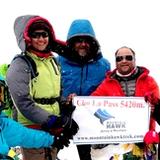
The passes are Kongma La at 5,535m, Cho La at 5,420m and Renjo La at 5,360m. Kongma La is the highest of the three, and every page I read agrees on that.
Our order is Kongma La first, on day 10, from Chhukung to Lobuche. Cho La is second, on day 13, from Dzongla to Thangnak. Renjo La is last, on day 16, from Gokyo to Arye. Our tour notes give the reason: the hardest pass comes early, while you are freshest, and the loop ends with Renjo La and the Gokyo lakes spread below it.
Pages do not agree on a word for this order. Most call Kongma La first anticlockwise or counterclockwise, and a few call the same order clockwise, so ask which pass comes first and ignore the word. One operator's page (February 2026) calls the reverse order, Renjo La first, "very challenging and more intense early on". Another operator's page (June 2025) says Kongma La first is "safer and more manageable" for first-timers because Renjo La first brings a pass after less time at altitude. The words differ. The two orders do not.
I put Kongma La first on purpose. Once it is behind you, both passes still ahead are lower.
The shape of the 22 days
The passes are three days out of 22. The other 19 are the approach, the gaps and the way home. Here is the loop in six blocks, with the highest bed in each.
| Days | Where | Highest bed | What the block holds |
|---|---|---|---|
| 1 to 5 | Kathmandu, Lukla, Phakding, Namche | 3,480m | Two hotel nights, the flight, a rest day in Namche |
| 6 to 9 | Tengboche, Dingboche, Chhukung | 4,700m | Dingboche twice, a day trip up the Chhukung valley |
| 10 to 12 | Lobuche, Gorak Shep, Dzongla | 5,180m | Kongma La, Everest Base Camp, Kala Patthar |
| 13 | Thangnak | 4,700m | Cho La |
| 14 to 16 | Gokyo, Arye | 4,800m | Gokyo, Gokyo Ri, Renjo La |
| 17 to 22 | Thame, Namche, Lukla, Kathmandu | 3,800m | Six days down, with a spare day in Kathmandu |
Day 11 is the one readers ask about. It reaches Everest Base Camp and sleeps at Gorak Shep, about 8 hours on our table. A trekker writing in the Kathmandu Post in May 2023 counted more than 500 climbers at Base Camp and Camp 1 that month, so a spring walker arrives at a busy place.
Nine days come before the first pass and six after the third. The seven days from day 10 to day 16 are the trek. Five of them are named for a pass or a viewpoint.
The first block is five nights below 3,500m. You come back through Namche on day 18, fourteen days after you first sleep there.
Where the rest days sit, and ten nights above 4,000m
Our table has three rest days. Day 5 is Namche, at 3,480m. Day 8 is Dingboche, at 4,350m, spent as a day trip up the Chhukung valley and back. Day 15 is Gokyo, at 4,800m, with a morning climb of Gokyo Ri and a second night in the same bed.
Count the beds and the pattern shows. Dingboche on day 7 is the first night above 4,000m. Arye on day 16 is the last. That is ten nights in a row, and Gorak Shep on day 11 is the highest of them. Tengboche on day 6, at 3,860m, and Thame on day 17, at 3,800m, sit either side of the run.
Notice what the table does not give you. There is no rest day between Kongma La and Base Camp, and none between Base Camp and Cho La. Days 10 to 13 are four walking days in a row of 7 to 9 hours. Day 12 begins with the early climb to Kala Patthar and ends at Dzongla, so you stand on a viewpoint at dawn the morning before Cho La and cross the pass the day after. One operator's page (December 2025) recommends at least two acclimatization days and another (June 2025) two to three. We have three. All three sit before or after the hard stretch, and none sits inside it.
Symptoms, dosing and when to turn round are in what altitude sickness does on the Base Camp route. The same rules apply here, with more nights.
Pass by pass: hours, height and ground
Hours below are from our day table. Measured figures come from one trekker's log (2017), who walked the loop in this direction, and they are one person's day in one season.
Kongma La, day 10. The table says 8 to 9 hours from Chhukung to Lobuche, and it is the longest day of the trek. One trekker's log (2017) records 8 hours 45 minutes, a day of 1,104m of climbing, and nearly four and a half hours to reach a half-frozen lake below the pass, which cracked and popped in the sun. The ground is a defined trail with cairns on rock at first, then scree, then a boulder field near the top where the path gets hard to follow. Our tour notes call the climb a steep scramble over loose rock. The way down is shorter and steeper than the way up. At the bottom the trail crosses the moraine of the Khumbu Glacier, where the same log describes crisscrossing trails and cairns and a lot of up and down, and used no spikes. There is no lodge on the pass. Each pass is a single day, and you carry water and food for it.
Cho La, day 13. About 7 hours from Dzongla, at 4,800m, over the pass and down to Thangnak, at 4,700m. It is the shortest of the three pass days on our table, and it comes after the other long ones. The same 2017 log has a day of 8 hours 22 minutes and 863m of climbing: a boulder-filled chute first, then the glacier, then a loose scree field on the east side and a very steep moraine on the west. Cho La is the pass with ice on it, and the next section is about what to put on your feet. For this crossing from the other direction, and for the Gokyo-first route, see the Gokyo Cho La pass guide.
Renjo La, day 16. About 8 hours from Gokyo to Arye, at 4,300m. One operator's page (January 2026) calls Renjo La the most scenic of the three, and our own tour notes say the same. Nepal Traveller (May 2025) calls it the easiest of the three on technique, and says it sees fewer trekkers than Base Camp. The 2017 log puts the climb from Gokyo at 570m and describes large steps built into the mountain on the way down. That log walked from Gokyo to Thame in a single 9 hour 41 minute day. We split it, with a night at Arye on day 16 and Thame on day 17, so only the climb and the steps carry over.
Cho La and what goes on your feet
For the Cho La glacier our tour notes recommend microspikes or light crampons, most of all early in the morning when the surface is icy. Your guide carries a rope as a precaution. There is no roped climbing. Trekking poles matter on all three passes.
Sources split on how much of this you need, and the split follows the season. The 2017 log wore microspikes for the Cho La glacier and wrote that walking was noticeably easier. He had bought them used the night before, from another hiker, for 1,500 rupees. He wore none on the Khumbu Glacier after Kongma La. One operator's page (February 2026) says the descent from Kongma La needs spikes for steep icy snow, and another (June 2025) lists no spikes for the Cho La glacier as a common reason trekkers fail.
Nobody can print one rule for all months. In the morning your guide looks at the ice and decides. Carry the microspikes and let the guide say whether they come out of the bag.
How hard it is against Everest Base Camp
The Three Passes trek is the harder walk because it has more of everything: seven more days, five more nights above 4,000m, three passes, and a stretch with no lodge for a full day at a time. The technique is no harder. The passes are non-technical, and what they ask is stamina and a steady head.
| Measure | Everest Base Camp trek | Three Passes trek |
|---|---|---|
| Days | 15 | 22 |
| Nights above 4,000m | 5 | 10 |
| Longest day on the table | 7.5 hours | 9 hours |
| Passes crossed | None | Three, days 10, 13 and 16 |
| Spare days | 1 | 1 |
Both treks share the valley up to Dingboche and the ground on to Gorak Shep. One operator's page (February 2026) calls Lukla to Dingboche and the way down from Namche easy on both and says the Kongma La route is far more difficult than the ordinary way to Lobuche. The Base Camp trail guide tells the shared ground in full, and the Base Camp difficulty guide covers that trek's hardest days.
Who should walk the Three Passes? A person who has already slept above 4,000m and liked it, who can walk 6 to 9 hours on consecutive days with a pack, and who can sit through a delay without losing the trip. Our tour notes say prior high-altitude experience above 4,500m is strongly recommended. One operator's page (June 2025) calls the difficulty half physical and half mental. I would add that the hard part is days 10 to 13, not any one pass.
If you have never trekked above 4,000m, walk the Base Camp trek first. If you want one pass and the lakes without the full loop, the Gokyo difficulty guide sets out that ladder.
The quiet side: Thame, Gokyo and the lodges
Teahouses stand at every overnight stop on our route. Rooms are twin beds, blankets and shared toilets. Hot showers are available in Namche and Tengboche, and they are an extra. Above 4,500m everything gets simpler. No lodge stands on a pass.
The west side is the quiet side. Thame is the birthplace of Tenzing Norgay and one of the oldest Sherpa settlements in the Khumbu, and it is far quieter than the main trail.
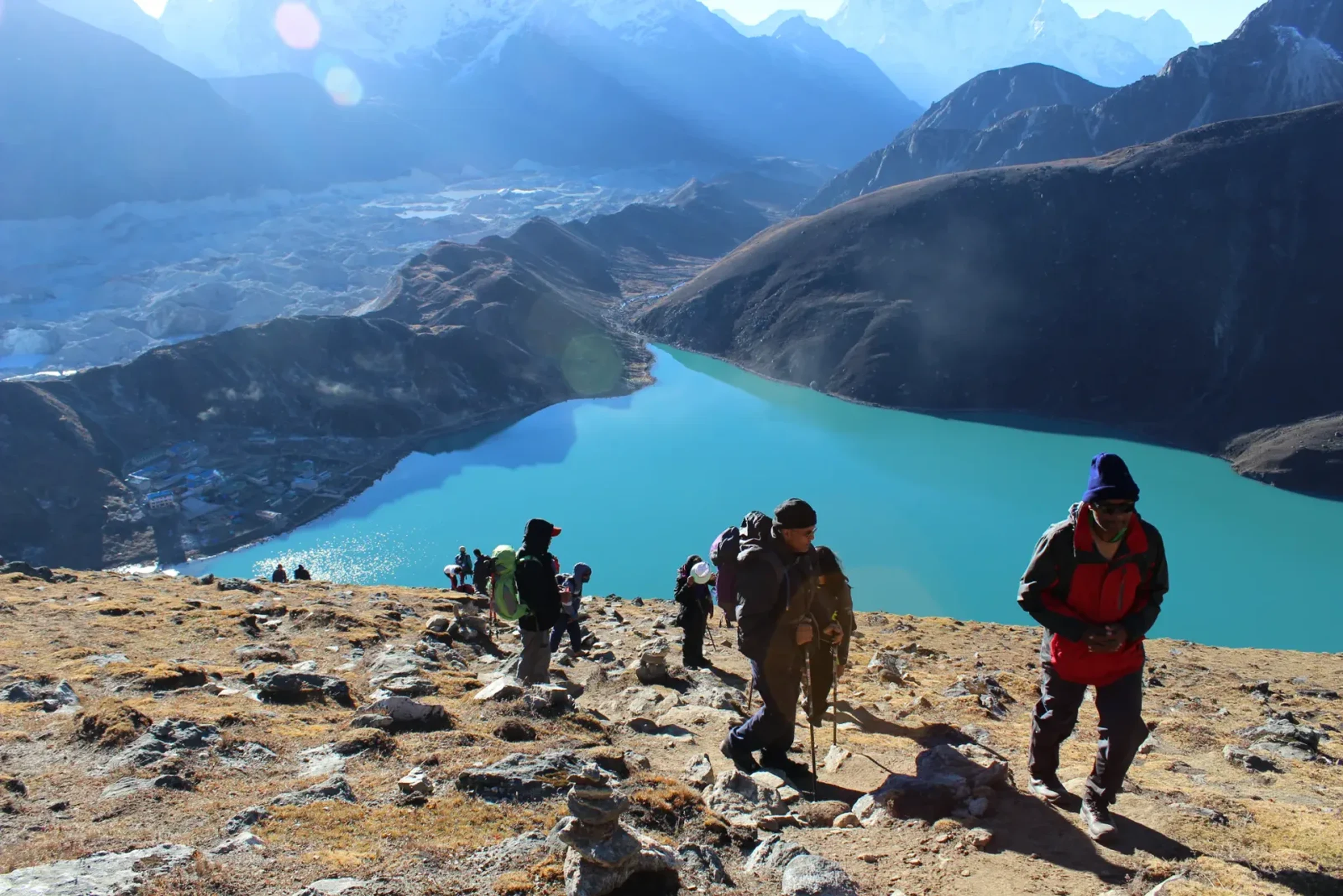
Off-season, lodges close. The 2017 log found the first lodge in Dzongla shut for the winter, and said many lodges on the main Everest and Gokyo routes close then. In May 2023 a trekker wrote in the Kathmandu Post that the Ngozumpa Glacier, between Thangnak and Gokyo, was the most tiring and dullest part of his loop. It sits on the day that follows Cho La on our table, four hours to Gokyo. For the lakes, Gokyo Ri and that side of the valley, see the Gokyo Valley guide.
Lukla flights and the Ramechhap question
In March, April, May, October and November, flights to Lukla operate from Ramechhap, also called Manthali, about a 5 to 6 hour drive from Kathmandu. In the other months they leave from Kathmandu. The airline decides month by month, on how many people are flying, and the decision is outside our control.
Dated reports agree on the pattern. Khabarhub reported on 24 March 2024 that daily flights from Manthali to Lukla had started for the season, to relieve congestion at Tribhuvan airport. Kantipur reported on 4 October 2026 that Manthali flights had increased after the autumn season began, with nine flights on the Saturday before.
Weather, congestion and runway conditions delay and cancel Lukla flights, and our flight notice asks you to keep one or two extra days free. Day 21 is that day on our schedule, a free day in Kathmandu before the flight home on day 22. If your long-haul ticket cannot be changed, add a second spare day. See the Everest region for the other treks that use the same airport.
Permits in one paragraph
You need two permits: the Sagarmatha National Park entry permit and the Khumbu Pasang Lhamu Rural Municipality permit. Both are in our price. The fees have changed recently and pages disagree, so the current figures are in the permits guide.
When to go
October and November give clear skies and stable weather on the passes. Spring, March to May, is warmer with cloud building in the afternoon. In winter the passes can be snowed in, and the monsoon makes the glacier crossing risky.
We have no season calendar built for this loop. Two cover its two valleys: the Everest Base Camp calendar for the Khumbu side and the Gokyo Cho La calendar for Cho La and the lakes.
What it costs at our price
Our price is USD 2,275 per person for the 22 days. That is about USD 103 a day, our own arithmetic. It covers four hotel nights in Kathmandu with breakfast, the flights between Kathmandu and Lukla with airport taxes, a licensed English-speaking guide, one porter for every two trekkers, teahouse beds and meals on the trek, the permits, and a down jacket, duffel and sleeping bag that go back at the end. It leaves out lunch and dinner in Kathmandu, insurance (compulsory), the visa, tips, drinks, laundry and hot showers, and personal equipment. Pages for treks of 18 to 21 days quote about USD 1,400 to 2,500, and ours has one more day than the longest of them.
| Trek | Days | Passes crossed | Price (USD) |
|---|---|---|---|
| Gokyo Valley | 14 | None | 1,575 |
| Everest Base Camp | 15 | None | 1,675 |
| Gokyo Cho La via Base Camp | 19 | One | 1,975 |
| Three Passes | 22 | Three | 2,275 |
The 19 day trek crosses Cho La only. The Gokyo Cho La trek via Base Camp is the shorter way to a pass.
Gear is in the packing checklist, and the down jacket, duffel and sleeping bag in our price mean you do not have to buy the three bulkiest items.
No payment is needed to reserve a place, a 30 percent deposit confirms it, and the refund is up to 100 percent if you cancel 45 or more days before departure (booking terms). When you are ready, book the Everest Three Passes trek.
Frequently Asked Questions
Do I need crampons?
Microspikes or light crampons are recommended for the Cho La glacier, most of all early in the morning. Your guide decides on the day. Poles are essential on all three passes.
Is it harder than the Base Camp trek?
Yes, on length and on altitude exposure. It is seven days longer, with five more nights above 4,000m and three passes. The technique is no harder.
Which pass is hardest?
Our tour notes name Kongma La. Most operator pages agree, since it is the highest and the longest day. One page I read calls Cho La the technically demanding one because of the glacier.
What if a pass cannot be crossed?
Your guide decides on the morning, from the weather and the surface. Kongma La has an ordinary way round: the main trail from Dingboche to Lobuche by Thukla, which one operator's page (February 2026) describes as the easier of the two.
What if my Lukla flight is cancelled?
Flights wait for weather, so you wait too. Day 21 is the spare day on the schedule, and the flight notice asks for one or two extra days.
Can I do it without high-altitude experience?
Our tour notes strongly recommend experience above 4,500m, because three passes above 5,300m inside one week need reliable acclimatization. Without it, start with the Base Camp trek.