
- The one-minute answer
- Summit day: what you actually do
- Why Mera is the harder fortnight
- Height and acclimatization
- What you see from the top
- Season and crowds
- What it costs, and why the permit no longer decides it
- Doing one as preparation for the other
- Who should pick which
- Frequently Asked Questions
- Is either peak a good first Himalayan summit if I have only done Everest Base Camp?
- Can I climb Mera Peak and Island Peak in one trip?
- What fitness do I need for either trip?
- Which peak is quieter?
- Where do the Lukla flights leave from?
Island Peak has the harder summit day. Mera Peak has the harder fortnight. Those two sentences answer Island Peak vs Mera Peak, and the rest of this article tests them against our own day tables.
Our Island Peak Climbing trip is 19 days and USD 2,175. Our Mera Peak climb via Zatra La Pass is 18 days and USD 2,475. The permit that used to separate the two peaks is now identical: the official Nepal Mountaineering Association fee table lists USD 350 in spring and USD 175 in autumn, winter and summer for both. Permit and price no longer decide it. Your body and your calendar do.
The one-minute answer
If ropes and ladders worry you, climb Mera. If cold and thin air worry you more, climb Island, which tops out 287m lower (6,189m against 6,476m) and sleeps at its highest camp about 180m lower. If you want Everest Base Camp and Kala Patthar on the same trip, the 19-day Island route has both built in. If you want a spare day for weather, Mera's Zatra La route has one, and the 19-day Island route does not.
That is the shape of it. The sections below show where each line comes from.
Summit day: what you actually do
On Island Peak you leave High Camp (about 5,600m) between midnight and 2 AM. First comes a rock gully by headlamp, then the Imja Glacier roped as a team through the crevasse zones. Some seasons the guides lay an aluminium ladder over the widest gap, and in others the route winds around it. Then the headwall: roughly 100 vertical metres of 40 to 50 degree snow and ice, climbed on a fixed rope with a jumar. It takes about two hours. Above it a corniced ridge runs about 300m on a fixed line to the top, another hour. You come down by the same line, abseiling the headwall, and the whole day runs 10 to 12 hours, ending in a teahouse bed at Chukhung.
Mera Peak starts from High Camp too, at 5,780m, and a little later, between 1 and 2 AM. It is five to seven hours of steady glacier walking by headlamp, roped to your climbing Sherpa, with one short fixed-line section on the final snow dome. The summit comes between 7 and 9 AM. Then the part people under-train for: the full descent to Khare on legs that already gave their best. Tent to teahouse is 10 to 14 hours.
So the Island day is shorter on paper and steeper on the ground. The Mera day is longer and gentler, and it happens higher. Neither needs a climbing resume, because your Sherpa drills the crampon steps, the rope-team travel and the fixed line at base camp before you need them. The detail on each lives elsewhere: the headwall and ridge in our Island Peak climbing guide, and what the grade means on Mera in our Mera Peak difficulty article.
Here is a small thing from the Island side. The crevasse under that headwall has been crossed on stairs placed in April 2009 and on a fixed ladder in autumn 2016, according to Wikipedia. Nobody will promise you a ladder this year.
Why Mera is the harder fortnight
This is the half of the claim that surprises people, because Mera is the walk. It is the walk at the end of a harder approach.
Start with day 4. Leaving Chutang (3,020m), the Zatra La route climbs about 1,600m to the pass at 4,610m, often on snow, in six to seven hours, before you have done a rest day anywhere. You then drop to Khartitang at 3,900m. Island's first week is the opposite: the Everest Base Camp trail, with a teahouse every night and the bakeries of Namche on day 4.
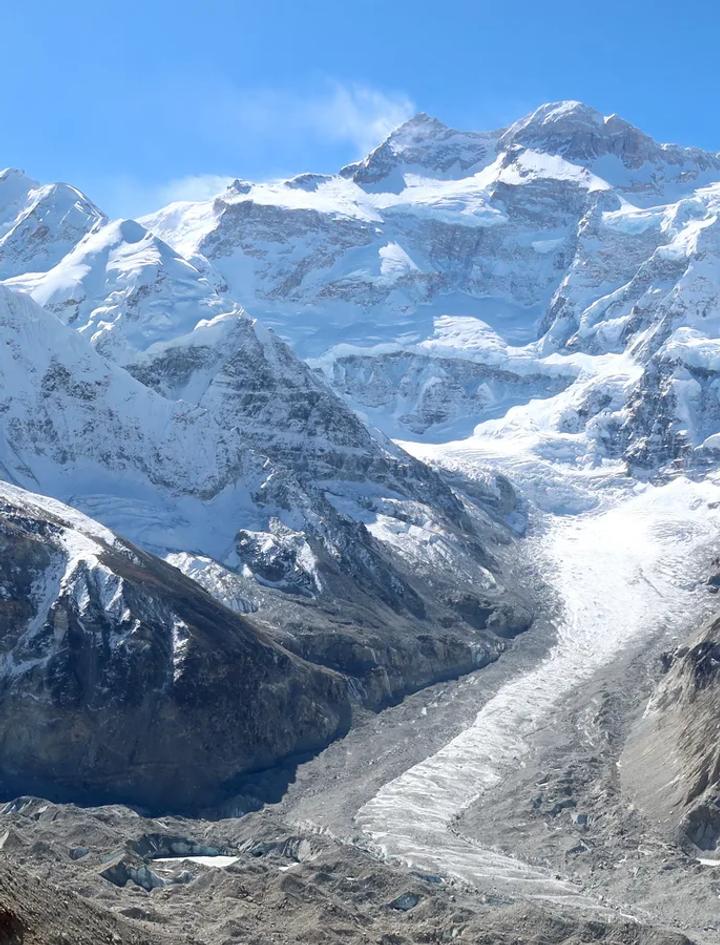
Then the Hinku Valley. Our own words for its lodges are "a notch simpler than Khumbu teahouses": twin rooms, shared toilets, wifi that is scarce and charging that is paid. Khare, the last settlement at 4,900m, is a huddle of lodges and rental shacks with the Mera glacier hanging directly above. The valley itself saw almost no visitors before the 1980s. On day 5 the trail empties and Mera shows itself at the head of the valley for the first time.
Above Khare you sleep in tents at base camp (5,300m) and High Camp (5,780m). The Island route has its two tented nights too, at 5,087m and about 5,600m. Our calendars put typical still-air High Camp nights in October at minus 14 to minus 9 degrees on Island and minus 16 to minus 11 on Mera. Those are derived ranges, not records, and the two-degree gap holds in every prime month.
On the evening of day 14 on the Zatra La route, the view back across the Hinku to Mera, now with your boot prints on it, is the quiet trophy of the trip.
None of this makes Mera dangerous. It makes it a longer, plainer and colder trip, and a trekker who has only done teahouse routes feels the difference by the third night in the Hinku.
Height and acclimatization
Mera is 287m higher at the summit, and the air at around 6,400m carries a little under half the oxygen of sea level. That gap matters on the day. It does not matter as much as how you reach it.
The 19-day Island route is the easier body-clock ramp. You sleep at Namche (3,440m), Tengboche (3,860m), Pheriche (4,200m), Lobuche (4,920m) and Gorak Shep (5,164m), climb Kala Patthar (5,545m) on day 10, and only then turn east into the Chukhung valley. At Pheriche, incidentally, the Himalayan Rescue Association post gives an altitude talk most days in season, and it is worth an hour of anyone's evening. By base camp you have slept at 5,164m and stood at 5,545m. Our Everest Base Camp altitude sickness guide explains why that ramp matters.
The 16-day Island Peak Expedition skips Everest Base Camp. It goes straight to Chukhung after a rest day at Dingboche and gives you two climbing days in the plan. It is for people on tighter leave who have already been high.
Mera's Zatra La route builds its own ramp: the spike over the pass, Kothe at 3,600m, a rest day at Thangnak (4,350m) with the Sabai Tsho lake hike, Khare, then base camp, High Camp and a full spare day. That spare day is the best single feature of the trip. If wind closes the summit window, you move the attempt without touching your flight home. The longer, lower Mera Peak via the Paiya route takes 17 days and has no spare day. For the route on either, read our Mera Peak complete guide.
The 19-day Island route has a buffer day in Kathmandu, which protects your international flight, and no spare summit day. That is a real difference, and it belongs in the decision.
What you see from the top
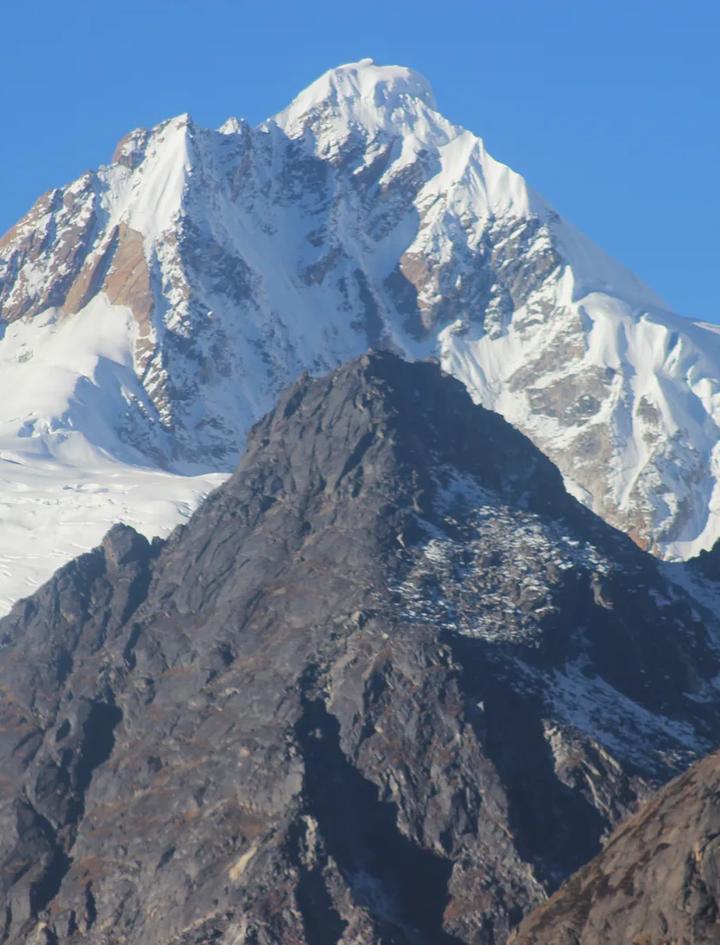
The views split the same way the climbs do. From Mera you see five of the 8,000m peaks in one sweep: Everest, Lhotse, Makalu, Cho Oyu and Kanchenjunga. Summit dawn there comes with the sky going violet behind Kanchenjunga, and nothing blocks the view in any direction.
Island Peak puts you inside a ring of walls instead. The south face of Lhotse fills the sky across the valley, with Ama Dablam, Makalu and Baruntse round the horizon. Mera gives the wide picture, and Island gives the close one. Anyone who chooses a peak by its photographs should look at both before booking.
Season and crowds
The two peaks share their good months: April, May, October and November. In every one of those, our calendars rate both climbs prime. March splits them. Island is a good month, while Mera is only a shoulder month because Zatra La is often still under snow on day 4, and the spring permit rate begins.
Crowds differ more than the calendar suggests. October is the busiest month on both, but Island's fixed rope is the busiest of the year, with a short queue at the base of the headwall on popular mornings. We leave High Camp ahead of the main wave to avoid standing in that queue in cold air. Mera's pinch point is smaller and earlier: the teahouses and tent sites at Khare have little capacity, and they fill. November is quieter on both. Month by month, see the Island Peak season calendar and the Mera Peak season calendar.
The monsoon months, June to August, are the wrong time for both: cloud, rain on the approach and unreliable Lukla flights.
What it costs, and why the permit no longer decides it
Four products, four prices, all per person and all with the permits inside:
| Trip | Days | Price |
|---|---|---|
| Island Peak Climbing, with Everest Base Camp | 19 | USD 2,175 |
| Island Peak Expedition, direct | 16 | USD 1,975 |
| Mera Peak via Zatra La Pass | 18 | USD 2,475 |
| Mera Peak via the Paiya route | 17 | USD 2,475 |
Mera costs USD 300 more than the 19-day Island trip and runs a day shorter. What each package already includes differs by product, personal climbing kit included, so check the tour page for the one you are weighing before you compare prices. Insurance with helicopter evacuation above 6,000m is compulsory on all of them and is not in the price.
The full line-by-line sits in our Island Peak cost breakdown and our Mera Peak cost breakdown.
Doing one as preparation for the other
Mera Peak or Island Peak first has no fixed answer, and neither peak is a prerequisite for the other. People climb both in either order, and published advice differs on which comes first, so take this as a reasoned suggestion, not a rule.
I would send a rope-nervous friend to Mera first. It teaches glacier rhythm, high camping, and how your own body behaves above 6,000m, and it asks for no steep ice. Island Peak afterwards is a genuine step up in skills: jumar work, a ladder or two, an abseil. If you have already done a high trek and want the rope work, Island first is a fair choice too.
Doing both in one trip is a different product. Our 21-day Amphu Lapcha Pass trek with Mera Peak crosses the 5,845m pass after the Mera summit and ends at Chhukung. It does not include an Island Peak climb.
Who should pick which
Pick Island Peak 19 days if you want Everest Base Camp and Kala Patthar in the same trip, and the headwall is the part you came for. Pick the 16-day Island Peak Expedition if you have already stood at Base Camp and have fewer days. Pick Mera via Zatra La if ropes and ladders are what keep you awake and you want a weather spare day. Pick Paiya if you want the lower, slower walk-in and can live without the spare day.
One more point. The 6,654m figure you may see for Mera belongs to a neighbouring peak, Peak 41, which an old list mislabelled. Mera's own top is 6,476m, and that is plenty.
Frequently Asked Questions
Is either peak a good first Himalayan summit if I have only done Everest Base Camp?
Yes, both. Base Camp gives you a night at 5,164m in Gorak Shep and a feel for your own pace, which is the data that matters most. After that, pick on temperament: a glacier walk or a headwall.
Can I climb Mera Peak and Island Peak in one trip?
Yes, but it is a long trip. Jagged Globe's two-summit expedition runs 29 nights: Mera on day 17, a technical pass on day 20, Island on day 23. We do not sell that combination. Our 21-day Amphu Lapcha Pass trek with Mera Peak costs USD 3,575 and has no Island climb.
What fitness do I need for either trip?
Enough to walk 5 to 7 hours a day for two weeks and then absorb one summit day of 10 to 14 hours. Climb hills with a loaded pack, and string long days together on consecutive mornings. Prior altitude is worth more than any gym routine, so go above 4,000m once beforehand if you can.
Which peak is quieter?
Mera. On the Hinku side entire mornings pass without meeting another group, while the Island headwall can have a queue on October mornings. The price of quiet is simpler lodges and fewer places to retreat to if the weather turns.
Where do the Lukla flights leave from?
In March to May and October to November the flights to Lukla leave from Ramechhap (Manthali), a drive of 5 to 6 hours from Kathmandu, so day 1 starts before dawn. In the other months they leave from Kathmandu. Weather delays are routine in both directions, which is why the longer itineraries hold a buffer day in Kathmandu.