Mera Peak is 6,476 metres high, and the standard route to its top is a glacier walk. You wear crampons and you are roped to a climbing Sherpa. Near the top there is one short fixed line up the final snow dome. Nowhere on the route do you climb rock or swing an axe into ice.
People hear that and relax, which is a mistake. At 6,400 metres the air holds a little under half the oxygen you breathe at sea level, and summit day runs 10 to 14 hours from your tent to a teahouse bed. The climb is graded Challenging, and the weight of that word sits on the altitude and the length of that one day.
Jimmy Roberts and Sen Tenzing first climbed Mera in 1953. The valley under it, the Hinku, saw almost no visitors until the 1980s, and it is still quiet enough that you can walk whole mornings in it without meeting another group.
Eighteen days sounds like a lot for one mountain. Ten of them get you to High Camp, one is the summit, and the rest bring you home, with a spare day held at Khare in case the weather says no. Here they are in order.
Walking this one? See the Mera Peak Climb Via Zatra La Pass package, dates and group sizes.
The Pass Comes First
Day one is arrival in Kathmandu at 1,345 metres, a hotel, and an evening meeting your trip leader. Day two is the paperwork day. The morning is a route briefing, insurance and permit papers, and a full gear check against the equipment list. The afternoon is sightseeing in the Kathmandu Valley, with time in Thamel to rent what you have not brought from home: double boots, crampons, ice axe, harness and helmet.
My advice is to rent all of it there, and to try the boots on with the socks you plan to summit in. Khare, the last village below the glacier, has rental shacks too. They are a good backstop for a snapped strap or a pair of boots that turns out to be the wrong size, and that is all they should be.
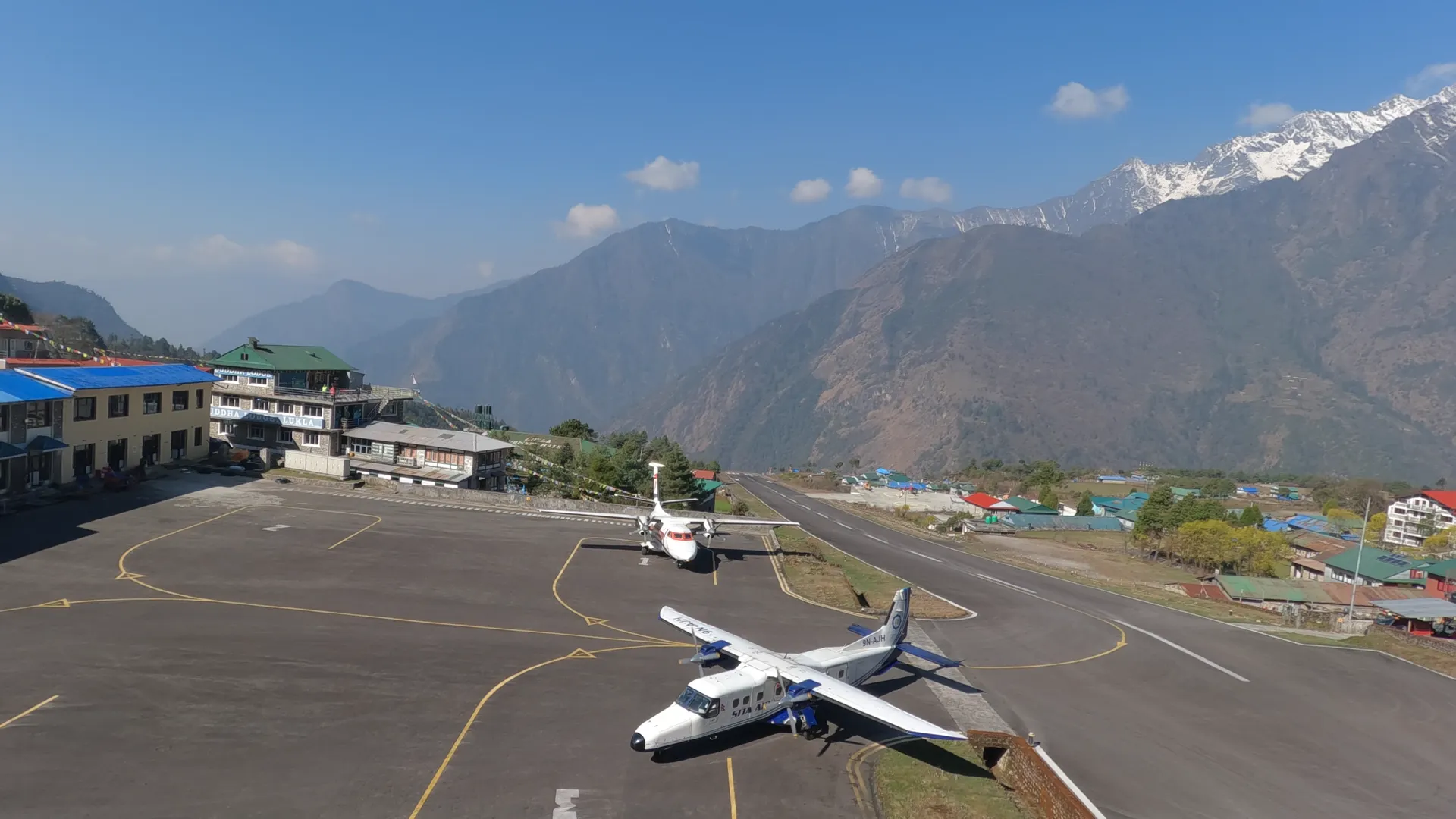
Day three starts with the flight to Lukla at 2,800 metres, about 35 minutes from Kathmandu. In the busy months of spring and autumn the flight leaves from Ramechhap instead, which puts a drive of five to six hours in front of it. At Lukla the Everest trail goes north. We turn east, away from that traffic, and climb gently for about four hours through forest and grazing land to Chutang at 3,020 metres. Chutang sits under the wall of the Kalo Himal ridge, and that ridge is tomorrow.
Day four is the first real test of the climb, and it comes early. The trail gains about 1,600 metres from Chutang to Zatra La at 4,610 metres, and the pass is often under snow. On day four nobody is acclimatized to that height, however fit they are. Go slowly and lean on your poles. Headaches on Zatra La are common.
At the top there are cairns and prayer flags. Behind you are Kongde Ri and the Lukla valley. In front of you is the Hinku, a valley with no road and no airstrip in it. From the pass the trail drops about 700 metres to Khartitang at 3,900 metres, six to seven hours after you left Chutang. That drop is deliberate. You touch 4,610 metres in the middle of the day and you sleep far below it.
I am glad the hardest walking of the first week comes this early. By the evening of day four you know how your body answers altitude, and you still have a full week of walking up the valley to use what you learned.
- Day01Arrival in Kathmandu
- Day02Pre-trip Meeting & Kathmandu Sightseeing
- Day03Fly to Lukla & Trek to Chutang+1,675 m
- Day04Cross Zatra La Pass to Khartitang+880 m
Up the Empty Valley
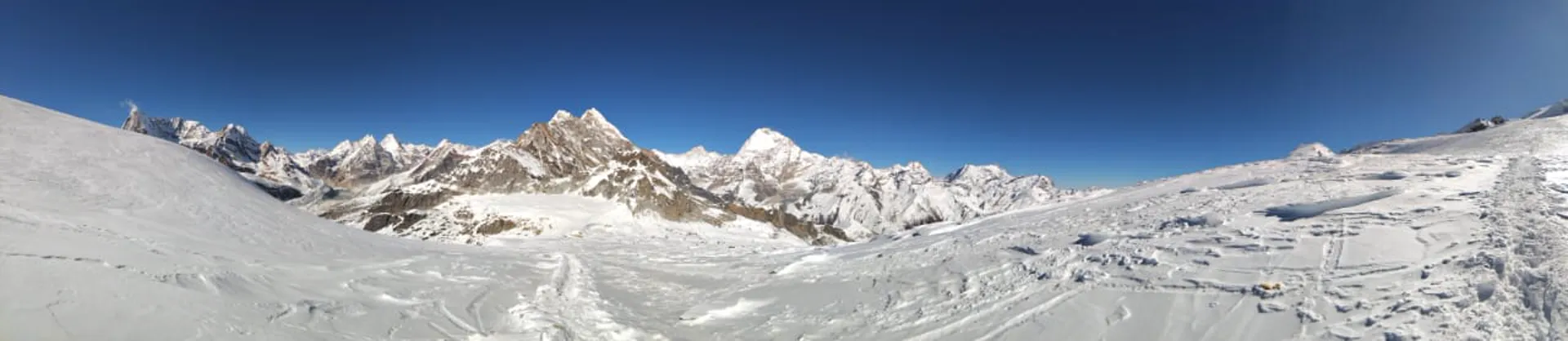
Day five goes down before anything goes up. The trail descends through rhododendron and pine into the Hinku proper and follows the river north to Kothe at 3,600 metres, about five hours. That leaves you 1,010 metres below the pass you stood on the day before. Somewhere on this stretch the valley walls rise, and Mera shows itself at the head of the valley for the first time.
If you are walking in May, listen at the stream crossings below Kothe. They run higher and louder then than they do in October, fed by the first serious snowmelt off the ridges above.
Day six walks the west bank of the Hinku Khola through summer yak pastures, past the gompa at Lungsumgba, to Thangnak at 4,350 metres. It is about five hours and 750 metres of gain. On this stretch the trees give out and the valley turns to moraine and stone. Thangnak is drying racks and simple lodges, and from here upward your guide runs oximeter checks every morning and evening.
The Hinku lodges are a notch plainer than the ones on the Everest trail. Expect twin rooms, shared toilets, and a blanket on top of your own sleeping bag at night. After dark the stove-heated dining room is the only warm room in the building, and everyone ends up in it. Charging is scarce, so a power bank earns its place in your pack. The menus get shorter above Kothe because everything on them arrived on a porter's back. Order dal bhat, because the refills keep coming, and have the garlic soup when it is offered.
Day seven is the acclimatization day, and I ask people to treat it as a working day. You climb high and sleep low. The walk goes up to Sabai Tsho, a turquoise lake in a bowl below the Sabai glacier, then onto the moraine ridge above it, which climbs past 5,000 metres. The strongest walkers can push on to a cairn at 5,271 metres on the flank of Kusum Kanguru, 921 metres above the bed they will sleep in that night. Then it is back to Thangnak for lunch and a slow afternoon of drinking water and fiddling with gear. In February the lake is usually frozen hard enough that some groups walk across a stretch of it.
Day eight is short on purpose. It is about four hours and 550 metres past the Dig Kharka pastures to Khare at 4,900 metres. In October those pastures are usually still lightly grazed, before the herders bring the yaks down for winter. Khare is the last settlement, a huddle of lodges and rental shacks with the Mera glacier hanging directly above it. In the afternoon the climbing Sherpa goes through your gear with you and checks every binding and fitting. Anything that does not fit gets sorted here, on flat ground, instead of on the glacier.
- Day05Trek to Kothe−300 m
- Day06Trek to Thangnak+750 m
- Day07Acclimatization Day at Thangnak
- Day08Trek to Khare+550 m
Onto the Ice
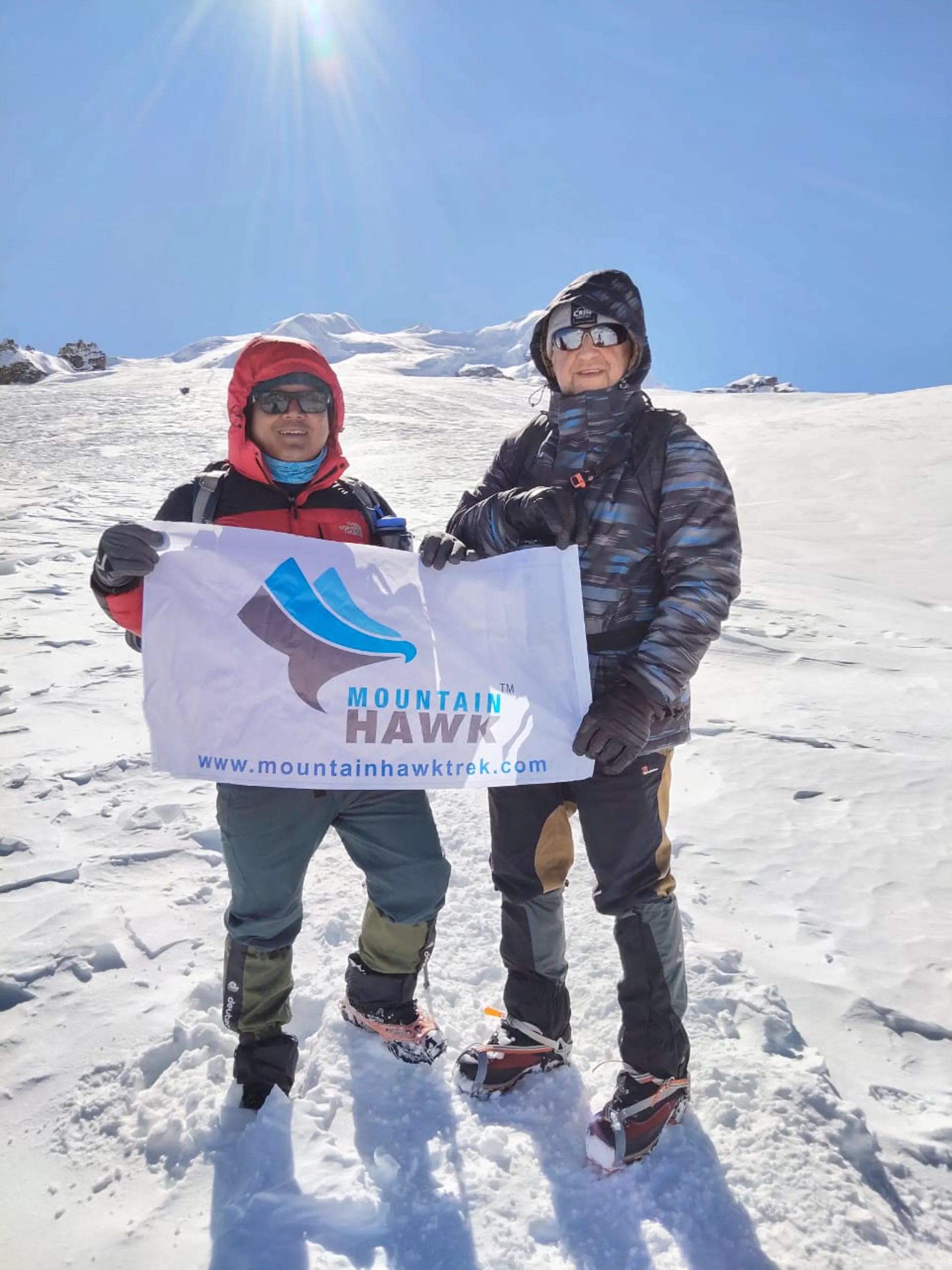
Day nine is the first day in crampons. You climb the tongue of the glacier to Mera La at 5,415 metres, then drop about 115 metres to Base Camp at 5,300, around five hours in all.
The afternoon is the skills session with the climbing Sherpa. Roped glacier travel comes first, then self-arrest with the ice axe, then clipping on to a fixed line and moving along it. You repeat each one until the movements feel automatic. On summit night you will do all of this in the dark, half asleep and cold, and the afternoon exists so that your hands already know the moves by then.
This is also the first night under canvas. The tented camps have sleeping tents, a camp kitchen and a dining tent, and the cook keeps the hot drinks coming. Drink them. At this height they do half the work of acclimatization for you.
Day ten is a short roped day up the summit glacier to High Camp at 5,780 metres, four to five hours and 480 metres of gain. High Camp is a shelf of rock at the edge of the summit glacier, and it is the highest bed of the whole climb. Everest, Lhotse and Makalu fill the skyline to the north. At sunset they turn orange while the stove roars beside the tents, and everybody puts their water bottles inside their sleeping bags so they will not freeze solid overnight.
Dinner is early. You lay your gear out by headlamp, and the guide makes the weather call for the night. That call belongs to the guide alone. Up here we watch the wind forecast harder than the thermometer: a calm night at minus 20 is a manageable climb, and a windy night at minus 10 is miserable and can end the attempt before it starts.
- Day09Trek to Mera La & Base Camp+400 m
- Day10Climb to High Camp+480 m
Summit Night
The alarm goes off around midnight. Breakfast is something you force down, crampons go on by headlamp, and the rope team leaves High Camp between one and two in the morning, into air around minus 20. The turnaround time is set before anyone leaves camp, because afternoon wind on the summit dome is the real deadline of the day.
Then it is five to seven hours of steady walking up the glacier. The angle stays moderate the whole way. What slows you is the air, and you settle into small steps and deliberate breaths, a rhythm you keep for hours. Behind Kanchenjunga the sky turns violet well before the sun appears, and sunrise catches you close to the top.
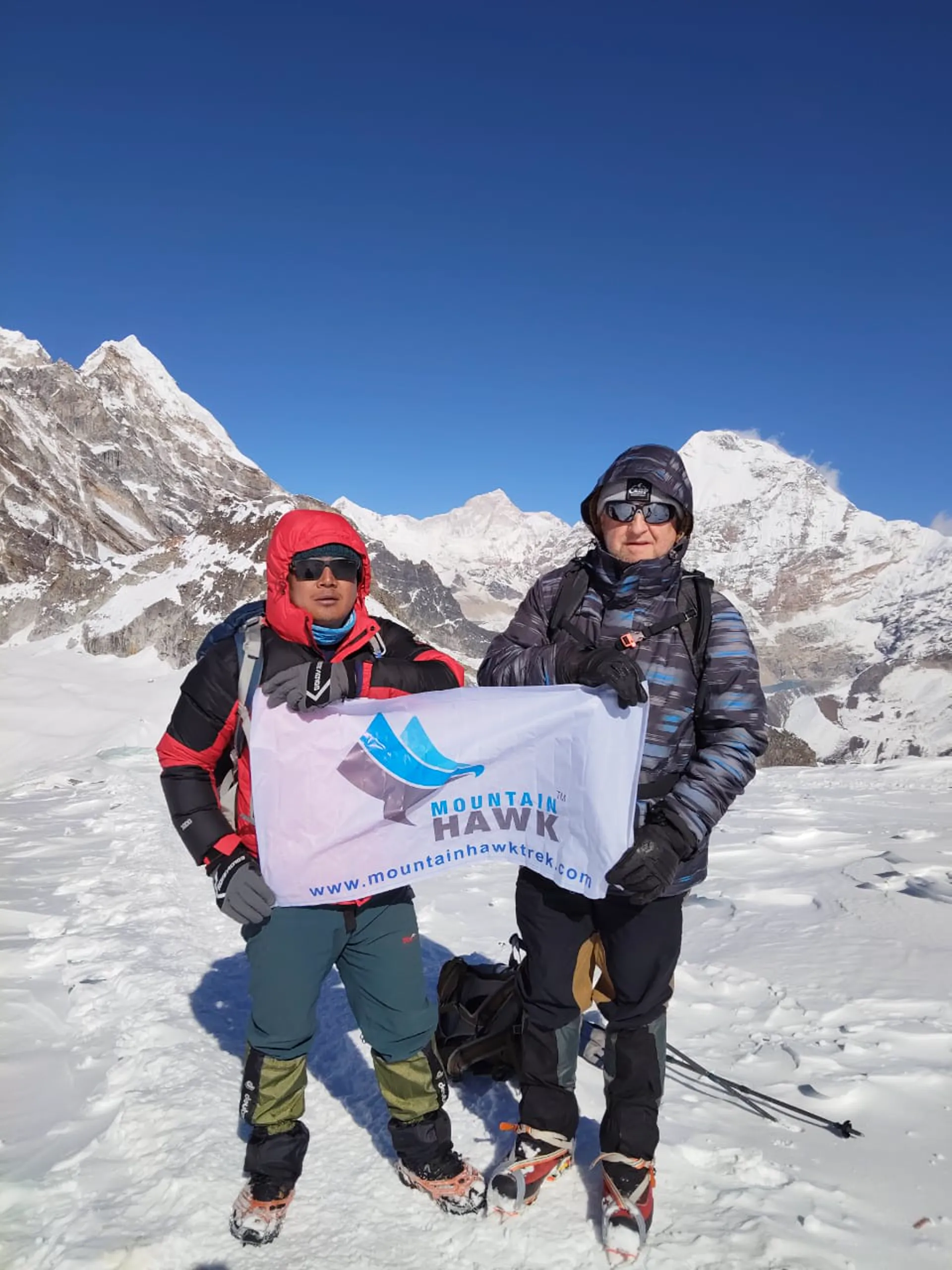
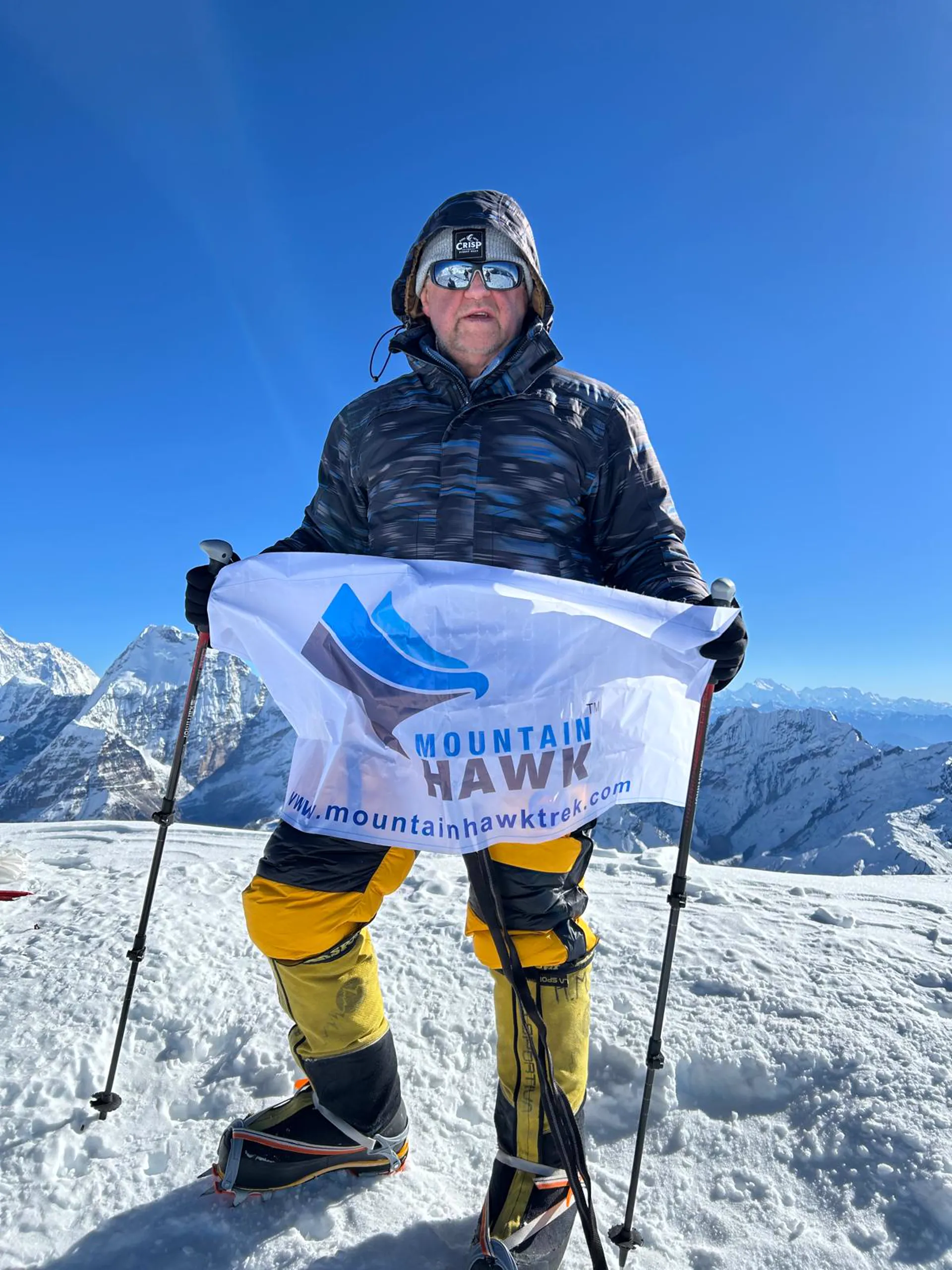
The fixed line comes on the final snow dome, a section of roughly 40 to 50 metres, clipped exactly the way you practised at Base Camp. Mera has three summits, and the one the standard route aims for is Mera North, at 6,476 metres. From the top you can see five of the world's 8,000 metre peaks in one sweep: Everest, Lhotse, Makalu, Cho Oyu and Kanchenjunga. Ama Dablam, Baruntse and Chamlang stand in the middle distance, above the cloud that usually fills the valleys at dawn.
Then comes the part people under-train for. From the summit you descend all the way to Khare at 4,900 metres, 1,576 metres below where you stood that morning, on legs that have already given you their best. From tent to teahouse the day runs 10 to 14 hours.
Day twelve is the spare day, held at Khare for weather. If wind or snow closed the summit window, this is the day the attempt moves to, without touching your international flight home. If the summit is already behind you, it becomes a slow morning in Khare. A spare day gives you one more chance at a window. It cannot make one appear.
- Day11Summit Mera Peak & Descend to Khare−880 m
- Day12Spare Day for Bad Weather
Back Over Zatra La
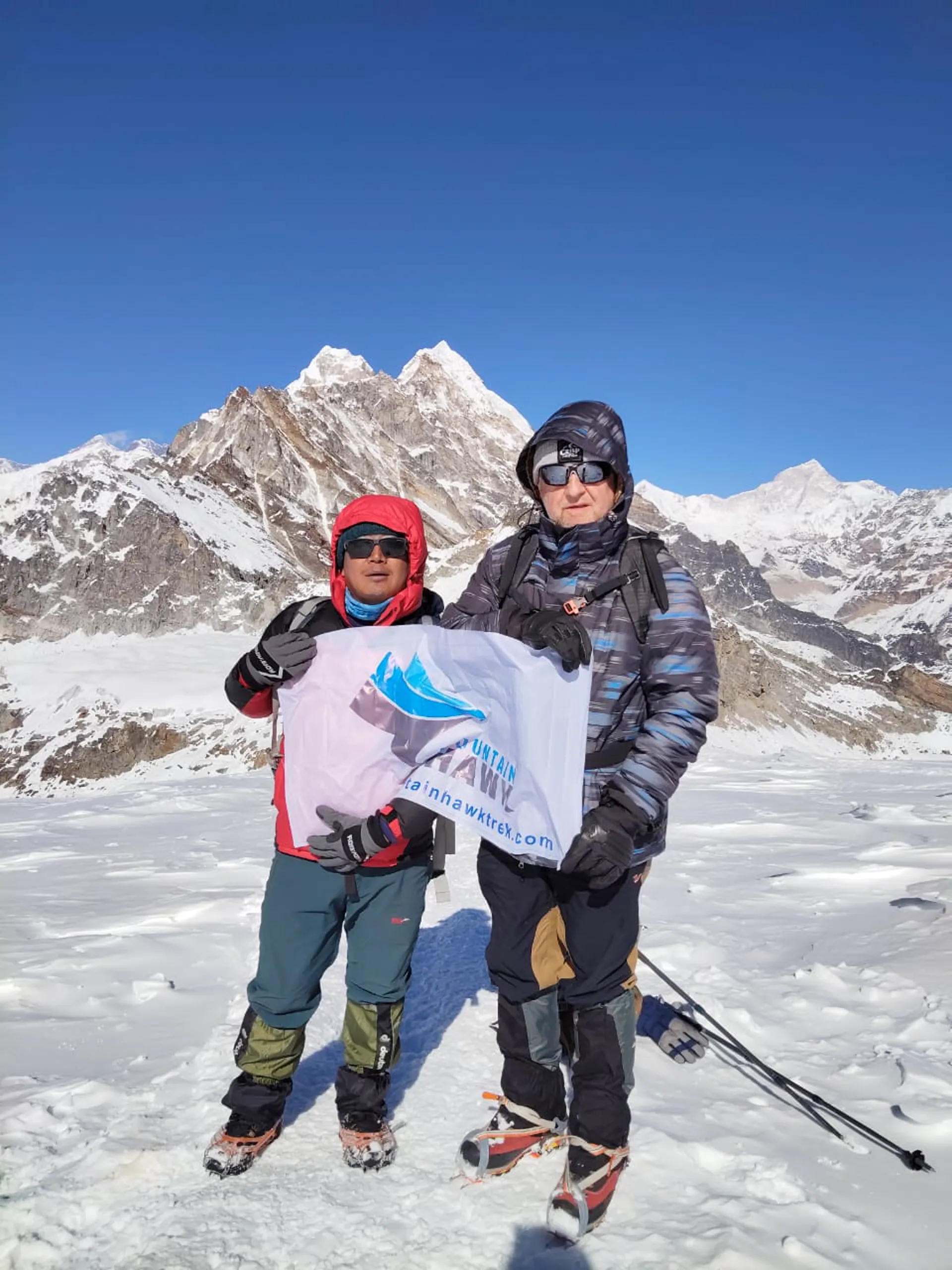
Day thirteen retraces the Hinku downhill to Kothe, about five hours. You finish 1,300 metres lower than Khare, the air thickens a little every hour, and appetites come back.
Day fourteen climbs out of the Hinku on its western wall to the high pastures of Thuli Kharka at 4,300 metres, about six hours and 700 metres of gain. It sets you up under Zatra La for the next morning. That evening, look back across the valley to Mera. You were on top of it three days earlier, and your boot prints are on it now. We call that view the quiet trophy of the trip.
Day fifteen crosses Zatra La a second time. From Thuli Kharka it is only 310 metres up to the pass, and after a week and a half at altitude your lungs treat it very differently from the way they did on day four. Then the long staircase of trail drops 1,810 metres to Lukla, six to seven hours in all. That night there is a celebration dinner with the crew, and a toast to the summit.
Day sixteen is the morning flight back to Kathmandu, or to Ramechhap, weather permitting, and then a hotel. The afternoon is for a hot shower and for carrying your rented gear back to the shop in Thamel. Day seventeen is free, and it doubles as a buffer against Lukla flight delays. It ends with a farewell dinner and a debrief. Day eighteen is the transfer to the airport.
- Day13Trek to Kothe−1,300 m
- Day14Trek to Thuli Kharka+700 m
- Day15Cross Zatra La & Trek to Lukla−1,500 m
- Day16Flight to Kathmandu−1,455 m
- Day17Leisure Day in Kathmandu
- Day18Departure
The same pass stands near both ends of the walking. On day four, Zatra La is the hardest thing you have done so far. On day fifteen it is a short climb out of Thuli Kharka on the way to a celebration dinner. Between the two crossings you walk four days up the Hinku, sleep two nights in tents, climb through one long night to the summit, and walk back down the valley.
What I want from anyone climbing Mera with us is fitness more than technique. We teach the rope work at Base Camp in one afternoon, and nobody can teach a body to carry itself through thin air for fourteen hours. If you have already trekked to 4,000 or 5,000 metres somewhere, bring what you learned about yourself up there. If you want to talk it through first, we are here.
Written by Prem Pandit, Founder