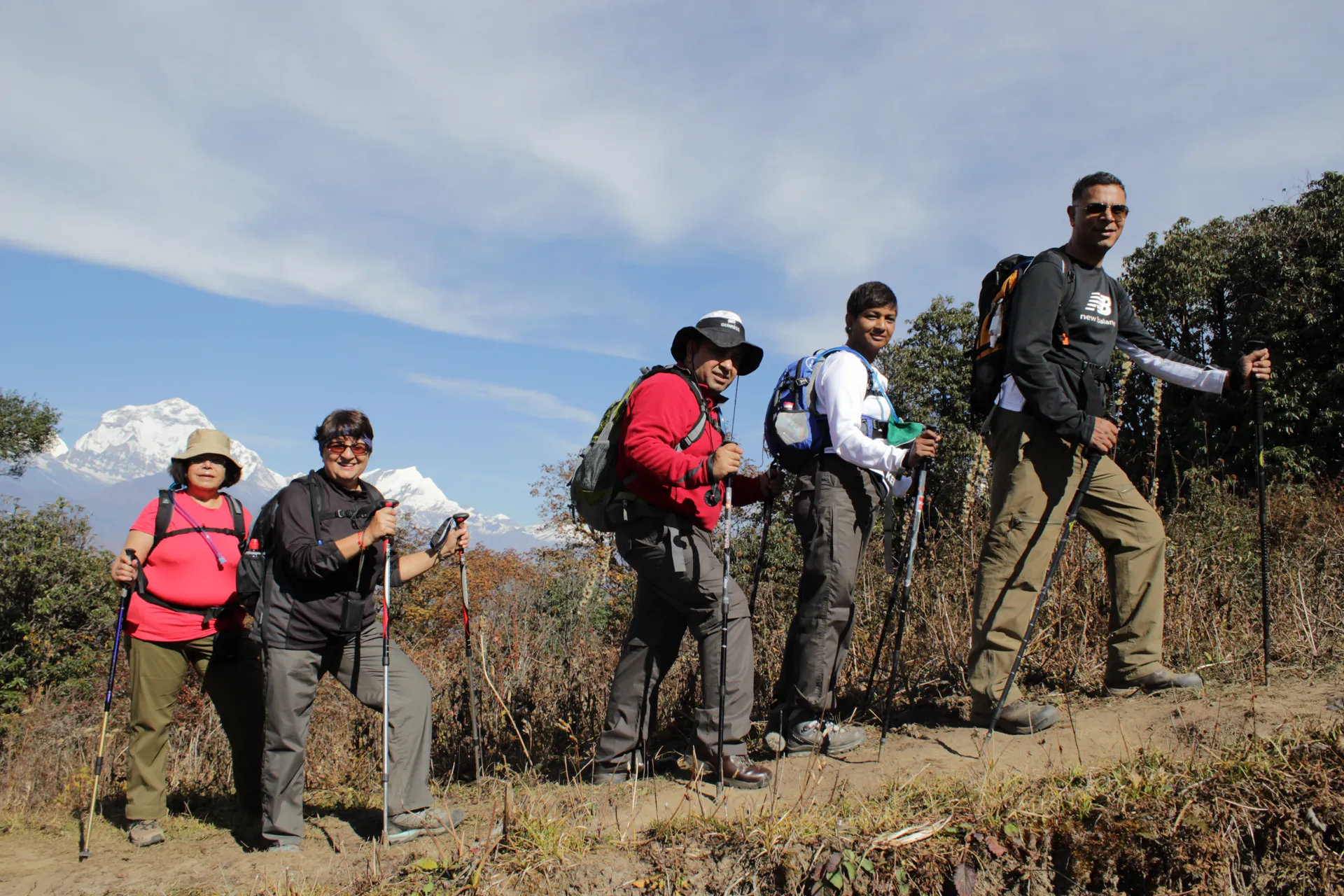

Most people arrive at this trek with eight days and a photograph. It is nearly always the same photograph: Dhaulagiri turning gold at dawn, seen from a hilltop above Ghorepani, with a crowd in down jackets along the bottom of the frame.
The photograph is accurate. What it leaves out is the day before it, when the trail gains 1,360 metres out of Tikhedhunga, most of that on stone steps, and the day after it, when a forest full of rhododendron takes you 710 metres down to Ghandruk. The hilltop is one morning. The trek is eight days, and five of them are on foot.
The Ghorepani Poon Hill Trek is graded Easy, and I agree with the grade. The highest night is at Ghorepani, 2,800 metres, and nothing on the trek is technical. The grade is about altitude, though. Your knees grade the stairs separately, and I would rather you heard that from me in Kathmandu than worked it out halfway to Ulleri.
So here are the eight days as they happen on the ground.
Walking this one? See the Ghorepani Poon Hill Trek package, dates and group sizes.
The Low Start
Day one is Kathmandu at 1,345 metres, a hotel bed and very little else. It is the only evening of the trip with nothing to recover from, so enjoy it for that.
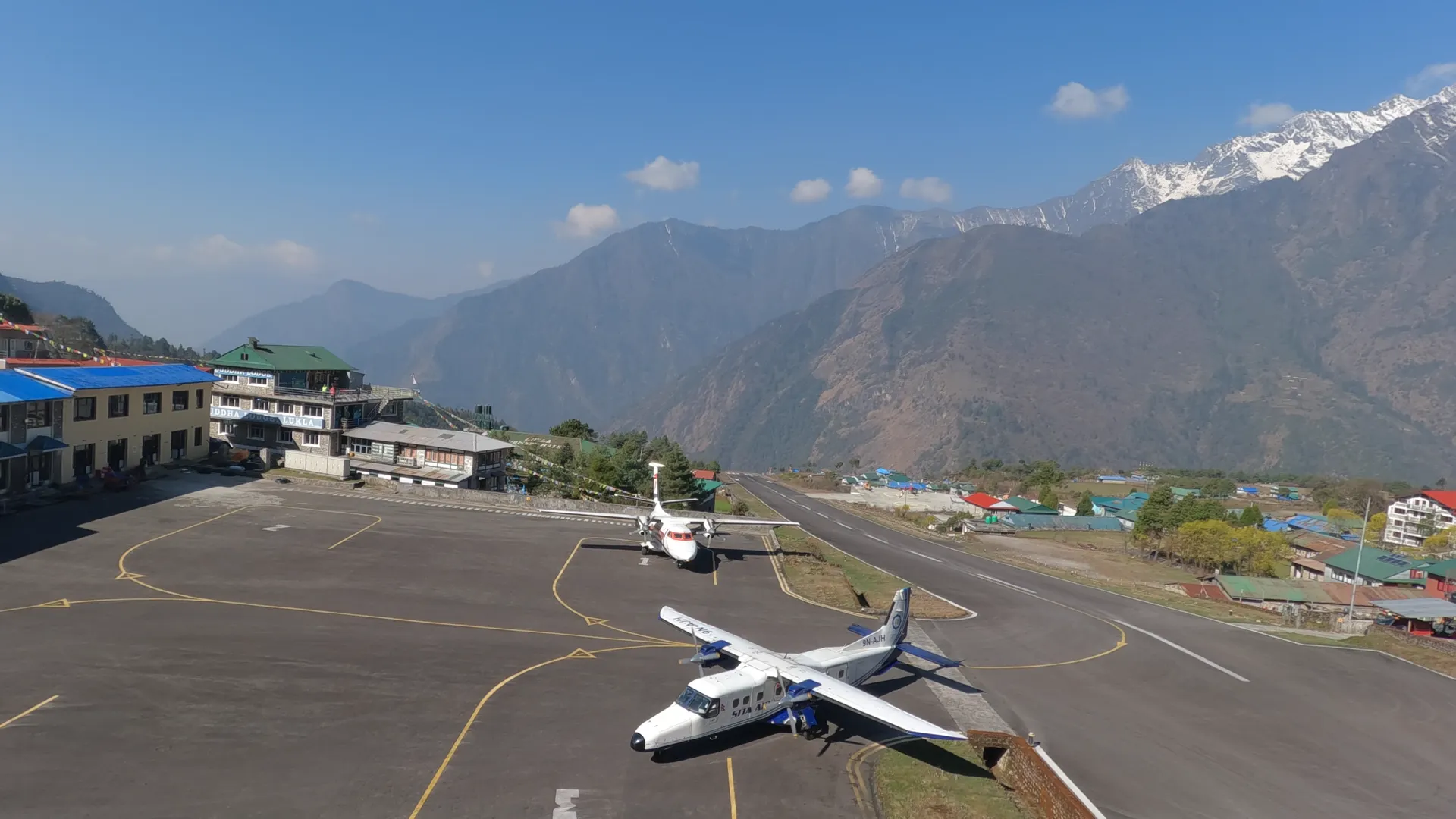
Day two covers the most ground and asks the least of you. The flight to Pokhara comes first, then an hour on the road to Nayapul, then about five hours on foot to Tikhedhunga at 1,440 metres. Add it all up and you finish the day 95 metres higher than the hotel you woke up in. I like pointing that number out on the first evening, because the next morning the same trail gains more than fourteen times as much.
The walk in is gentle. It follows the river past paddy fields and small settlements, and it is the kind of afternoon where the pack settles onto your shoulders and your boots find their own speed without being asked.
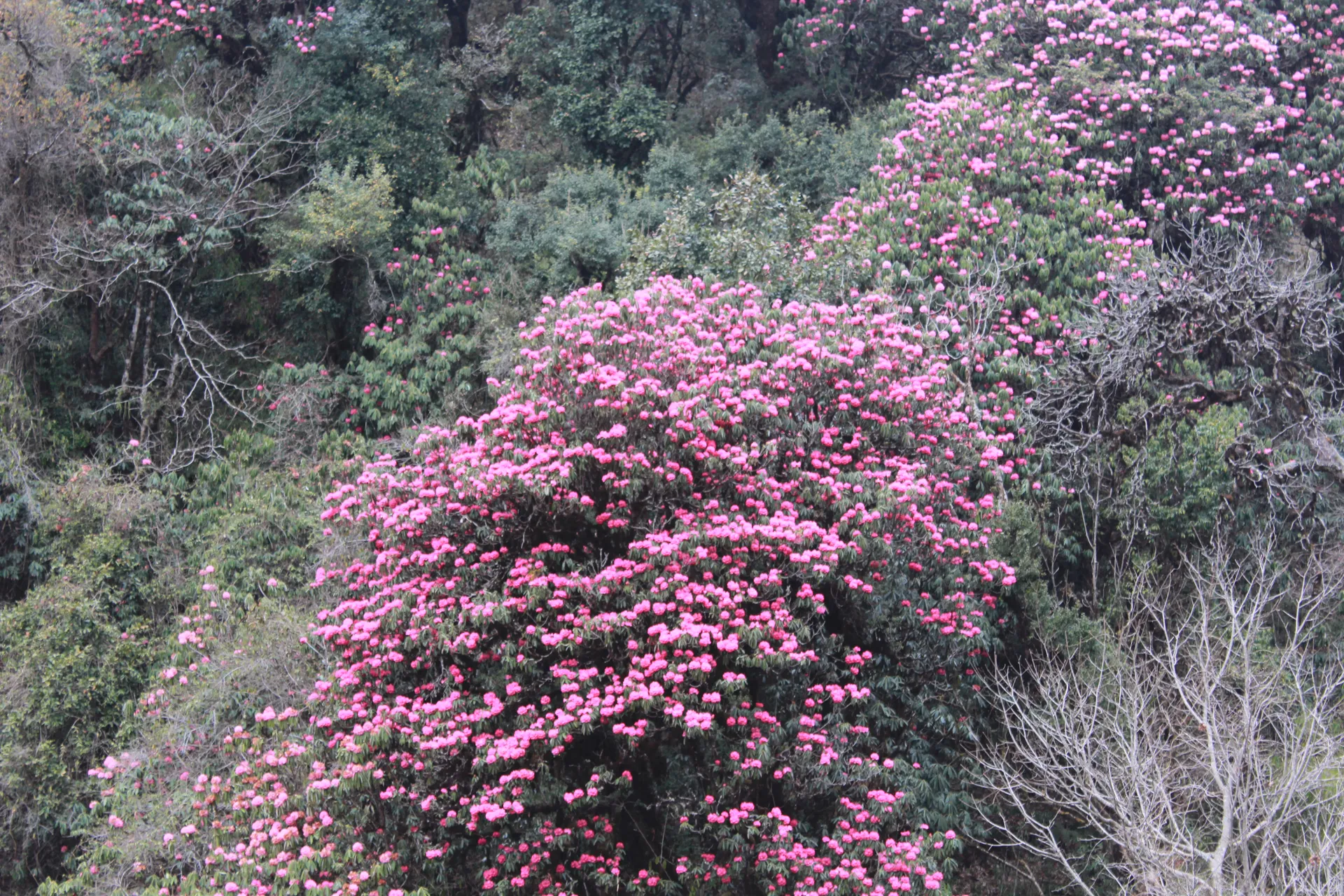
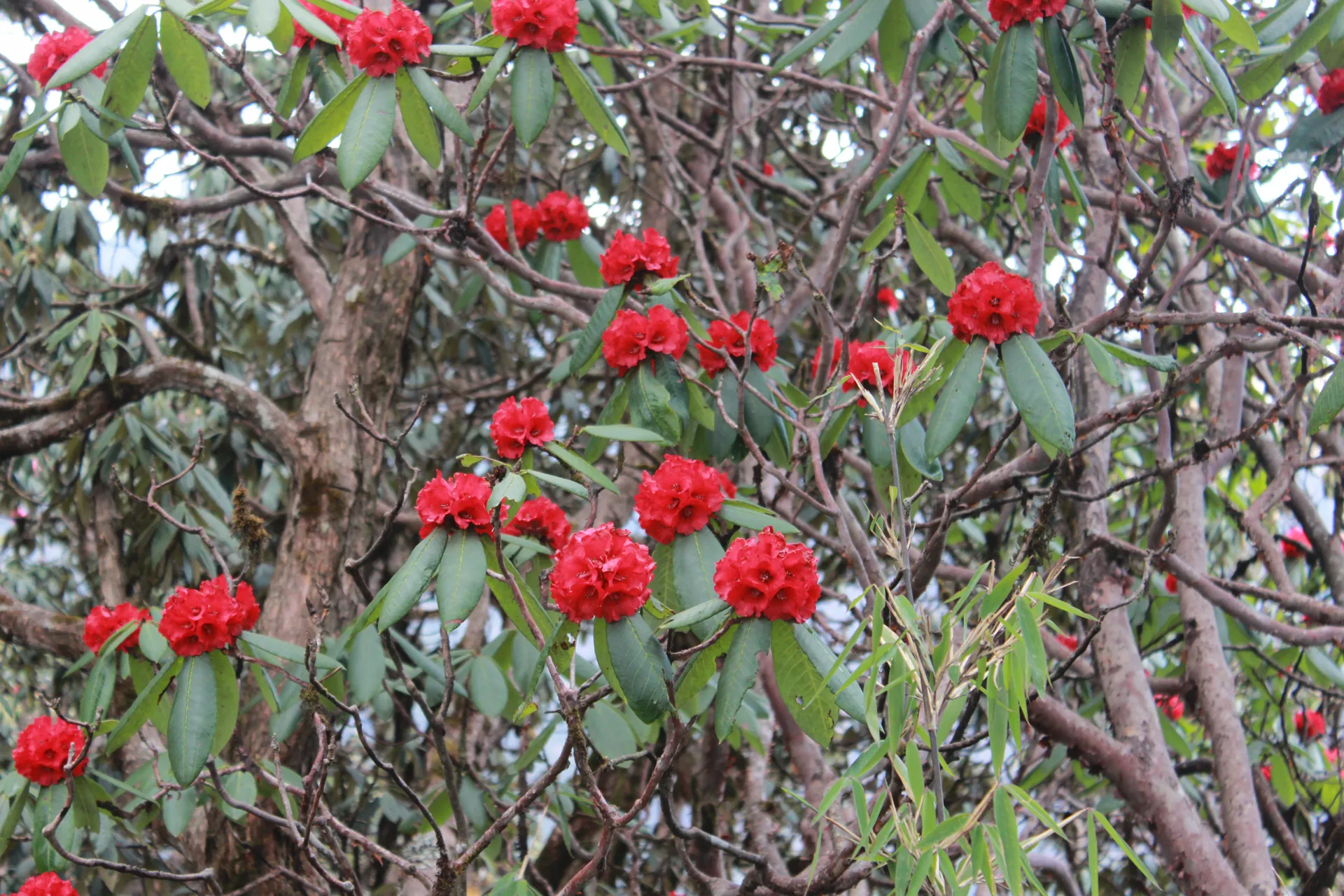
If you are walking in the last week or so of February, look at the low forest on this stretch. Rhododendron flowers from the bottom of the hill upward, and the stands around Tikhedhunga and Ulleri turn first every year. It is a scattering of red on bare branches, weeks ahead of the canopy in the photographs, and almost nobody is here to see it.
Tikhedhunga is a small village with basic teahouses, and the staircase starts right at its edge. You will see the first steps before dinner. Go to bed early anyway.
- Day01Arrival in Kathmandu
- Day02Fly to Pokhara, Drive to Nayapul & Trek to Tikhedhunga+95 m
3,300 Steps to Ulleri
Day three is the physical heart of this trek. Six hours from Tikhedhunga to Ghorepani, and a gain of 1,360 metres, the biggest single climb anywhere on the trek.
Our own count for the staircase is 3,300 hand-laid stone steps, up to Ulleri at 2,070 metres. You will hear other numbers. They run from about 3,000 to 3,767, and that last one came from somebody who filmed every step on the way up. Nobody in Nepal audits a staircase, sections of this one have been rebuilt over the years, and so every count in circulation is somebody's own tally. What every source agrees on is the 630 metres between Tikhedhunga and Ulleri, and that almost all of it arrives as steps.
Pace is the whole technique here. The people who charge the lower steps to get them over with usually pay for it later in the day, in their calves, on the gentler stretch above Ulleri. Stop when you want to. Nobody on this staircase is racing you.
Ulleri is where the day turns. There is hot tea and Gurung hospitality, and the view back down the staircase gives you the first moment of the day to feel pleased with yourself.
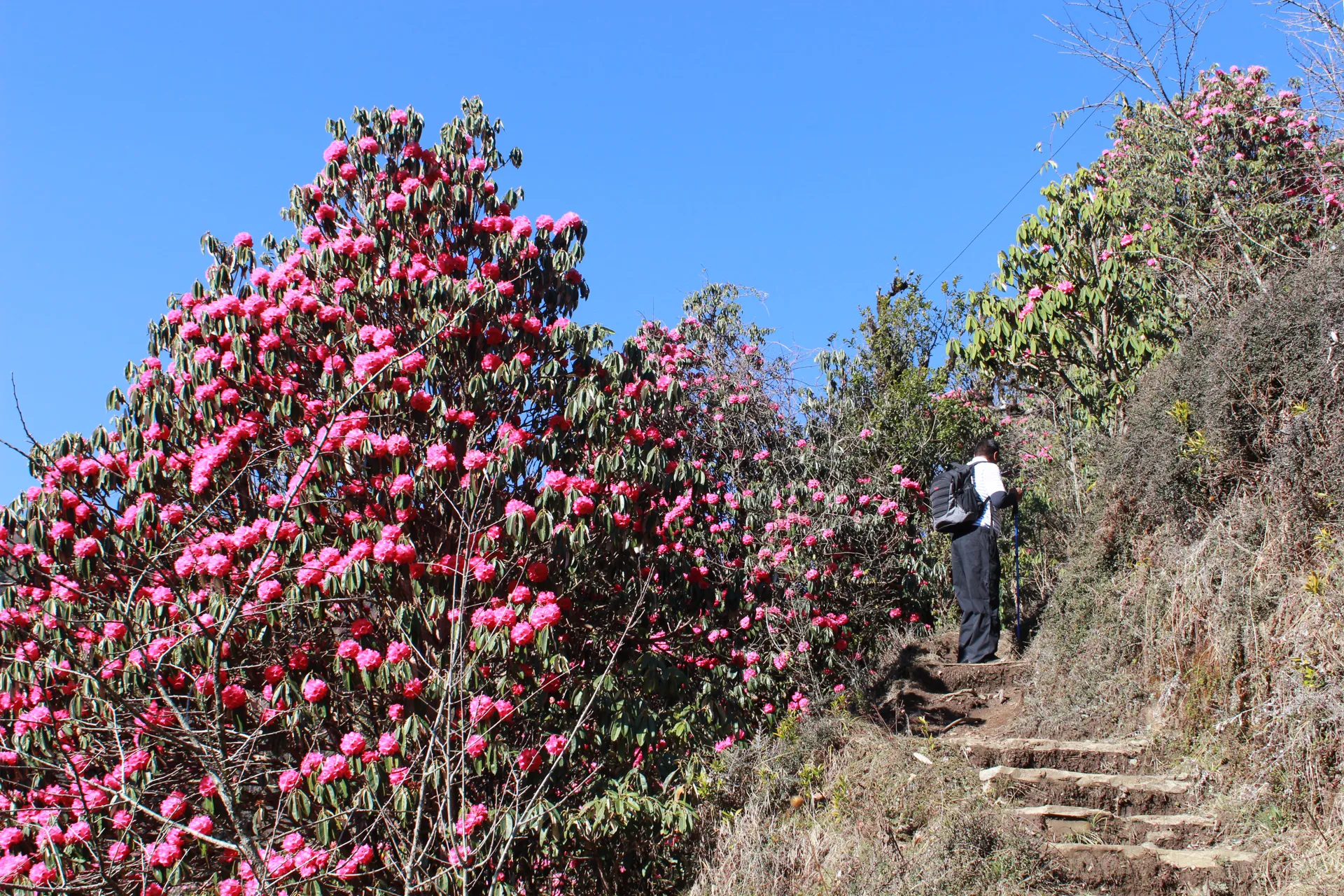
Above Ulleri the gradient eases and the trail climbs the remaining 730 metres through oak and rhododendron forest. In the last ten days of March this is where the canopy turns red and pink overhead and the steps carry on underneath it. We have watched people arrive in the first week of March expecting that forest and find bare branches at Ghorepani instead. The flowers run on elevation and temperature, and no operator can move them for you.
Ghorepani sits at 2,800 metres, and in October and November its lodges fill by mid-afternoon, so your guide will have phoned ahead. The walls between rooms are thin enough that you will learn your neighbour's sleep habits by morning. Pack earplugs where you can find them. Dinner is dal bhat for most of the dining room, because the refills keep coming, and after that staircase a small plate is the last thing anyone wants.
Everyone goes to bed early at Ghorepani. The reason is the alarm.
- Day03Trek to Ghorepani+1,360 m
The Tower at 3,210 Metres
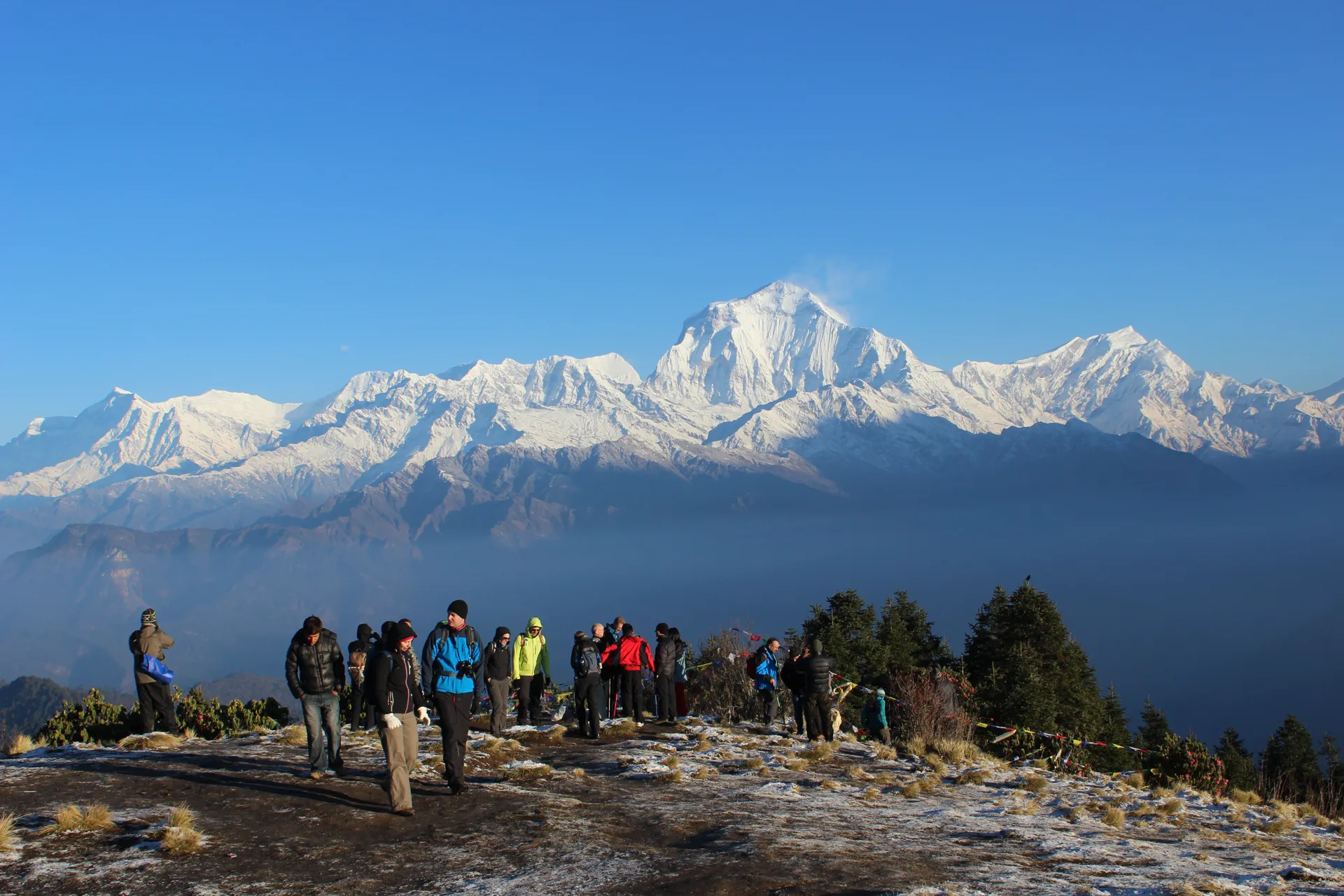
The climb to Poon Hill starts in the dark. In the busy months a line of head torches leaves Ghorepani somewhere between quarter to five and quarter past, and the path goes up through the forest on stone steps. It is about 45 minutes and 410 metres of gain, which after yesterday feels almost polite.
If you want a good corner of the tower, leave twenty minutes before the main wave. You walk up alone in the dark and watch the crowd arrive, instead of arriving inside it. Twenty minutes of sleep is a small trade for that.
At the top a wooden observation tower stands beside the 3,210 metre sign. There is also a single tea stall, and everything it sells came up the hill on somebody's back the day before, which is worth remembering when you wrap your hands around the cup.
Then the light arrives. Dhaulagiri takes it first, 8,167 metres of mountain across the Kali Gandaki, and from there it sweeps across the Annapurna range: Annapurna I at 8,091 metres, Annapurna South, Hiunchuli and the fishtail of Machhapuchhre. Tukuche Peak belongs to Dhaulagiri's group, and Nilgiri marks the edge of the gorge. On the clearest mornings Manaslu shows far off to the east. In January you might share all of this with a dozen people. In peak season it can be two hundred.
My advice is to stay after the photographs. About forty minutes after sunrise most groups head straight back down for breakfast, and the railing empties almost at once. The light keeps warming on Annapurna South, and you get the second half of the morning with room to stand in it.
Breakfast is back in Ghorepani. After that the day still has about five hours in it, through rhododendron forest to Tadhapani at 2,650 metres. That leaves you 150 metres below the village you slept in and 560 below the tower you stood on at dawn. Tadhapani sits on a ridge facing the south face of Machhapuchhre, so the mountain you watched light up that morning is still in front of you when the day ends.
- Day04Trek to Tadhapani−150 m
The Forest Walks You Down
Day five is four hours from Tadhapani to Ghandruk at 1,940 metres, and it drops 710 metres doing it. After the staircase on day three, people expect a downhill day to feel like a reward. Their knees disagree by lunchtime.
The stone is uneven for hours at a stretch, and a rolled ankle on wet stone is the most common small injury we see on this trek. Poles earn their place on this descent even more than on the climb. For a lot of knees, this is the harder day of the two.
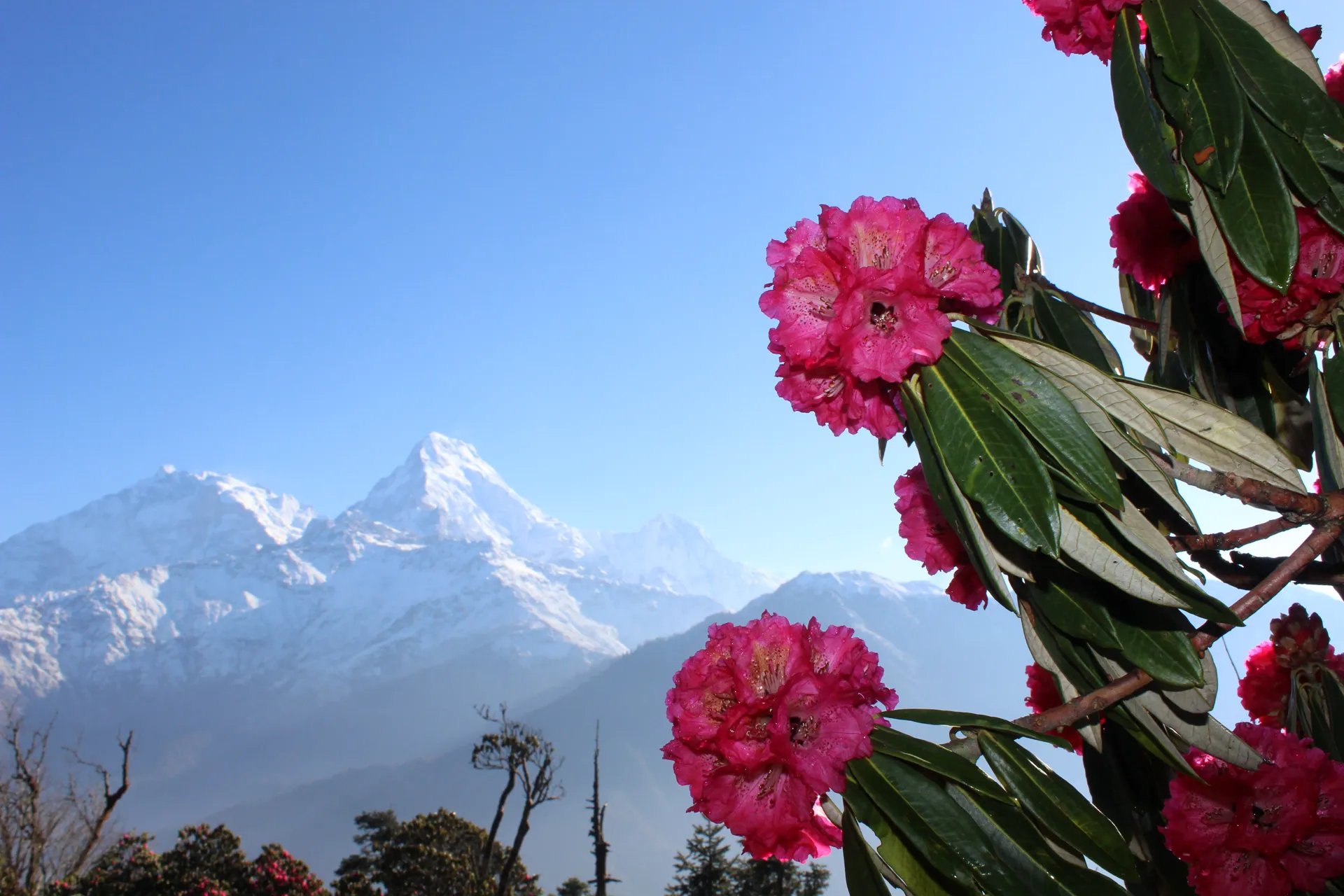
It is also the densest flowering forest on the whole trek. In a good spring it is hard to walk this section quickly, because you keep stopping to look up into it. I think that is exactly the right way to walk it.
Out of season the forest is bare, and bare has a reward of its own: sightlines through the trees to Annapurna South that the spring canopy hides completely. Mid-November is our own favourite window on this trek for that reason. Hardly anyone books it for the bare branches, and everyone notices them once they are there.
Ghandruk is one of the largest Gurung villages in the region, stone-paved lanes under slate roofs, with lodges whose terraces face Machhapuchhre and Annapurna South. There is a Gurung museum in the village, and a military history exhibition too. The museum is a good twenty minutes that almost everybody walks straight past. Do not be almost everybody.
Gurung families have been feeding trekkers in Ghandruk for decades, and the food shows it. If dhido, the buckwheat porridge, or gundruk, the fermented greens, turns up on the table, try it. The showers run hot here as well, and after the stone of the last three days that feels like a luxury.
- Day05Trek to Ghandruk−710 m
Back to the Road
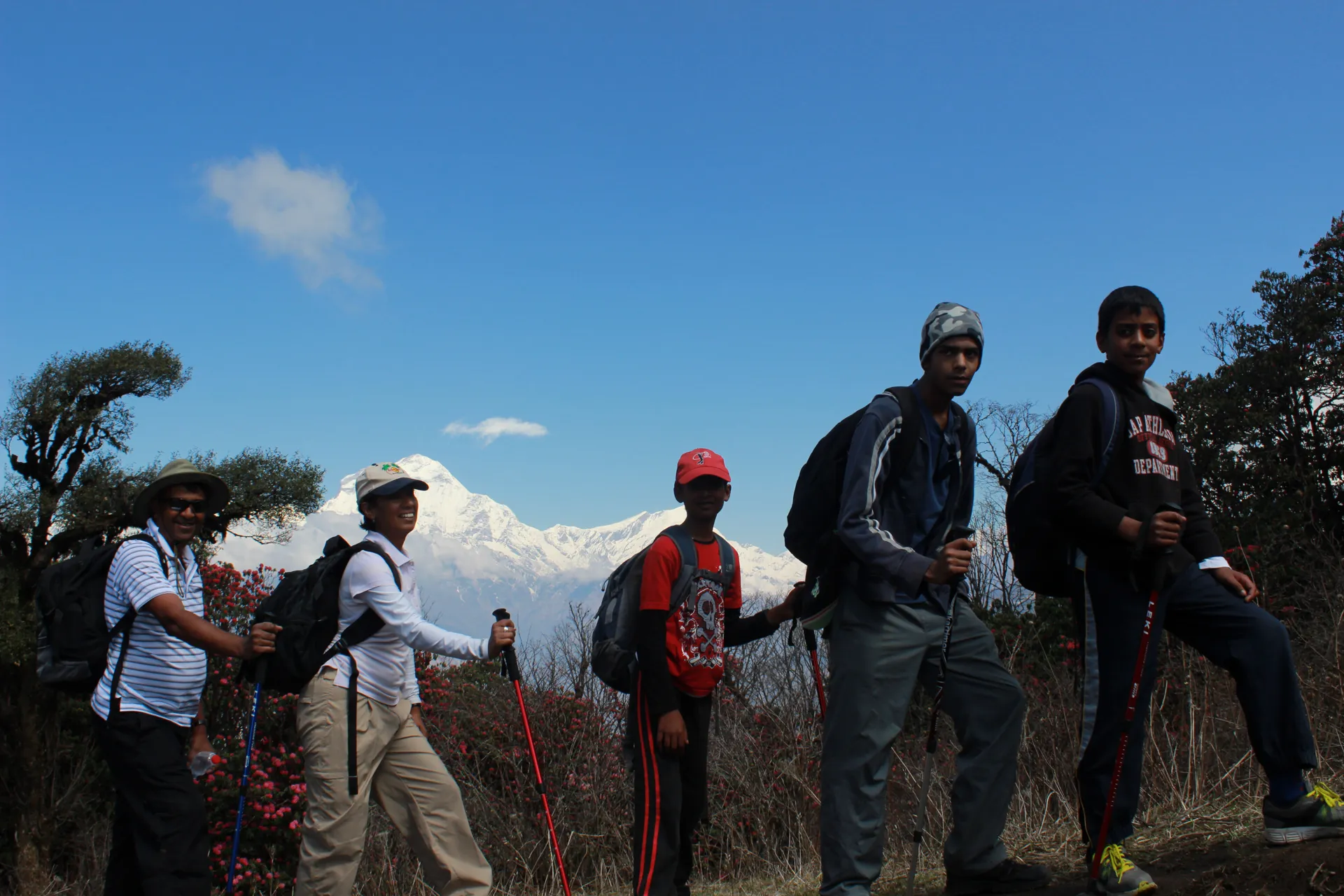
Day six finishes the walking. The trail drops from Ghandruk to Nayapul, the same road-head you left on day two, and a vehicle carries you on to Pokhara at 865 metres. Between Ghandruk and your Pokhara bed that evening you lose 1,075 metres. The walking itself makes a loop, and after Poon Hill it never covers the same ground twice.
The terraces below Ghandruk change with the calendar, so this last morning looks different depending on when you walk it. In September the rice is high and green. By November it has been cut and the hillside has turned gold, and the whole descent looks like a different trek from the one a monsoon walker did over the same fields.
Pokhara is a hotel bed again, the first since Kathmandu. Day seven is the drive back to Kathmandu, which gives you most of a day in a vehicle to sort through the photographs. Day eight is departure, a transfer to the international airport and nothing more.
For many people this is their first trek in Nepal, and eight days is long enough to learn the things a longer trek takes for granted: how a teahouse works, and what stone steps feel like on the third day.
- Day06Trek to Nayapul & Drive to Pokhara−1,075 m
- Day07Drive Back to Kathmandu+480 m
- Day08Departure
This is a short trek, and its whole shape bends around one morning on a hilltop. The effort comes before it, on day three's staircase. The long, flowering walk down comes after it, on day five. Everything else is getting to the trail and getting home again.
I like that shape. The tower gives back more than the staircase took, and the descent to Ghandruk hands you a long day in the forest to think about what you saw from the top. Weigh the stairs honestly and the sunrise will take care of itself. If you want to talk through either one, we are here.
Written by Prem Pandit, Founder