
- Day-by-day difficulty breakdown
- The Ulleri staircase, and the step count nobody agrees on
- Altitude and AMS: why 3,210m barely counts as an issue
- Training, and a fitness test that means something
- Who this trek suits
- How Poon Hill compares: ABC, EBC, Mardi Himal, Langtang
- Does the season change the difficulty
- The guide requirement, gear, and the descent that tests your knees
- The honest answer
Poon Hill's summit sits at 3,210m. Everest Base Camp sits at 5,364m. That gap alone tells you most of what you need to know about why Mountain Hawk Trek grades this trek Easy on its own tour page, while Everest Base Camp and Annapurna Base Camp both carry harder ratings.
Easy does not mean flat, and it does not mean forgettable. Somewhere between Tikhedhunga and Ghorepani sits a stone staircase that has broken more first-day confidence than any other single stretch of trail in the Annapurna region. How many steps, exactly, depends entirely on which blog you read. This guide gives the honest range, walks through the trek day by day using Mountain Hawk Trek's own 8-day itinerary, and answers the questions that decide whether Poon Hill is right for you: the fitness test, the altitude risk, who it suits, and how it stacks up against the bigger treks in the region.
For the full route, permits, and packing list, the complete Poon Hill guide covers that separately. This one is about the physical reality of walking it.
Day-by-day difficulty breakdown
Mountain Hawk Trek runs this as an 8-day package, door to door from Kathmandu. Five of those days put you on the trail, though the first and last are short walks wrapped around transport. The rest are flights, drives, and arrival or departure buffer.
| Day | Route | Elevation | Gain/Loss | Hours | Difficulty |
|---|---|---|---|---|---|
| 1 | Arrival in Kathmandu | 1,345m | - | - | Rest day |
| 2 | Fly to Pokhara, trek to Tikhedhunga | 1,440m | net +95m | 5h | Easy |
| 3 | Tikhedhunga to Ghorepani | 2,800m | +1,360m | 6h | **Hard** |
| 4 | Poon Hill sunrise, on to Tadhapani | 3,210m then 2,650m | +410m / -560m | 5h | Moderate |
| 5 | Tadhapani to Ghandruk | 1,940m | -710m | 4h | Moderate (knees) |
| 6 | Ghandruk to Nayapul, drive to Pokhara | 865m | -1,075m | trek + 1h drive | Easy |
| 7 | Drive to Kathmandu | 1,345m | drive | - | Rest day |
| 8 | Departure | - | - | - | - |
Day two is a transit day dressed up as a trek. You fly Kathmandu to Pokhara, then walk from the roadhead at Nayapul up to Tikhedhunga, a gentle warm-up before the trail turns serious the next morning.
Day three is the one people remember. Tikhedhunga to Ghorepani gains 1,360m in a single push, and most of that climb happens on the Ulleri staircase, which starts right at the edge of Tikhedhunga village. Six hours, most of it uphill, much of it on stone. This is the hardest single day on the route by a wide margin.
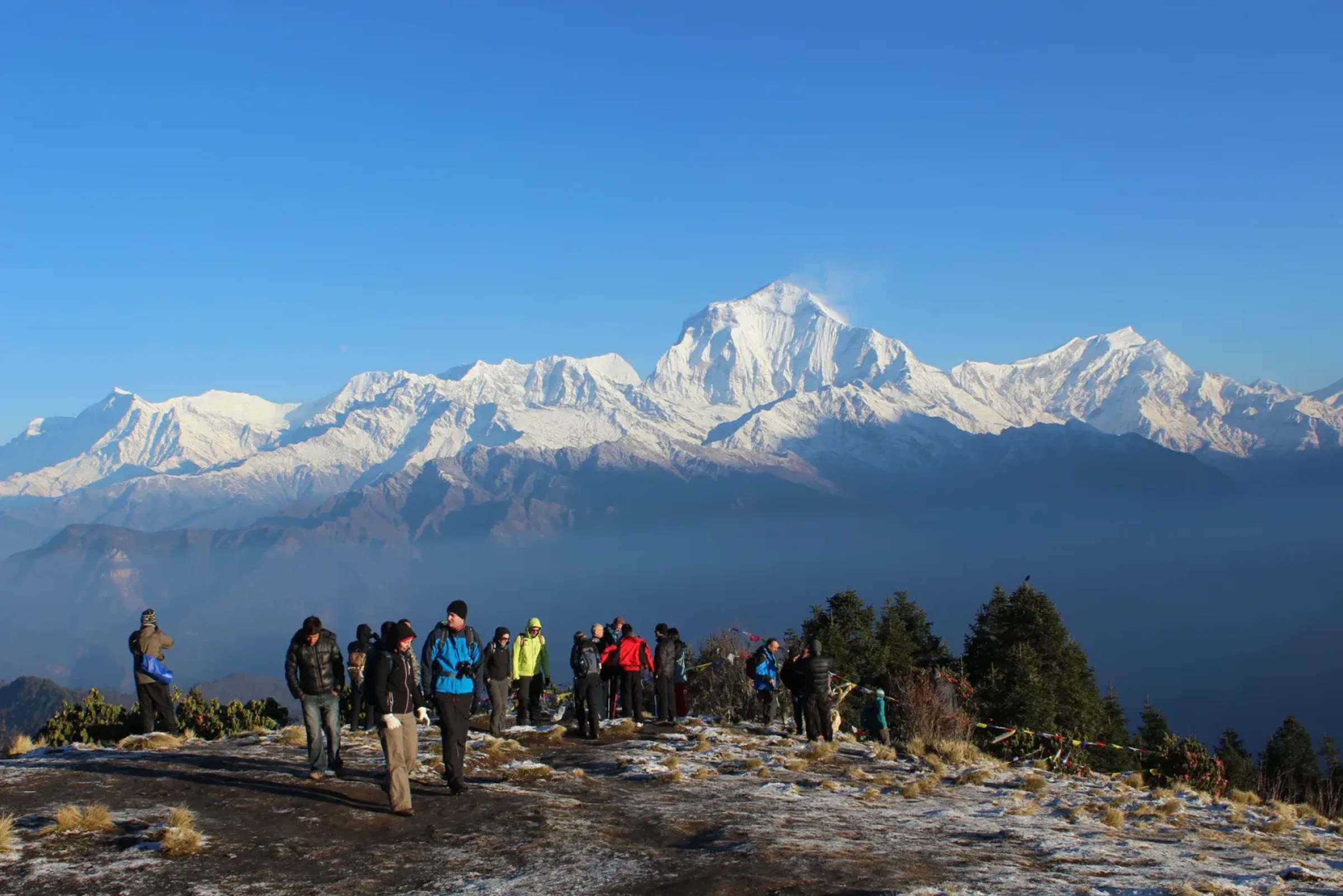
Day four starts in the dark. You leave Ghorepani well before sunrise for the climb to the Poon Hill viewpoint at 3,210m, a final push our own itinerary puts at 45 minutes, then descend to Tadhapani through rhododendron forest once the sun is up. The single tea stall at the viewpoint charges toward the top of the trek's usual NPR 100-300 hot-drink range, since everything up there arrived on someone's back the day before. Day five continues the descent to Ghandruk, and day six finishes the loop back down to the roadhead and a drive into Pokhara. Neither day is technically hard. Both are long enough, and downhill enough, to matter for anyone who skipped the training.
Trekkers who push straight through Ulleri without stopping to catch their breath usually feel it the next morning, in their calves, on the gentler but still uphill stretch toward Ghorepani. Pace the staircase. The trek rewards patience more than speed.
The Ulleri staircase, and the step count nobody agrees on
Ask five different sources how many stone steps run from Tikhedhunga to Ulleri and you will get five different answers. Mountain Hawk Trek's own tour page states 3,300. Independent trekking blogs quote 3,000, 3,200, and roughly 3,500. One YouTube trail count, filmed step by step, lands at 3,767.
Nobody is lying. There simply is no official count. No trail authority in Nepal audits stone staircases, and the numbers in circulation are personal tallies from individual trekkers, counted differently depending on where exactly they started and whether they treated a stacked group of stones as one step or several. The staircase itself has also been patched and rebuilt in sections over the years, which changes the true count over time without anyone circling back to update the blogs that quoted the older number years ago.
What every source agrees on is the shape of the climb: roughly 700m of elevation gain over two to three hours, almost entirely on hand-laid stone. It is the steepest sustained climb on the route, and it lands on day three, before your legs have had a real chance to adjust to multi-day trekking.
Trekking poles help here more than almost anywhere else on the trip. So does an early start, before the midday sun turns the lower staircase into a sweatbox with no shade for long stretches. For a full packing list built around sections like this one, see the Nepal trek packing list.
Altitude and AMS: why 3,210m barely counts as an issue
Acute mountain sickness becomes a genuine clinical concern above roughly 3,500m. Poon Hill's summit tops out at 3,210m, below that line, and the highest overnight stop on the route, Ghorepani, sits lower still at 2,800m.
That gap matters more than it sounds like it should. You are not sleeping at altitude on this trek in any meaningful sense. Exposure to 3,210m lasts less than an hour, during the pre-dawn climb and the time spent at the viewpoint itself, then you descend again. Compare that to Annapurna Base Camp, where trekkers sleep at 4,130m, or Everest Base Camp, where the trail tops out at 5,364m and multiple nights are spent above 4,000m.
Mild symptoms are still possible. A headache, some breathlessness on the Ulleri stairs, general fatigue if you pushed too hard the day before. That is normal exertion at moderate elevation, not altitude sickness in the clinical sense. Serious AMS on this specific route is rare enough that guides who have worked it for years, ours included, describe it as something they have not personally seen happen here.
For the full framework on AMS symptoms, severity, and what to do if something feels genuinely wrong at altitude, see our altitude sickness guide. What is specific to Poon Hill is simpler than anywhere else in the region: the altitude exposure is short, the sleeping elevation is low, and the risk profile reflects both.
Training, and a fitness test that means something
Give yourself four to six weeks if you already walk regularly. Longer if you are starting from close to zero.
The test that matters: can you walk five hours on hilly terrain, carrying an 8kg daypack, without being wrecked at the end of it? If yes, you are ready for Poon Hill. If that five-hour walk leaves you sore for two days afterward, that is your training gap, and it is worth closing before you fly.
Build the plan around three things. Cardio, three to four sessions a week, brisk walking, cycling, or a stair machine if you have access to one. Leg strength, specifically squats, lunges, and step-ups, because the Ulleri staircase punishes weak quads far more than it punishes weak lungs. And some loaded-pack practice, even just a daypack with a few books in it on your regular walk, so your shoulders and hips already know what the real thing feels like on day three.
None of this requires a gym membership or a personal trainer. A hilly park, a flight of stairs, and three to four weeks of consistency get most reasonably fit adults ready for this specific trek. It is not the training load Everest Base Camp or Manaslu demand. It does not need to be.
Who this trek suits
Beginners first. Multiple independent guides and blogs describe Poon Hill as the standard first Himalayan trek in Nepal, and the reasoning holds up on inspection: short daily distances, teahouses every few hours rather than every few days, no technical climbing, and an altitude ceiling low enough to remove the one variable, AMS, that complicates every recommendation for a first-time trekker elsewhere in the region. If this is your first multi-day hike anywhere, Poon Hill is a reasonable place to start, provided you do the training above rather than skip it. Our beginner's guide to trekking in Nepal covers the broader picture if Poon Hill is one option among several you are weighing.
Seniors, next. Age matters less than fitness here. Trekkers well into their 60s and 70s complete this route regularly, and the same staircase that tests a fit 25-year-old tests an unfit one just as hard. The adjustment that helps is pace, not ambition: an extra rest day, an earlier start each morning, shorter daily targets.
Families with kids from roughly age 8 upward manage this trek without unusual difficulty, again assuming reasonable pace and no rush up the stairs. There is no altitude risk in the clinical sense, no technical terrain, and a teahouse at the end of every trekking day for recovery. The Ulleri staircase is the one section worth planning around specifically for a family group. Everyone climbs it at their own speed, and there is no shame in that.
Who Poon Hill suits less well: trekkers chasing a genuine high-altitude challenge, or anyone hoping for solitude in October and November. This is one of the most heavily trafficked short treks in Nepal, and Ghorepani's teahouses fill by mid-afternoon in peak season. If altitude and quiet trails matter more to you than an easy introduction, Mardi Himal or the Annapurna Base Camp trek deliver both in ways Poon Hill was never built to.
How Poon Hill compares: ABC, EBC, Mardi Himal, Langtang
| Trek | Max altitude | AMS risk | Main difficulty driver |
|---|---|---|---|
| Poon Hill | 3,210m | Near zero | The Ulleri staircase, once |
| Mardi Himal | 4,500m | Moderate | Exposed ridge above High Camp |
| Annapurna Base Camp | 4,130m | Moderate | Multiple nights sleeping at altitude |
| Everest Base Camp | 5,364m | Higher | Sustained altitude over 14 days |
| Langtang Valley | 4,773m | Moderate | Gentler approach, still genuinely high |
Our own comparison of Poon Hill, Mardi Himal, and Annapurna Base Camp scores Poon Hill 3 out of 10 for difficulty, against 5 for Mardi Himal and 6 for ABC. That is not a close gap. Mardi Himal adds an exposed ridge walk above High Camp that Poon Hill has no equivalent of. ABC keeps you sleeping at 4,130m for several nights running, high enough that altitude, not fitness, becomes the limiting factor for some trekkers.
Everest Base Camp is a different order of trek. Fourteen days against Poon Hill's eight, a summit more than 2,000m higher, and sustained multi-day altitude exposure Poon Hill never asks of you. If the deciding question is which trek needs the least training and carries the lowest altitude risk, Poon Hill wins clearly against all three, and against Langtang too.
Langtang tops out near 4,773m at Kyanjin Ri and is generally the gentlest of the higher-altitude options, worth a look if Poon Hill feels too short and Everest Base Camp feels like too much. For a full breakdown of who should pick which trek, the Mardi Himal, Annapurna Base Camp, Everest Base Camp, and Langtang Valley trek pages all have the full logistics if any of them catch your interest instead.
Does the season change the difficulty
Yes, in two different ways depending on when you go. Full month-by-month weather, crowd levels, and sunrise visibility live in our best time to trek Poon Hill guide. This section is only about how season changes the physical difficulty of the walking itself.
Winter, December through February, brings snow and ice above Ghorepani. The stone steps toward the viewpoint can glaze over in the early morning cold, and at that point the trek needs microspikes and proper insulation, not just a warm jacket. The walking distance and daily hours do not change. The footing does. That raises the bar slightly for anyone unused to walking on ice.
Monsoon, June through August, is a different problem entirely. The same staircases turn slick and unpredictable underfoot. Leeches are active on the lower, grassier sections between Nayapul and Ulleri, an unpleasant but not dangerous nuisance. Landslide risk rises on the cut sections of trail lower down, where the path runs along steep hillside. None of this closes the route. All of it makes an already staircase-heavy trek meaningfully less pleasant, and for a first-timer specifically, we would not recommend a monsoon departure.
October, November, March, and April avoid both problems: dry stone, no ice, no leeches. If your dates are flexible at all, that flexibility is worth using here.
The guide requirement, gear, and the descent that tests your knees
Nepal has required a licensed guide for foreign trekkers in regulated areas since April 2023, and the Annapurna Conservation Area, where Poon Hill sits, is one of them. Mountain Hawk Trek's own tour page states the same requirement directly: a government-licensed, English-speaking guide on every departure. Permit logistics, ACAP and TIMS specifically, are covered in full in our Nepal trekking permits guide.
Worth being precise about what this rule is not. It is a different requirement from the restricted-area permit system that governs treks like Manaslu or Upper Mustang, where a separate 2026 change dropped an old two-trekker minimum on permit applications. Poon Hill was never a restricted area. There was never a two-trekker minimum here to drop. The guide mandate stands on its own, and it has applied since 2023 regardless of anything that has changed elsewhere since.
A guide does not make the trek physically easier. It removes the risks that come from route-finding and language, which matter less here than on a genuinely remote trek, but still matter in peak season when Ghorepani's teahouses fill fast and a guide who knows which one has a spare room saves you real time.
The gear question that matters most is trekking poles. Bring them, and use them on both the ascent and the descent, not just the downhill stretch. The Ulleri staircase is a cardio test on the way up. The descent from Tadhapani to Ghandruk, dropping 710m over four hours on uneven stone, is a knee test coming down, and several independent trekking accounts single out that descent as harder on joints than the climb ever was. If your knees already complain on ordinary stairs at home, poles move from optional to close to mandatory here. Good ankle support helps for the same reason. The terrain is not technical anywhere on this route, but it is uneven for hours at a stretch, and a rolled ankle on wet stone is the most common minor injury we see on this specific trek.
The honest answer
Poon Hill earns its Easy rating. No ropes, no technical terrain, an altitude ceiling that removes AMS as a real concern, and a route short enough to fit into an 8-day trip from Kathmandu and back. None of that makes it a stroll, though. The Ulleri staircase, whatever the true step count turns out to be, is a genuine physical test on day three, and the knees pay for it again on the descent from Tadhapani a day later.
Train for five weeks, bring poles, pace the stairs, and most reasonably fit adults handle this trek without much drama. If you want the full cost breakdown before you commit, what the trek costs covers permits, guide fees, and teahouse prices in detail, starting from the $675 package price on our own tour page. If you want to talk through your dates, your fitness, or whether Poon Hill or something else in the region is the right call, get in touch and we will give you a straight answer.