
- On the trail
- 13 days
- High point
- 4,130m
- Starts
- Kathmandu
- Nights
- Teahouse
- Best window
- Spring & Autumn
- Effort
- Moderate
I know the trail to Annapurna Base Camp well enough to predict exactly where new trekkers lose their nerve, and it is the same place every time. They expect a climb. What they get is a climb that changes its mind twice before it lets them near the mountain.
That is not a complaint. It is the reason I like this trek. Everest Base Camp goes up. This one goes up, down, up, down, and up again, and somewhere around the third change of direction most people stop checking their watch and start paying attention to the ground under their boots instead.
What follows walks the thirteen days in the order your legs will feel them, not the order a brochure would put them in. Some of it is stone steps. Some of it is a hot spring on a riverbank. All of it is the actual trail, told the way I tell it to the groups I still guide myself.
Walking this one? See the Annapurna Base Camp Trek package, dates and group sizes.
The Part on Wheels
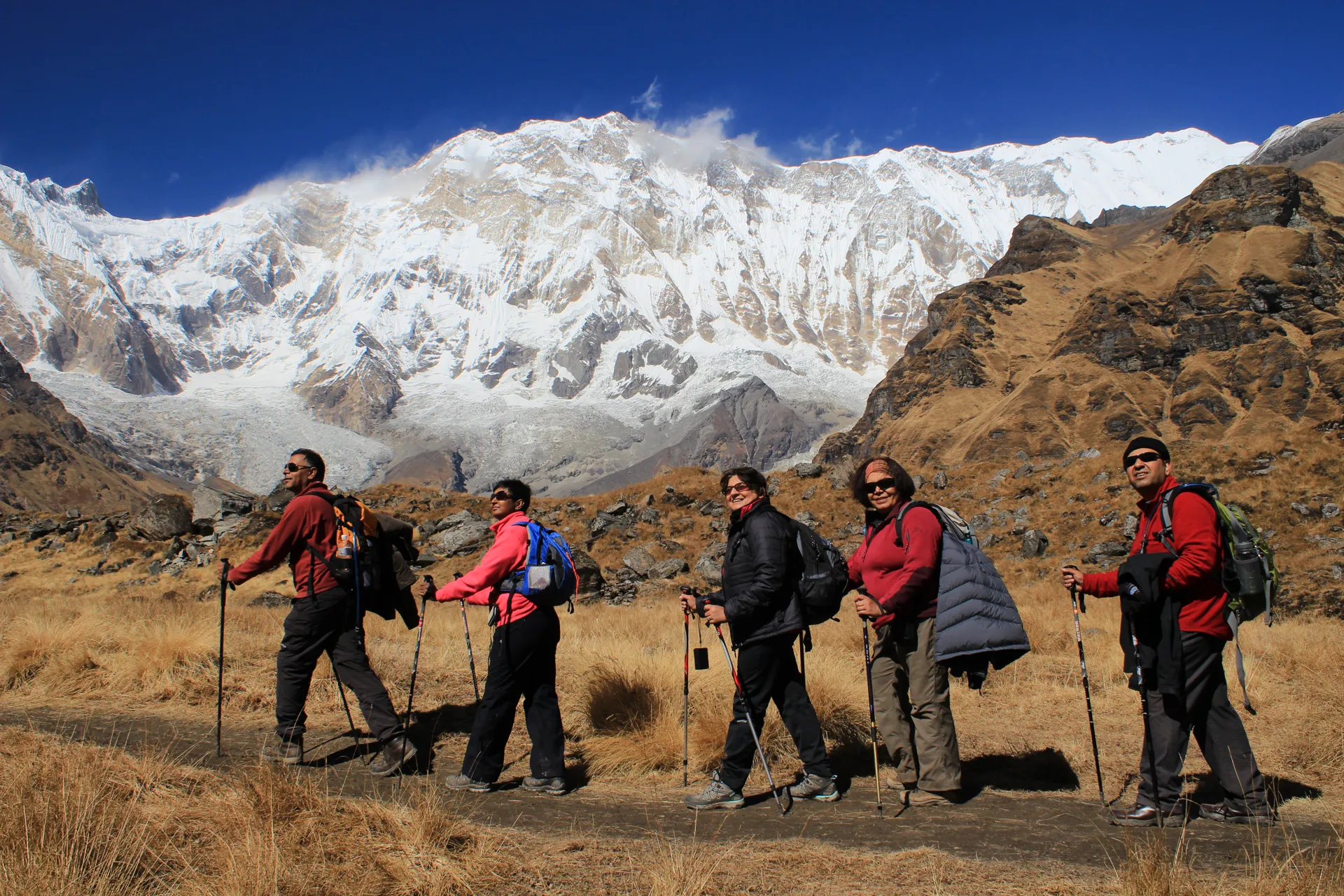
Kathmandu on day one is one hotel night and not much else worth writing home about. You land, you rest, you meet the group if you have not already. I use it to check gear and answer the questions people are too nervous to ask over the phone beforehand.
Day two is a full day on wheels, six hours from Kathmandu to Pokhara, and I tell every group the same thing before we leave: this is the last day your legs get to do nothing. Pokhara sits close to the lake, low enough that the mountains are still just a shape on the horizon rather than something you feel in your knees.
Day three changes that. Five hours to Tikhedhunga, and this is where the actual trek starts, not the drive before it. The path is straightforward, more warm-up than test, but it is the first day your boots do the work instead of an engine. Tikhedhunga sits low enough in the valley that you will probably still be in a t-shirt when you arrive. Enjoy it. Tomorrow is not like this.
| Day | Stage | Altitude | On foot | Night |
|---|---|---|---|---|
| 1 | Arrival in Kathmandu | 1,345 m | Hotel | |
| 2 | Drive to Pokhara | 865 m | 6 hr | Hotel |
| 3 | Trek to Tikhedhunga | 1,440 m | 5 hr | Teahouse |
Sunrise, Then One Step Back
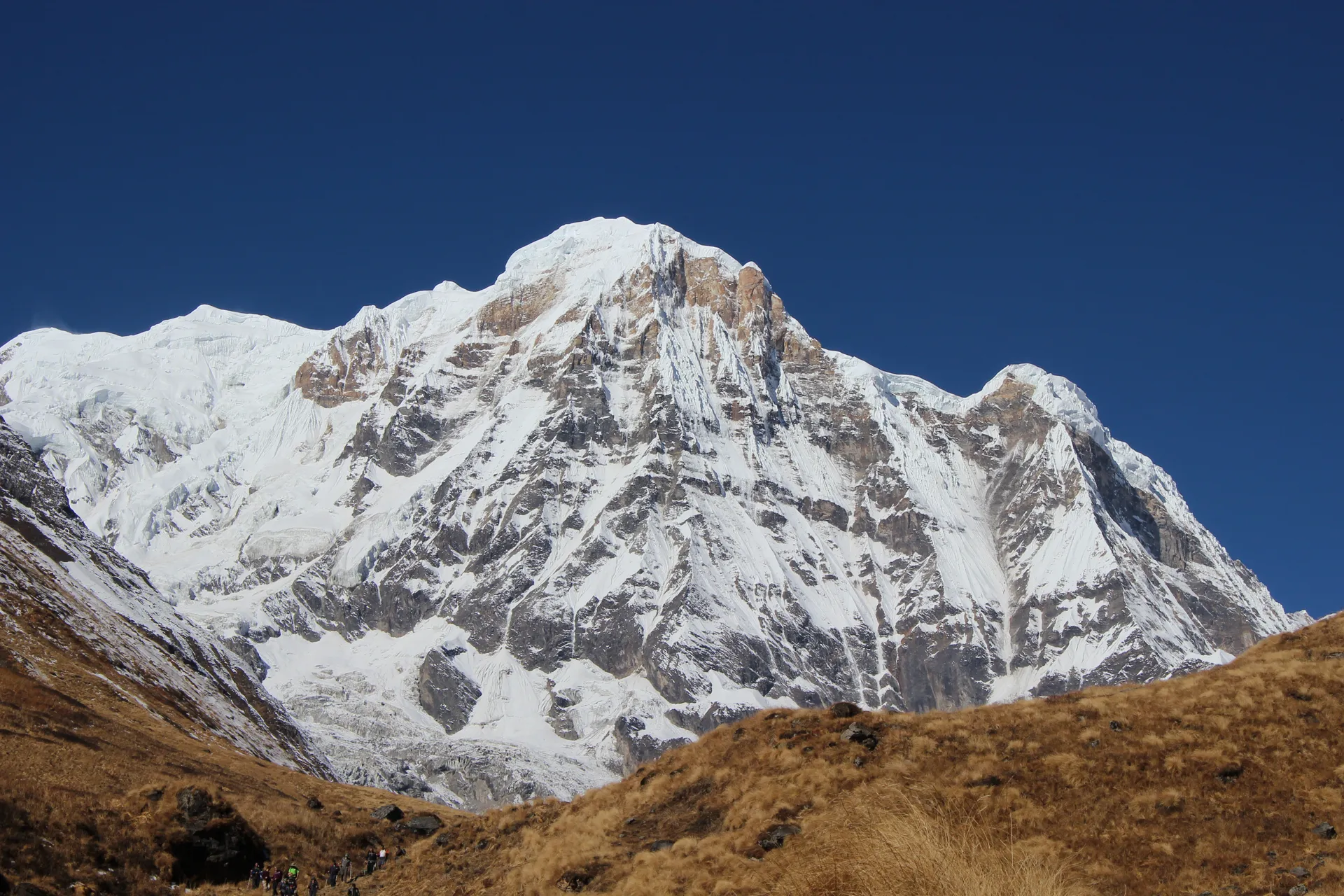
Day four is the one people remember for their legs, not their eyes. From Tikhedhunga to Ghorepani is one trekking day on paper, but on the ground it is one long staircase, including the climb through Ulleri: over 3,200 stone steps cut straight into the hillside, no flat stretch anywhere in the middle to catch your breath. The trail gains 1,360 vertical metres in that single day. Nobody I have guided has called it their favorite few hours of the trek, and nobody has forgotten it either.
Ghorepani sits at 2,800m, and day five actually begins before the sun is up. We leave in the dark for the Poon Hill sunrise, headlamps on, breath visible, half the group still deciding whether they are more cold or more awake. That sunrise still gets me every time the light hits the range and the whole group goes quiet at once. Nobody talks through it. Nobody needs to.
Then breakfast back in the village, and the day is not finished asking things of you. Five hours on to Tadhapani, and the odd truth about day five is that you gain a sunrise and lose ground at the same time. Tadhapani sits 150 metres lower than Ghorepani. Every group I have walked with notices that on the map before they feel it on the trail: you climbed all of yesterday to get here, and now you are giving some of it back on purpose.
I tell people not to read that as a setback. It is the shape of this trek, not a flaw in it. Chhomrong and the real climbing are still ahead.
| Day | Stage | Altitude | On foot | Night |
|---|---|---|---|---|
| 4 | Trek to Ghorepani | 2,800 m | 6 hr | Teahouse |
| 5 | Trek to Tadhapani | 2,650 m | 5 hr | Teahouse |
Losing Ground to Gain It
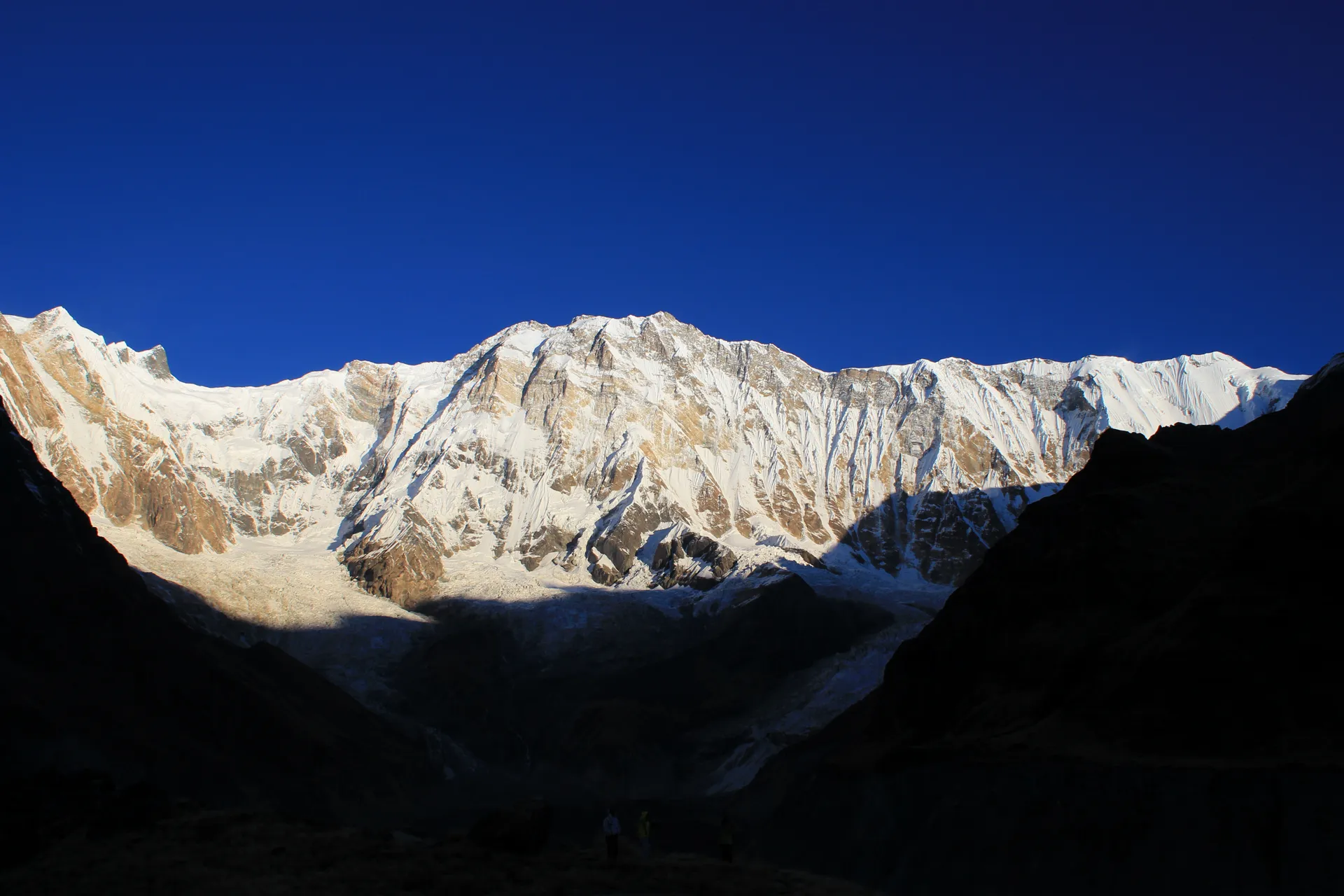
Day six drops to Chhomrong, and it drops hard: 533 metres down from Tadhapani in a single day, the lowest point on the trail since Tikhedhunga. Chhomrong itself is the last real village before the gorge narrows and the shops thin out. If you forgot something, buy it here. Above Chhomrong there is very little to buy at all.
Below the village the trail drops again, on a long stone staircase down to the river and straight back up the other side. People ask me exactly how many steps it is, and I have stopped pretending I know. I have heard 1,800. I have heard 3,000. Nobody has ever actually counted them properly, and every guide I know gives a different number with the same straight face. What is not in dispute is what it does to your knees on the way down and your thighs on the way up.
Day seven climbs straight back to Himalaya at 2,800m, a gain of 683 metres that exactly undoes what days five and six gave away between them. I always point that out to groups walking it: the trail took the altitude from you gently over two days and hands it all back at once over one.
Himalaya is not a hotel. I still find that funny, watching people's faces when they realize the name on the map is a cluster of a few teahouses and nothing else. Nobody is disappointed by it. The dining room is warm, and that is what actually matters by day seven.
| Day | Stage | Altitude | On foot | Night |
|---|---|---|---|---|
| 6 | Trek to Chhomrong | 2,117 m | 6 hr | Teahouse |
| 7 | Trek to Himalaya | 2,800 m | 6 hr | Teahouse |
The Morning at 4,130 Metres
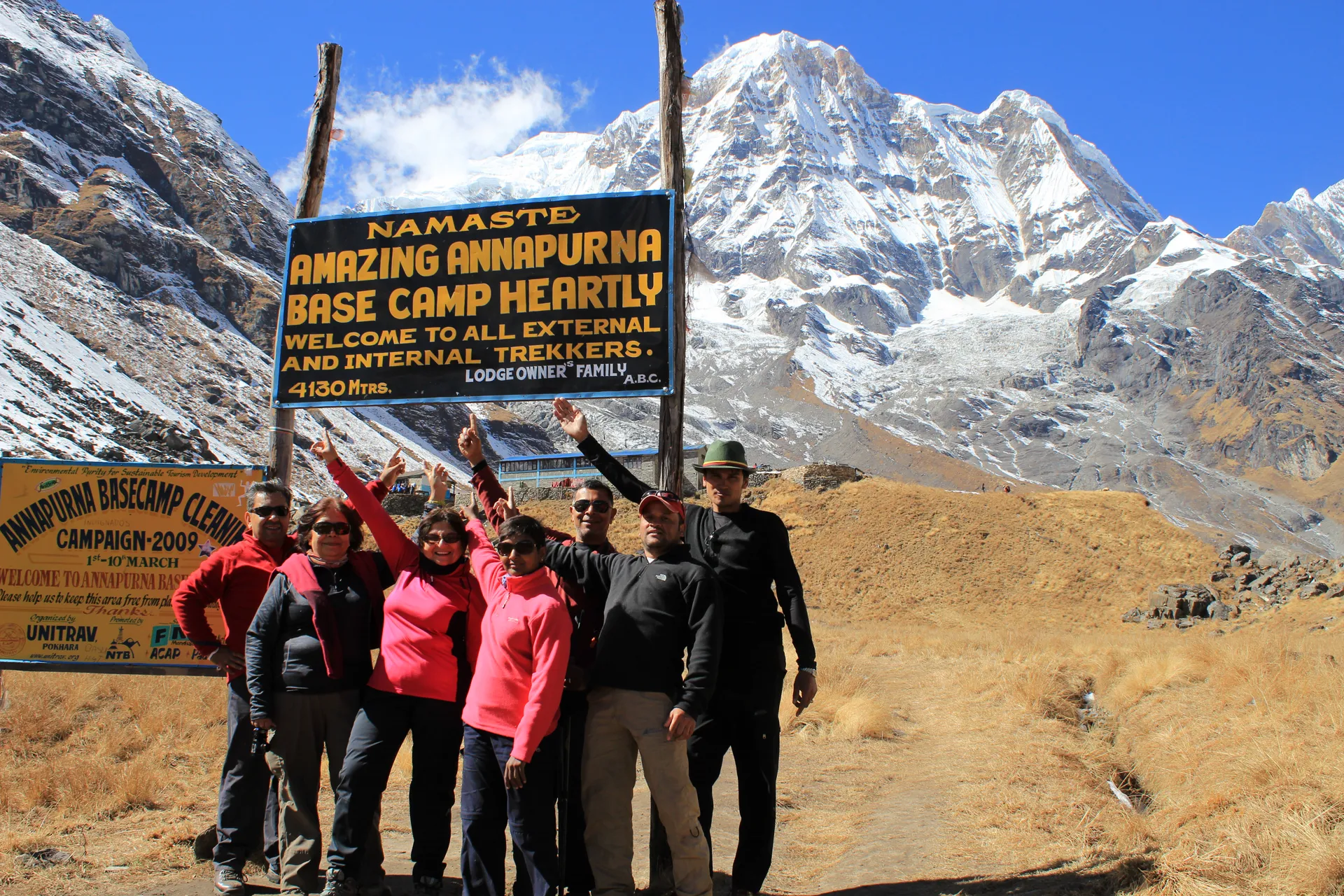
A single day. Six hours, and it is the biggest single climb of the entire trek: 1,330 vertical metres from Himalaya straight up to Annapurna Base Camp at 4,130m. It is the second straight day of climbing after day seven's 683 metre push out of Chhomrong, and it gains almost twice as much in one push. Legs that were already tired at breakfast are asked to do more than any other day on this trail.
Nothing about the walk itself prepares you for the moment the valley opens. You spend the whole morning inside forest and moraine with your head down, watching your feet on loose ground, and then the trail turns a corner and the sanctuary simply arrives. Annapurna I stands at 8,091m directly ahead, its south face rising more than four kilometres straight off the valley floor. Annapurna South and Hiunchuli close the view to the west. Machhapuchhre's fishtail summit sits behind you, close enough that you keep turning around to check it is still there. Gangapurna finishes the ring.
Every group I bring into that basin does the same thing without anyone suggesting it. They stop. Not for a photograph. Just stopping, because the mountains are doing something a camera does not actually capture.
You sleep at base camp itself that night, at 4,130m, and the reason becomes clear the next morning. First light does not arrive gradually here. It hits Annapurna South first, then sweeps across the whole wall of the sanctuary in a matter of minutes, peak by peak, until the entire ring is lit at once. I have seen that morning more times than I can count and it has never once looked the same twice.
This is the day the whole trip is built around, and it earns that in a way the photographs online do not quite prepare you for.
| Day | Stage | Altitude | On foot | Night |
|---|---|---|---|---|
| 8 | Trek to Annapurna Base Camp | 4,130 m | 6 hr | Teahouse |
Five Days Back to the Road
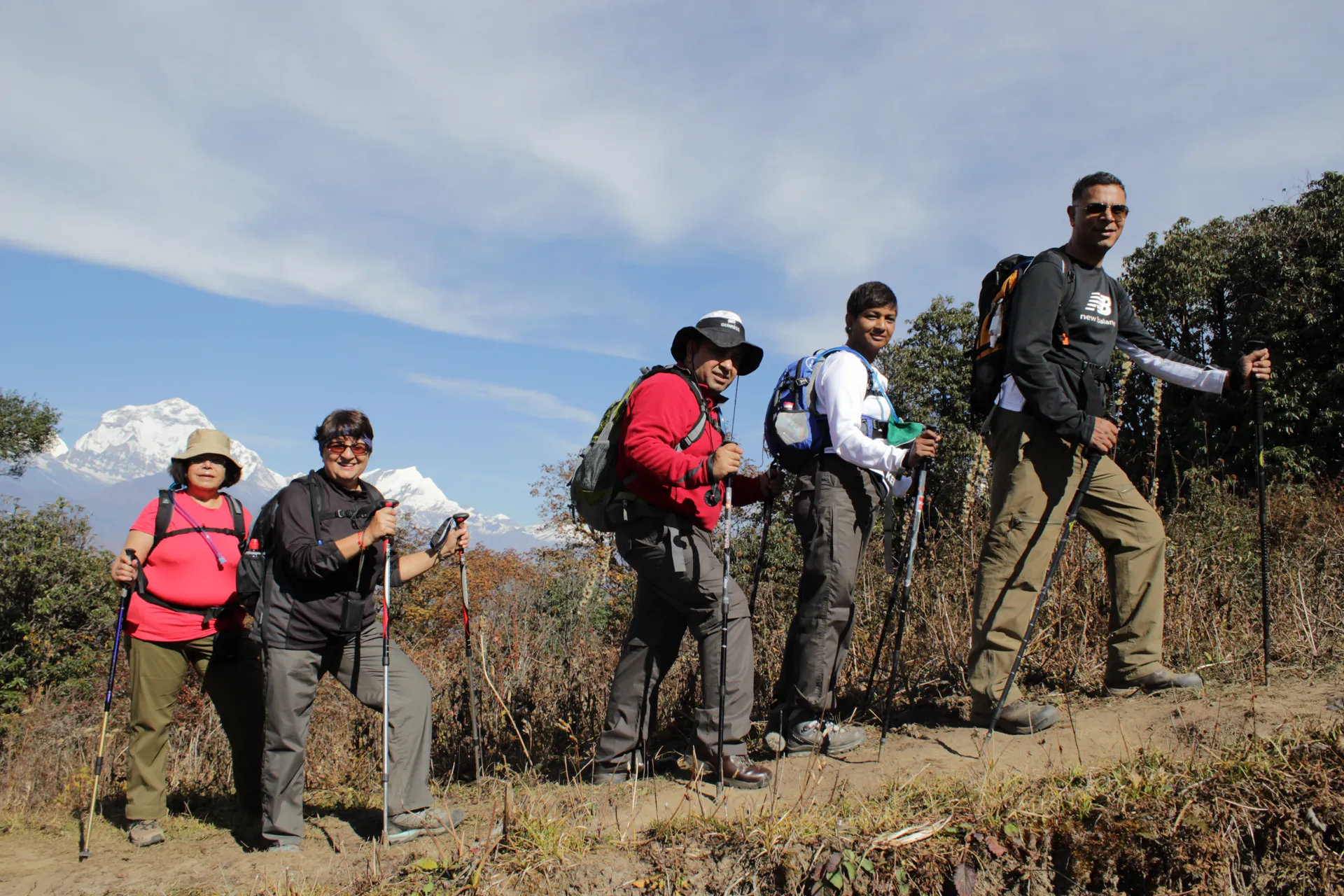
Day nine is the single biggest change of the entire trek in the other direction: a 1,730 metre drop from base camp down to Bamboo, all in one day. Legs that spent the last two days climbing spend this one doing the opposite kind of work, and by the afternoon most people in a group tell me their knees are more tired than anything else on the trek so far.
Day ten continues down to Jhinu Danda at 1,780m, and this is the day I look forward to as much as any other on the walk. There are natural hot springs on the bank of the Modi Khola, a short walk down from the teahouses, stone pools built right into the riverbank. Jhinu Danda is the one stop on this trek I never skip, whatever the weather or how far behind schedule we are running. After nine days of teahouse showers, sitting in water that is actually warm changes how the whole trek feels in your memory afterward.
Day eleven is different from every other day on this itinerary because it is both a trek and a drive in the same stretch: the walk out to Nayapul, then a vehicle to Pokhara and a hotel bed again for the first time since day two. Day twelve is the long drive back to Kathmandu. Day thirteen is departure, a transfer to the airport with no walking in it at all.
I tell people the last few days are not an afterthought, even though they get treated that way in most accounts of this trek. The trail gave you the mountain. These days give you back to your own life, gradually, in a jeep seat and then a plane seat, and that adjustment deserves its own attention rather than a footnote after the summit.
| Day | Stage | Altitude | On foot | Night |
|---|---|---|---|---|
| 9 | Trek Back to Bamboo | 2,400 m | 5 hr | Teahouse |
| 10 | Trek to Jhinu Danda | 1,780 m | 6 hr | Teahouse |
| 11 | Trek to Nayapul & Drive to Pokhara | 865 m | Hotel | |
| 12 | Drive Back to Kathmandu | 1,345 m | Hotel | |
| 13 | Departure | 1,345 m | Transfer |
People ask me which day was the hardest, expecting one answer. There isn't one. Day four's staircase, day seven's climb back to Himalaya, day eight's push to base camp, day nine's descent, each one hard in a different way and each one over almost as soon as it started. What stays with people afterward is not any single day. It's the shape of the whole thirteen, the up and down and up and down of it, which is a stranger and more honest map of what walking into the Annapurna Sanctuary actually feels like than a straight line ever could be.
I still guide this trek myself when I can, and I still notice something new on it every time, usually somewhere between Chhomrong and Himalaya, where the forest changes and nobody in the group is talking. If the shape of that walk sounds like the trek you want, we are always happy to talk about when.
Written by Prem Pandit, Founder