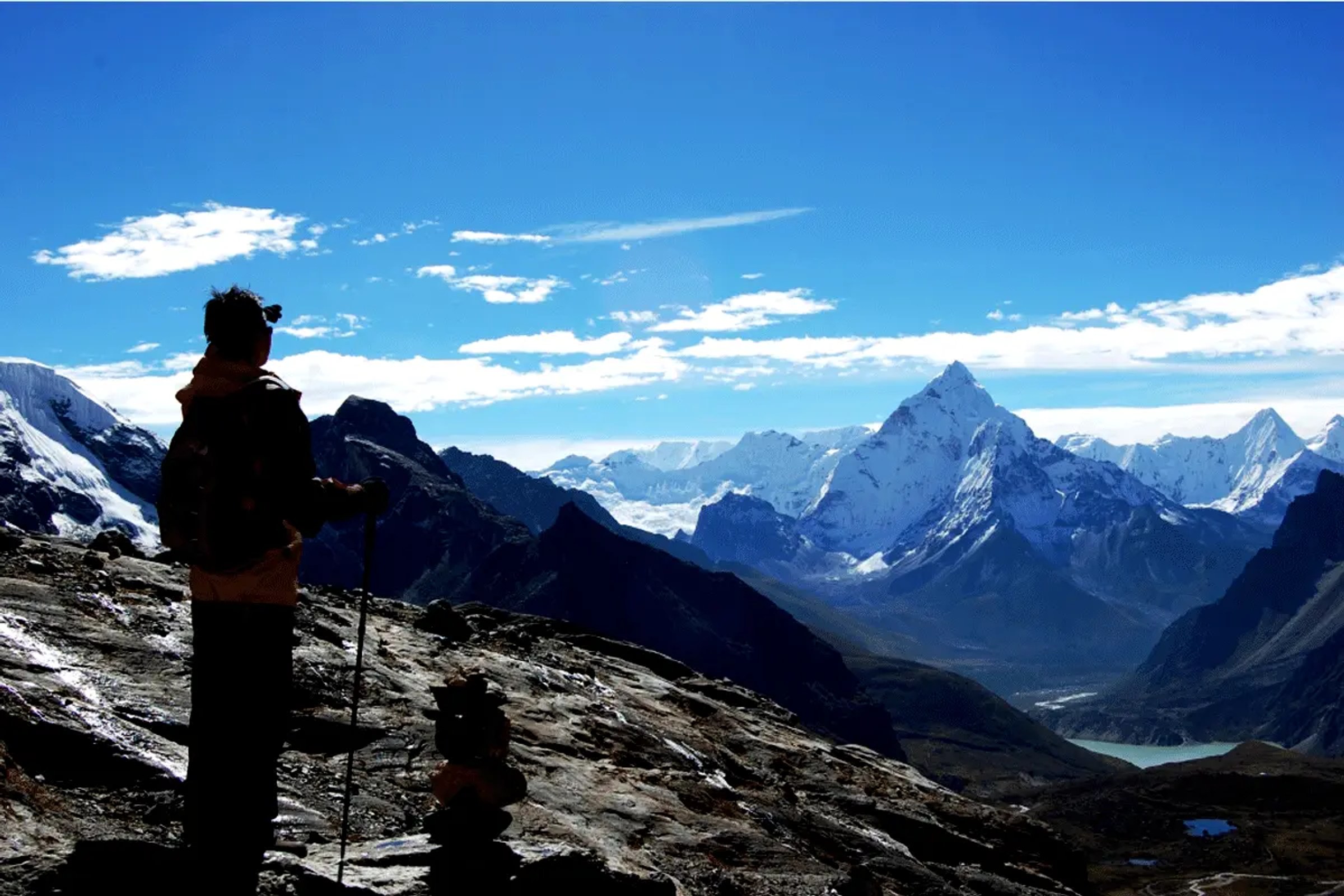

The Cho La is a notch between two rock walls, with Cho Oyu off to the northwest and Cholatse to the south. West of it is the Gokyo valley: quiet, with simpler lodges and long stretches where your phone finds no signal. East of it is the Khumbu valley and the main trail to Everest Base Camp, which in peak season carries hundreds of trekkers a day.
This trek walks up the first valley, crosses into the second and walks out down it. Ten days take you to the foot of the pass, one day takes you over it, five days of walking bring you out on the Everest side, and the last three are Kathmandu again.
Most of the ground on either side of the pass already has a page of its own on this site, and I will not walk you through it twice. The space here goes to the part no other page here covers: the short day to Thangnak, the crossing, and the morning after, when you wake up in a different valley.
Here are the numbers for the day that decides this trek. You leave Thangnak, at 4,700 metres, between half past four and half past five in the morning. You are at the top of the pass three to four hours later. The glacier takes 45 minutes to an hour. You walk into Dzongla, at 4,800 metres, about seven hours after you set out.
On paper that day gains 100 metres. It is a true figure and it tells you almost nothing.
Walking this one? See the Gokyo Cho La Pass Trek package, dates and group sizes.
Before the Gokyo Side
Day one is arrival in Kathmandu and a hotel. Day two is the pre-trip meeting with your guide and a preparation day, with some sightseeing around it.
Use part of day two to sort out microspikes for the glacier on day eleven. If you do not own a pair, you can buy one in Kathmandu or rent one in Namche. If you rent, check the fit against your own boots before you accept them.
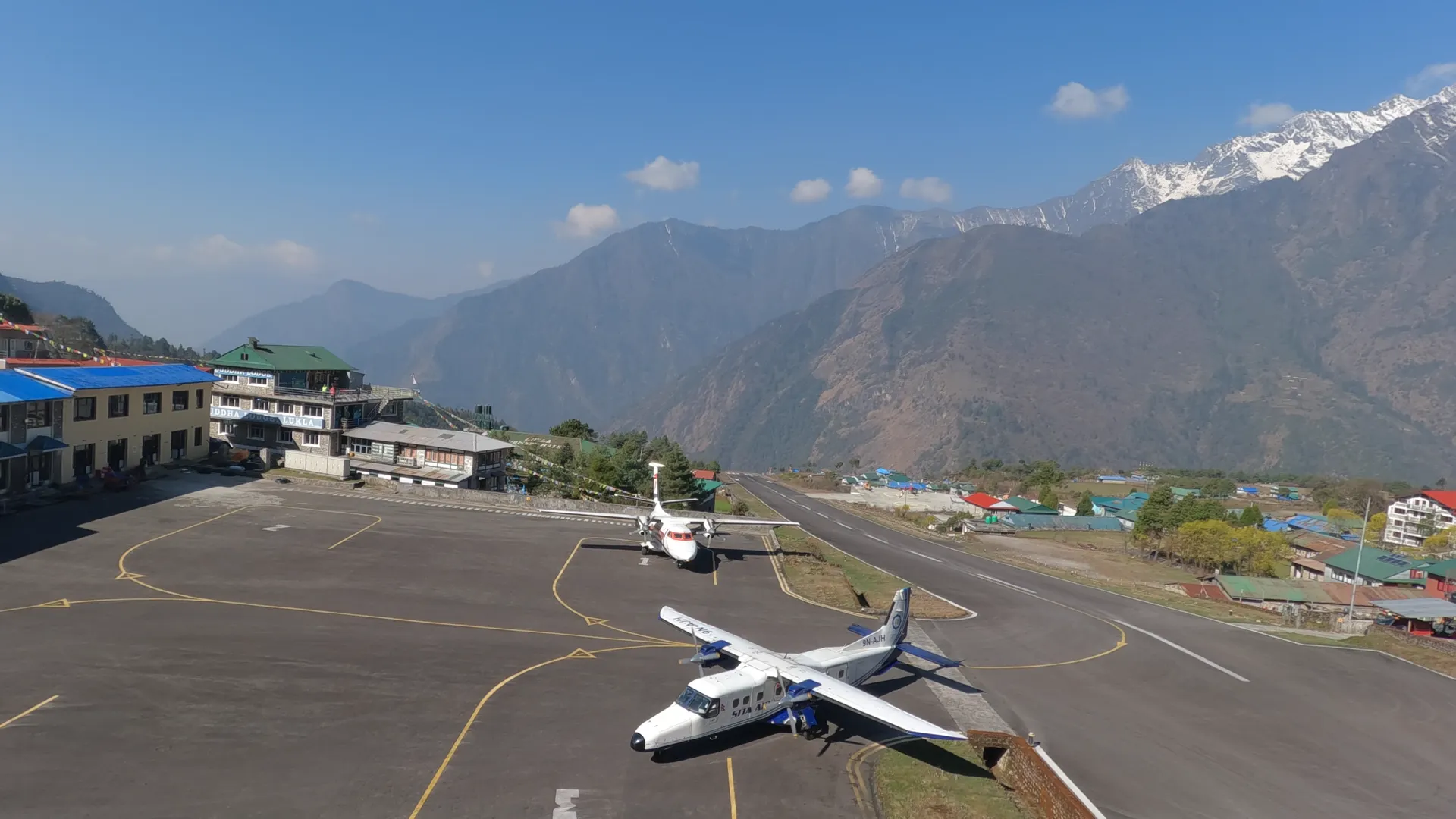
Day three is the flight to Lukla and about three hours on foot to Phakding, which sits lower than the airstrip you landed on. Day four is about seven hours up to Namche Bazaar at 3,480 metres, and day five is the acclimatization day there. None of this differs from the Base Camp trek. The pass is still six days away.
- Day01Arrival in Kathmandu
- Day02Pre-trip Meeting & Kathmandu Sightseeing
- Day03Fly to Lukla & Trek to Phakding+1,293 m
- Day04Trek to Namche Bazaar+870 m
- Day05Acclimatization Day in Namche Bazaar
Up the Gokyo Side
Above Namche the trail turns northwest up the Gokyo valley. Day six goes to Dole at 4,130 metres, the first of nine nights in a row above 4,000. Day seven is about five hours to Machhermo at 4,470. Day eight is about five hours more to Gokyo on the shore of the third lake, and day nine is the early climb up Gokyo Ri and back down to a second night in the same village.
I have told those four days properly in the Gokyo Valley itinerary, from the fork above Namche to the morning on the hill. On this trek they are the same days, walked with something else in mind.
That something is the pass. Gokyo Ri is steep, and it is still easier than the Cho La crossing, which makes it a good rehearsal. Notice how your legs handle loose rock in the cold before sunrise, because on day eleven you do it again for longer.
Two things change on this side of the Khumbu. The lodges are simpler than on the main Everest trail, and Gokyo itself has only six to eight teahouses. And from Machhermo upward, phone coverage is patchy at best and often absent, all the way over the pass. Tell the people at home before Machhermo that they may not hear from you for a few days.
- Day06Trek to Dole+650 m
- Day07Trek to Machhermo+340 m
- Day08Trek to Gokyo+300 m
- Day09Gokyo Ri & Return to Gokyo
Three Hours to Thangnak
Day ten is about three hours from Gokyo to Thangnak, at 4,700 metres. You sleep a little lower than you did at Gokyo.
Three hours is one of the shortest walks on the itinerary, and it falls the day after Gokyo Ri for a reason. The pass wants legs that have had an afternoon off.
Thangnak is a staging post, and the evening there has one job: finding out what the pass is doing. Guides hear current conditions by radio from the teahouses on both sides of the Cho La, and the evening before is when you check the weather and the state of the route.
Pack that night. The daypack for the crossing should weigh no more than eight to ten kilograms. Put fresh batteries in your headlamp, because you start in the dark. Put the microspikes where you can reach them without unpacking everything on a frozen slope.
Then sleep, if you can.
- Day10Trek to Thangnak−70 m
Over the Cho La
Groups leave Thangnak between half past four and half past five. In October the air at the pass around dawn sits between minus 10 and minus 15, and the wind can make it feel like minus 20, so the down jacket goes on before the first step and stays on.
The first part of the day is the climb, and it is steep and loose. It is moraine and boulders, where each foot placement shifts a little under you and the poles earn their place. Go slowly. Three to four hours after Thangnak you are at the top, in the gap between the rock walls, with the Gokyo side behind you and the Everest side ahead.
The glacier is short, 45 minutes to an hour of walking. On icy mornings it needs microspikes or light crampons, and your guide carries a rope as a backup. You do not need climbing skills here. What you need is careful feet on a hard, slick surface after three or four hours of climbing at height, and the patience to keep them careful.
Then you go down, and the descent toward Dzongla is a steep, rocky gully. Falls on this gully are one of the ways the Cho La hurts people. Go down it as slowly as you came up.
There is a second reason for the early start. Cloud builds over the pass most afternoons, and you want to be over the top and well down the far side before it arrives.
You walk into Dzongla, at 4,800 metres, about seven hours after leaving Thangnak.
Dzongla has three or four teahouses, and in October they can be full by early afternoon. Arrive by about two, or have your guide call ahead.
If I could keep only one day of this trek, I would keep this one. Gokyo Ri gives you a view. The Cho La moves you, on your own feet, from one valley into the next.
- Day11Cross Cho La Pass to Dzongla+100 m
The Busy Side of the Wall
Day twelve is about three hours from Dzongla to Lobuche at 4,930 metres, the shortest walk of the second half. After the crossing it should be. At Lobuche you are on the main Everest trail, and the change is immediate. For six days you walked the side of the Khumbu that sees a fraction of the traffic. This side sees hundreds of trekkers a day in peak season, and Lobuche is one of its two smallest overnight stops, with beds that fill every night in the middle of April and October.
Day thirteen is about eight hours from Lobuche out to Everest Base Camp and back to sleep at Gorak Shep. Day fourteen is the pre-dawn climb up Kala Patthar and then the long walk down to Pheriche, about seven hours. Both days are told in full in the Everest Base Camp itinerary, and walking them from Dzongla does not change them much. The difference is in your legs, which by the morning of day thirteen have already done Gokyo Ri and the Cho La.
Then come two long days down, about seven hours each, to Namche on day fifteen and Lukla on day sixteen. Use your poles on every descent. After nine nights above 4,000 metres, the long downhill stretches are where knees get hurt.
- Day12Trek to Lobuche+130 m
- Day13Trek to Everest Base Camp & Gorak Shep+250 m
- Day14Kala Patthar & Trek to Pheriche−980 m
- Day15Trek to Namche Bazaar−720 m
- Day16Trek to Lukla−685 m
Back to Kathmandu
Day seventeen is the morning flight from Lukla to Kathmandu and a hotel. Day eighteen is a leisure day. Lukla flights are cancelled often enough that a free day between the mountains and your flight home is worth keeping, and if your flight leaves Lukla on time, the day is simply yours in the city. Day nineteen is the transfer to the international airport.
- Day17Flight from Lukla to Kathmandu−1,450 m
- Day18Leisure Day in Kathmandu
- Day19Departure
The Gokyo Valley trek goes up one valley and comes back down the same one. This trek goes up the Gokyo valley, crosses a single wall of rock and comes down the Khumbu, so above Namche the valley you walk out through is not the one you walked in by.
On the day table the crossing is a single row: day eleven, between two three-hour days, ending at Dzongla, 100 metres above where you woke. On the trail it is a start in the dark below a slope of loose rock, an hour at most on hard ice with spikes on your boots, and a long gully down to Dzongla, three or four teahouses on the far side of the wall you have just come over.
Written by Prem Pandit, Founder