
- The cold, bed by bed
- Two long days on a daypack
- What you cannot replace after Sekathum
- Charging and signal
- Cash
- Water
- First aid, altitude kit and papers
- What the porters carry
- What to rent or buy
- Frequently Asked Questions
- What sleeping bag do I need at Lhonak?
- Is there an ATM on the trek?
- Can I charge my phone along the way?
- How heavy should my duffel be?
- Do I need microspikes?
Nothing on a packing list for Kanchenjunga is exotic. The layers, the boots and the sleeping bag are the ones you would take anywhere in Nepal. What changes is the supply line. Past Sekathum, where the road ends, nothing you forget can be replaced on the trail, and the beds at Lhonak are colder than most trekkers expect.
Our 21-day Kanchenjunga Base Camp trek is a restricted-area route with a licensed guide, and we lend a down jacket, a four-season sleeping bag and a duffel. For the general kit, layer by layer, use our Everest Base Camp packing list and our Nepal trek packing list. Boots, base layers, toiletries and rental prices are covered there, so I leave them out.
The cold, bed by bed
The tour page gives one altitude. The nights give three. The table shows typical night temperatures from our season calendar for the places that matter: Ghunsa at 3,415m (nights 7, 8 and 12), Lhonak at 4,792m (nights 10 and 11, the highest bed) and Pangpema at 5,143m, which you visit by day and never sleep at. These are derived still-air ranges, worked out from our Everest data by height, and they are not records. Wind makes every one of them feel lower.
| Month | Ghunsa night (°C) | Lhonak night (°C) | Pangpema night (°C) |
|---|---|---|---|
| January | minus 9 to minus 4 | minus 18 to minus 13 | minus 20 to minus 15 |
| February | minus 8 to minus 3 | minus 16 to minus 11 | minus 18 to minus 13 |
| March | minus 4 to 0 | minus 13 to minus 8 | minus 15 to minus 10 |
| April | minus 1 to 3 | minus 10 to minus 5 | minus 12 to minus 7 |
| May | 2 to 6 | minus 7 to minus 2 | minus 9 to minus 4 |
| June | 6 to 9 | minus 2 to 2 | minus 4 to 0 |
| July | 8 to 10 | 0 to 4 | minus 2 to 2 |
| August | 7 to 10 | 0 to 3 | minus 2 to 1 |
| September | 5 to 8 | minus 4 to 0 | minus 6 to minus 2 |
| October | minus 1 to 3 | minus 10 to minus 5 | minus 12 to minus 7 |
| November | minus 5 to minus 1 | minus 15 to minus 10 | minus 17 to minus 12 |
| December | minus 8 to minus 3 | minus 17 to minus 12 | minus 19 to minus 14 |
Read the October row against the afternoon highs. Ghunsa reaches 10 to 14°C by day, and two nights later Lhonak sits at minus 10 to minus 5°C. That is a swing of 20 degrees or more, and it is why several thin layers beat one heavy jacket here. November is colder again. January is the floor. In July the same bed is mild and the trouble is rain.
Use the rest day at Ghunsa to test the layers you will sleep in. The next two nights go higher than anything behind you, and a wrong layer is easier to fix at 3,415m than at 4,792m.
We lend the sleeping bag and the down jacket, and they go back after the trek. I give no rating here. If you run cold, ask us for the rating before you fly, and bring a thin liner for the two Lhonak nights. The full table with day highs is in our month-by-month calendar, and the October and November pages carry the kit for those months.
Two long days on a daypack
Neither base camp is a place you sleep. Day 11 walks from Lhonak to Pangpema and back in about 7 hours, a climb of 351m, and you return to the same bed. Day 15 walks from Tseram through Ramche to Oktang and back in about 8 hours. The climb from the bed is 870m. No day has a bed at the top, so the duffel stays where it is and the daypack carries everything the day asks for.
Wind decides more than the thermometer on day 11. Put the gloves on before you leave the teahouse. Windproof pants and a warm layer for the stop at the top go in the daypack. Sunglasses with a spare pair belong in the daypack too, because the glare off snow does not wait for a convenient moment.
Our equipment list asks for several pairs of thermal underwear because you sweat a lot even when the weather is cold. On a 7-hour day that means the layer against your skin is damp when you stop, and the stop is where the cold finds you. I would carry a dry top in the daypack for exactly that moment.
Oktang needs a word. It is a day trip from Tseram at 3,870m, a bed 922m below Lhonak. Our calendar carries no temperature for Tseram or Oktang, so none appears here. The day table does say that you start lower and climb further, which makes Oktang the harder day on the legs. Our north versus south base camp comparison sets the two days side by side.
Day 14 crosses three passes in about 7 hours, from Sele Le Base Camp to Tseram. Fresh snow on any of them slows the day, and the guide makes the call on the morning. Whether you need microspikes depends on your dates, so ask the guide in Kathmandu. Our difficulty guide takes the pass day apart hour by hour.
What you cannot replace after Sekathum
The drive on day 4 ends at Sekathum, 1,575m, which is 245m lower than Taplejung where you slept. Khebang, where the trek ends on day 18, is 1,915m, only 340m higher. Everything between those two beds is walked, and our tour notes say it straight: infrastructure above 3,000m is limited, and facilities get simpler above Tseram.
So carry spares of the small things. A second charging cable weighs nothing. Mark Horrell, writing about his April 2018 trek, reported that an iPhone cable was not easily obtainable at Lhonak. Spare batteries for the torch, a blister kit, a sewing kit and a small padlock for a room door complete the short list. Label your prescription medicines. I would rather carry two spare cables than ask a stranger for one at 4,792m.
Board is in our price, but the walking days run 5 to 8 hours, and days 17 and 18 are 7 hours each. Buy snacks in Kathmandu and carry more than you think you need. The equipment list we ask every trekker to follow, boots to beanie, is in our complete Kanchenjunga guide.
Charging and signal
Plan to carry your own power. Village electricity comes from small hydro or solar, and where it exists it can cost something. Best Heritage Tour, in December 2025, put a charge at Ghunsa at USD 2 to 5 a device. An account of a May 2016 trek found no charging offered at Lhonak, Khambachen or Sele Le, and the author charged devices with a solar panel on a sunny day. Conditions change, which is the reason to rely on none of it.
Operator packing pages name power banks of 15,000 to 20,000 mAh and a small solar panel. Cold drains batteries fast, so sleep with the phone and the spare battery inside your bag. Download offline maps before day 4, and save your insurer's emergency number on paper as well as on the phone. Do not count on mobile data above the roadhead. If you need to reach home, tell the family before day 4 that replies may be slow.
Cash
Withdraw your rupees in Kathmandu. Mount Mania Treks, in May 2026, lists Kanchenjunga among the regions with essentially no ATM access. By the same page's figures, a Nepali bank charges NPR 500 to 800 a withdrawal, and a machine pays out NPR 10,000 to 35,000 a time, so a single trip to a high-limit machine saves fees. Nepal Trekking Experts advises carrying rupees in small notes.
Beds and meals are in our price. Cash pays for charging, hot showers, snacks, drinks, tips and the Kathmandu lunches and dinners we exclude. Breeze Adventure puts a hot shower at USD 3 to 6 at higher elevations. Our cost breakdown prices tips and insurance and builds a full budget, so I will not add up the sums twice.
Water
Teahouses boil water. Do not drink tap water. Carry bottle room for 2 to 3 litres and a back-up method, either tablets, which Nepal Trekking Experts says need 30 minutes to an hour, or a filter.
The back-up matters most at the high beds. In April 2018 the staff at Tseram could not give Horrell boiled water at breakfast, and he set off without it. Ask your guide the evening before to have boiled water ready for the morning.
First aid, altitude kit and papers
Our price includes a general first aid kit carried with the staff. Your own kit covers the things that go wrong slowly: blister care, oral rehydration salts, anti-diarrhoea medicine, pain relief, antiseptic with tape, and any prescription with a copy of the prescription. Remote means help is slow. Helicopter evacuation takes longer here than in the Khumbu or Annapurna regions, and your guide is the first line.
Ask your doctor about acetazolamide before you leave. I give no dose here. How altitude sickness develops and what the early signs look like is in our guide to altitude sickness on the Everest trek, and it applies on this side of Nepal as well.
Travel insurance is compulsory and not in the price. Read the policy for helicopter evacuation first. Carry paper copies of the passport, the visa and the policy, and a few spare passport photos. The paperwork list and the fees are in our Kanchenjunga permit guide.
What the porters carry
We lend a duffel, and the porters carry it between beds. Pack it to the limit your guide gives you in Kathmandu. Our rule of thumb is 10 to 12kg per trekker, the figure on our Nepal packing list. The duffel meets you at the bed. It does not climb to Pangpema or Oktang, so anything you want during the day goes in the daypack.
Day 3 is 249km by road, 8 to 9 hours, after the flight east. We confirm the baggage allowance for that flight at the pre-trip meeting on day 2, so you do not need to guess it from home.
What to rent or buy
We lend the jacket, the bag and the duffel. Everything else is yours. Our Nepal packing list says boots, base layers and wool socks are the things worth buying at home, and that Thamel in Kathmandu rents most of the rest by the day. Break the boots in before you fly, on long walks with the pack you will carry. Thirteen walking days is a long time to learn what a stiff heel does.
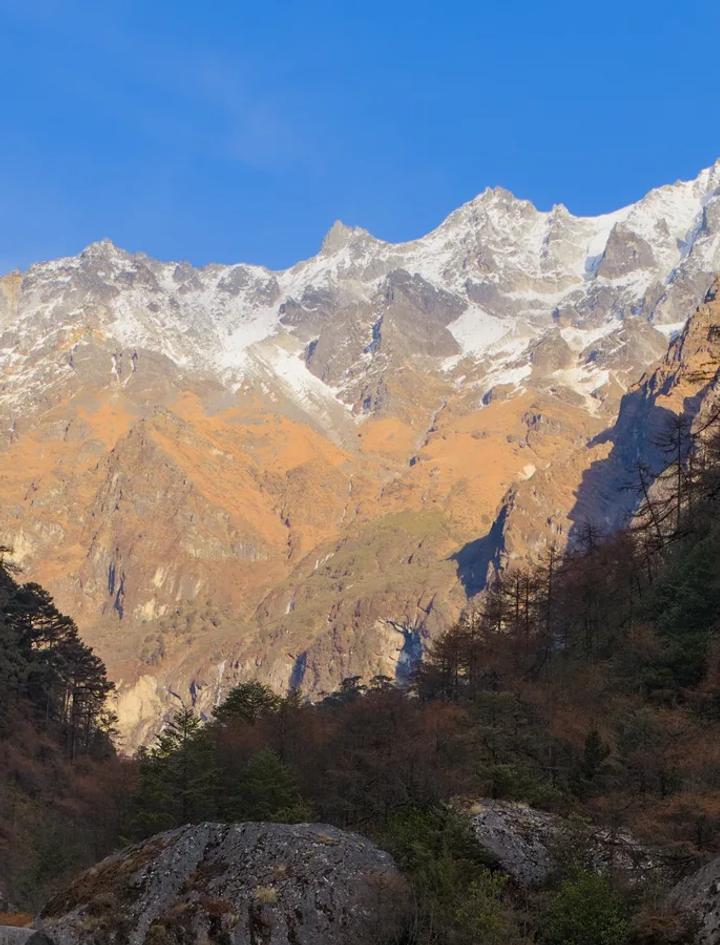
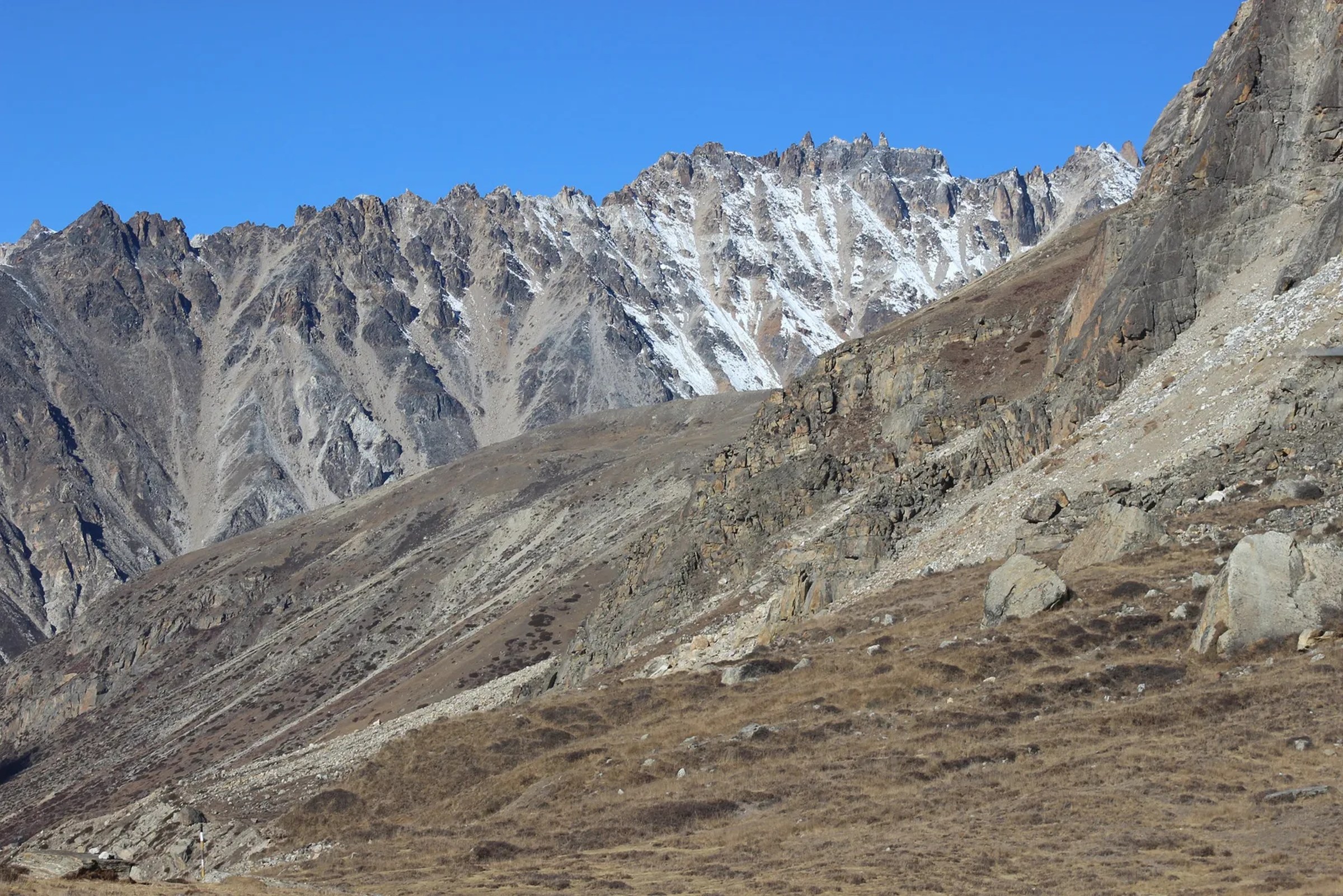
Cover photograph: the upper Ghunsa Khola valley between Khambachen and Lhonak in October, by King james007 on Wikimedia Commons, licensed CC BY-SA 4.0.
Frequently Asked Questions
What sleeping bag do I need at Lhonak?
One that handles the night. Our calendar puts October nights there at minus 10 to minus 5°C and November nights at minus 15 to minus 10°C, as derived still-air ranges. We lend a four-season bag. Ask us for its rating if you sleep cold.
Is there an ATM on the trek?
No source we checked places one. Withdraw in Kathmandu, and expect a fee of NPR 500 to 800 per withdrawal at a Nepali bank.
Can I charge my phone along the way?
Sometimes, and often for a fee. Do not plan around it. A power bank, a spare cable and a small solar panel give you your own supply.
How heavy should my duffel be?
Aim for 10 to 12kg, and follow the figure your guide gives you in Kathmandu.
Do I need microspikes?
It depends on your dates. Snow on the passes of day 14 is the question, and your guide decides on the morning. Ask in Kathmandu before you buy anything.