- The cost at a glance
- What the USD 2,575 covers
- What it leaves out, with figures
- What the extras add up to
- Why the same trek is priced from USD 1,345 to USD 3,500
- Group size, solo and private
- How the cost compares
- Choosing a date and a quote
- Frequently Asked Questions
- How much does the Kanchenjunga trek cost with Mountain Hawk Trek?
- What is not included in the price?
- Are the permits included in the price?
- How much extra should I carry?
- Is the Kanchenjunga trek more expensive than Everest Base Camp?
Our 21 day Kanchenjunga Base Camp trek costs USD 2,575 per person. Search for the price and you will meet the same trek at USD 1,345 on one page and USD 3,500 on another, and neither number is a mistake. They price different things.
Most of the gap is days and what sits inside the number. A price that leaves out the porter, the flight or the long road to Taplejung looks light on the page and gets heavier at every step after it. The route, the two base camps and the mountain are in our Kanchenjunga Base Camp trek complete guide. What follows is arithmetic.
The cost at a glance
Every line of our price, in or out.
| Line | Included? |
|---|---|
| Flight from Kathmandu east and back | Yes |
| Every road transfer from Kathmandu, including Taplejung and Sekathum | Yes |
| Both permits the trek needs | Yes |
| Licensed guide, porters, and their food, lodging, pay and insurance | Yes |
| Teahouse beds and meals on the trek | Yes |
| Three Kathmandu nights, twin sharing, breakfast, airport transfers, city tour | Yes |
| Down jacket, sleeping bag and duffel (returned after the trek) | Yes |
| Government taxes and the tourist service charge | Yes |
| Travel insurance (compulsory) | No |
| Nepal visa | No |
| International flights and airport departure tax | No |
| Kathmandu lunches and dinners | No |
| Tips for trekking staff and driver | No |
| Drinks, laundry and other personal items | No |
| Sightseeing and monument entrance fees | No |
| Personal trekking equipment | No |
Spread over 21 days, the package works out at about USD 123 a day. That is our own arithmetic, and the day count matters again further down.
What the USD 2,575 covers
Two days of the schedule are roads. After the flight east, day 3 is 249km and 8 to 9 hours by road to Taplejung at 1,820m. Day 4 is 39km and 5 to 6 hours to Sekathum at 1,575m, which is 245m lower than the bed you left. A trek that starts with two days in a vehicle has a transport bill, and ours is inside the price: the flight and every surface transfer from Kathmandu. The full day table is on the Kanchenjunga Signature Itinerary page.
The trek runs on a government-licensed English-speaking guide and as many porters as the group needs. Their food, lodging, salary, insurance and equipment are ours to pay, and they never appear on your bill. Groups are capped at 8. Beds are in teahouses and meals are standard teahouse meals, and the tour notes call the board full.
It helps to see what that board replaces. Nepal Trekking Experts puts food and a teahouse bed at USD 20 to 35 a day, which over the 14 trail days from day 5 to day 18 is USD 280 to 490 that our price already holds. The same page prices a Kathmandu hotel at USD 20 to 50 a night, and three of those nights are in ours.
We lend the cold-weather kit too. The down jacket, the sleeping bag and the duffel come back with you at the end. Our equipment list still asks you to bring several pairs of light cotton socks to wear under the wool ones, on the logic that carrying extra weight beats washing socks all trek.
The Kanchenjunga Conservation Area Permit and the restricted area permit are both included in our price. The fee schedule and how the permits are issued are in our restricted area permit guide.
What it leaves out, with figures
Every figure in this section comes from a page I read in full, and each is attributed. None of them is our price.
Travel insurance is compulsory on our trek and it is not in the price. Nepal Trekking Routes puts a policy with high-altitude and helicopter evacuation cover at USD 100 to 250, and Nepal Trekking Experts gives a range from USD 50 to USD 300. Neither page prices a rescue on this route. Help is far away here, which our difficulty guide walks through day by day, and the evacuation clause is the line of the policy to read first.
Tips for the guide, porters and driver are separate. Breeze Adventure says USD 120 to 180 per trekker and says tips are strongly expected.
Extras on the trail are small and constant. Breeze Adventure puts charging at USD 2 to 5 a device and a hot shower at USD 3 to 6 at higher elevations. Nepal Trekking Routes lists a shower at NPR 300 to 700 and Wi-Fi at NPR 300 to 800, and says supplies cost more in the upper villages of Ghunsa, Khambachen and Lhonak. LangtangTreks reports no cash machines beyond Taplejung, so rupees for the trail go in your pocket before the road ends.
Kathmandu has its own lines. Lunch and dinner there are yours. An extra night is USD 70 per person in a single room or USD 40 per person in a double, breakfast included. Sightseeing and monument fees are separate.
On gear, Nepal Trekking Experts prices renting or buying boots, a jacket, a sleeping bag and poles at USD 100 to 300. That range includes a jacket and a bag, which we lend, so for you it is the boots and poles that count.
The Nepal visa and your international flights are not in our price either. I have no sourced figure for 2026 for either one, so I leave both out of every sum below.
What the extras add up to
Three of those lines have a range from a page I read in full: tips at USD 120 to 180 (Breeze Adventure), insurance at USD 100 to 250 (Nepal Trekking Routes), and personal spending of USD 10 to 25 a day (Nepal Trekking Routes). The trail days run from day 5 to day 18, which is 14 days with the rest day at Ghunsa, so spending comes to USD 140 to 350.
Add the three: USD 360 to 780. On top of USD 2,575 that puts the trek at about USD 2,900 to 3,400.
That total leaves out the visa, the international flight and Kathmandu lunches and dinners. The visa and the flight depend on where you live, and I have no source for Kathmandu meals, so the sum is a floor for the trip and a fair estimate for the trek.
Why the same trek is priced from USD 1,345 to USD 3,500
Every price below is one operator's published figure, read on its own page, and none is ours. Five things move them.
The first is days. Breeze Adventure sells a 16 day short circuit at USD 2,200 to 2,400 and a 20 day classic circuit at USD 2,600 to 3,000. It puts a trek to one base camp only, 12 to 14 days, at USD 1,900 to 2,200. Ours is 21 days and reaches both. If you are weighing one camp against two, our north versus south base camp guide compares them.
The second is the flight and the road. Nepal Trekking Experts lists the Kathmandu to Bhadrapur flight at about USD 140 one way, and Nepal Trekking Routes at USD 140 to 150. A third page projects USD 160 to 240 a sector. A return trip is double any of those, so the flight alone is at least USD 280 to 300. Then the jeep to Taplejung: Nepal Trekking Experts quotes USD 250 to 300 private or USD 18 a seat shared, and Nepal Trekking Routes quotes USD 300 to 500 a vehicle. A package that does not include these starts several hundred dollars lighter.
The third is the porter. On those same pages a guide runs USD 30 to 40 a day and a porter USD 20 to 30, so the pair costs USD 50 to 70 a day. The USD 1,345 to 1,575 package at Nepal Trekking Experts lists the porter as an exclusion, provided on request.
The fourth is group size. That same operator publishes a price ladder by group:
| Group size | Price per person |
|---|---|
| 2 to 3 | USD 1,575 |
| 4 to 6 | USD 1,475 |
| 7 to 10 | USD 1,425 |
| 11 to 15 | USD 1,375 |
| 16 to 20 | USD 1,345 |
The trek is identical down the whole table, and the price moves USD 230. Our group cap is 8.
The fifth is support level. Nepal Trekking Routes sorts the market into a basic supported trek at USD 1,700 to 2,600, a better supported small group at USD 2,700 to 3,500, and a private trek from USD 2,800. MountainMart lists a 19 day package at USD 1,800 to 2,800 with flights and transport inside the figure.
I find the bottom of that range the hardest to read. A real price with the porter left out is a trek you will pay for twice. The number worth comparing is the one with the flight, the road, the porter and the permits inside it. Ask each operator how many days the price covers, then ask what is inside it, in that order.
Group size, solo and private
Since 22 March 2026 individual foreigners can apply for restricted-area permits, and we confirm the current position for Kanchenjunga at booking, for the reason the permit guide above sets out. The guide rule did not change, and a licensed guide is mandatory in the restricted area. A cheaper solo trek is not on offer anywhere, because one person then carries the guide and the transport that a group of up to 8 would share.
Three of the pages I read, from Breeze Adventure, Nepal Trekking Experts and Himalayan Recreation, still say solo is prohibited or that two trekkers are the minimum. Whatever the permit position, the price logic they describe, with a shared departure costing less per person, still holds.
How the cost compares
Two other guided treks of ours sit at the same price on the live site. Our 15 day Manaslu Circuit trek is from USD 1,675, and so is our 15 day Everest Base Camp trek. Per day that is about USD 112, against about USD 123 for Kanchenjunga, which is about USD 11 a day more.
The total is USD 900 higher for six more days. Those days are paid days like any other: a rest day at Ghunsa still has a guide, porters and a bed, and the two road days at the start are a vehicle and a driver. For what a restricted-area trek costs beyond the package, our Manaslu Circuit cost breakdown puts figures on the same kinds of lines. For the Everest side, see what the Everest Base Camp trek costs.
Choosing a date and a quote
October to November brings the clearest views and April to May brings the rhododendron blooms, per our tour notes. Our month-by-month calendar goes through every month from the cold at Lhonak to the snow on the passes.
If you hold a quote from another operator, put it beside ours and count the same things: days, flight, road, porter, permits. A quote that matches ours on all five and still comes in USD 500 lower has found its saving somewhere, and the line to look at first is the porter. Our Makalu and Kanchenjunga region page lists what else we run in the east.
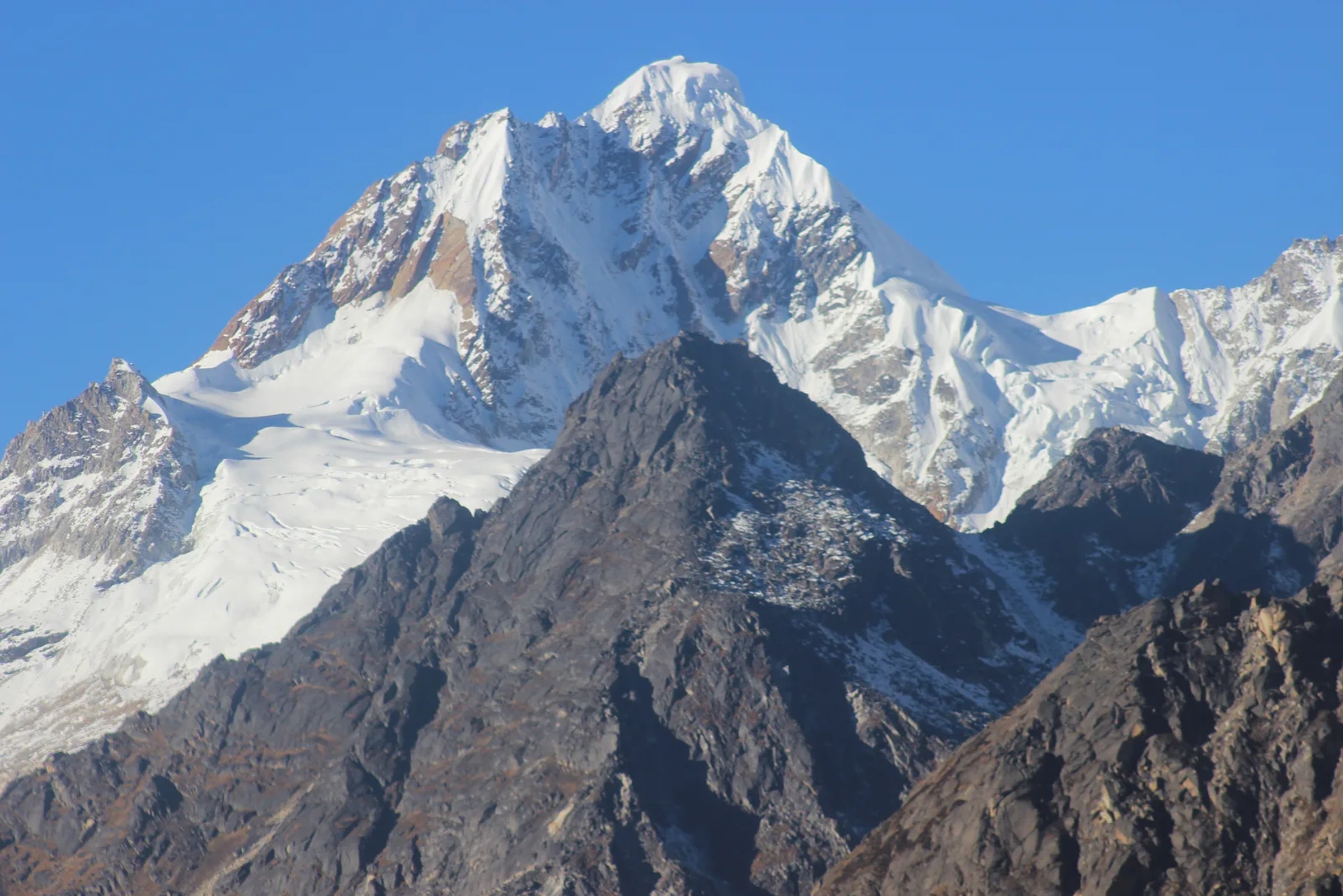
Cover photograph: a peak above the upper Ghunsa valley, by King james007 on Wikimedia Commons, licensed CC BY-SA 4.0.
Frequently Asked Questions
How much does the Kanchenjunga trek cost with Mountain Hawk Trek?
USD 2,575 per person for 21 days from Kathmandu back to Kathmandu. It includes the flight east and back, all road transfers, both permits, a licensed guide, porters, teahouse beds and meals, and three Kathmandu nights.
What is not included in the price?
Travel insurance, the Nepal visa, international flights, Kathmandu lunches and dinners, tips, drinks, laundry, sightseeing fees and personal equipment. An extra Kathmandu night is USD 70 per person single or USD 40 double.
Are the permits included in the price?
Yes. The Kanchenjunga Conservation Area Permit and the restricted area permit are both in the USD 2,575, and we apply for them.
How much extra should I carry?
From pages we read, tips run USD 120 to 180, insurance USD 100 to 250 and personal spending USD 10 to 25 a day. Over the 14 trail days that is about USD 360 to 780, before the visa and the international flight.
Is the Kanchenjunga trek more expensive than Everest Base Camp?
Per day, yes, by about USD 11. Our 15 day Everest Base Camp trek is from USD 1,675, about USD 112 a day, and the 21 day Kanchenjunga trek is USD 2,575, about USD 123.