
- What Lobuche East is
- The route: base camp to high camp
- Summit day: rock, headwall, false summit, notch
- How hard Lobuche East is, and who it suits
- Acclimatization: the rest days are the plan
- Lobuche East or Island Peak
- Permits and fees
- Gear
- Best season
- What it costs, and how it pairs with the Everest Base Camp trek
- Frequently Asked Questions
- Do you need a guide to climb Lobuche East?
- Is Lobuche East harder than the Everest Base Camp trek?
- How early does summit day start?
- What happens if the weather turns on summit day?
- What does the NMA permit cost in autumn?
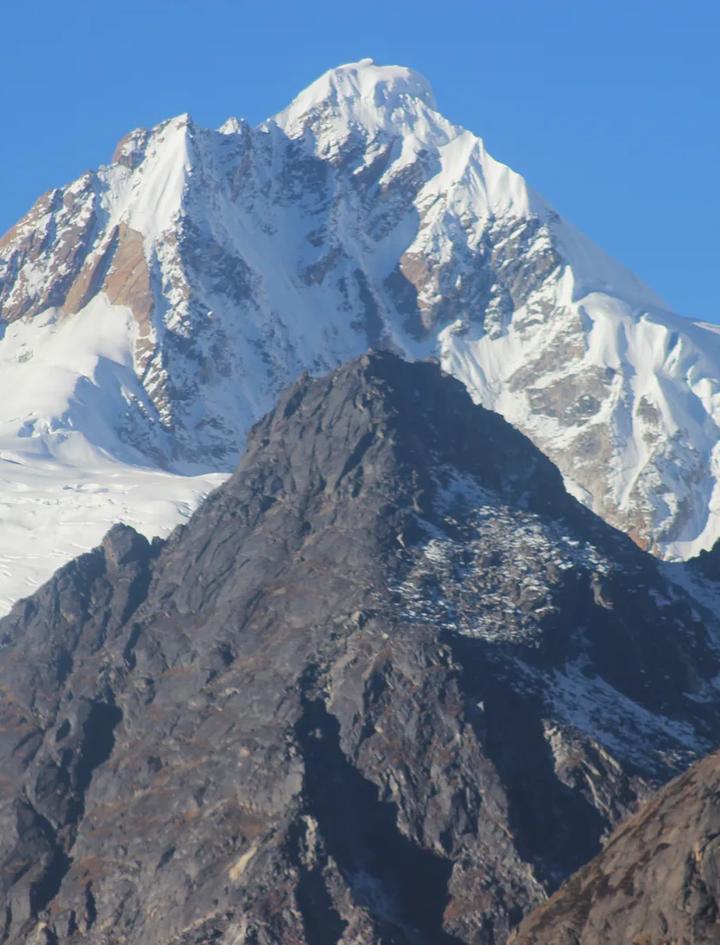
Lobuche East is 6,119m high, sits beside the Everest Base Camp trail, and has two summits that most guides talk about as one. This Lobuche East climbing guide explains the difference, because it decides how your summit day goes.
The first summit is a false one. You reach it by a fixed-rope snow headwall and a ridge, and many guided groups turn round there. The true summit lies beyond a notch, along a narrower and more exposed ridge. Which one you stand on depends on the weather, your legs and your guide on the morning.
We run this climb as an 18-day Lobuche East trip from Kathmandu, and what follows is how it works on the mountain: the route, the summit day, the grade, the permits, the kit and the season.
What Lobuche East is
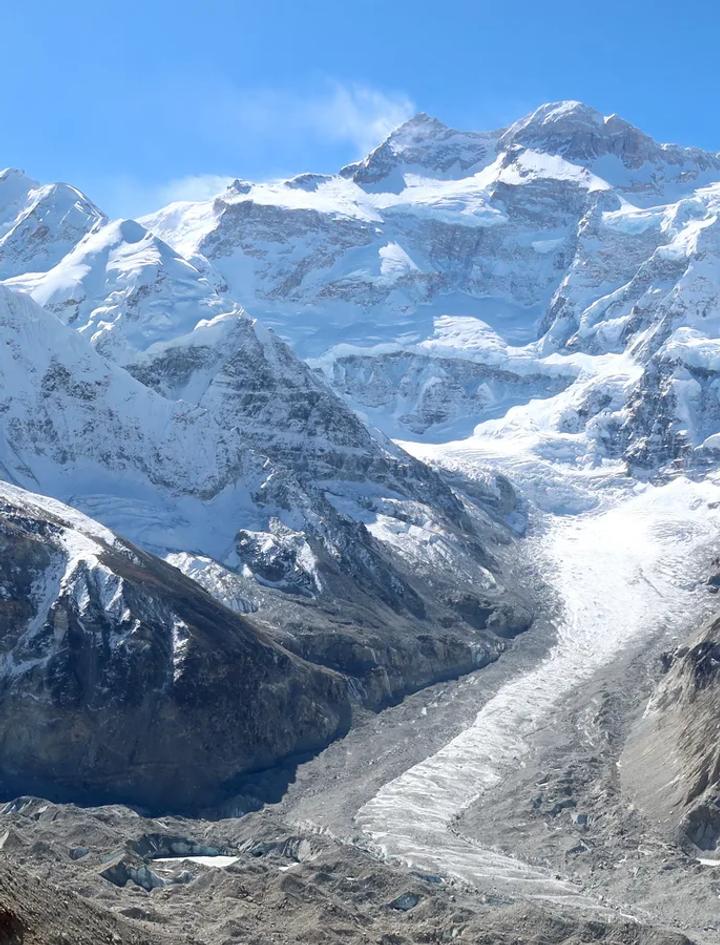
Lobuche East is a trekking peak in the Khumbu, a short walk above Lobuche village (4,940m) and the Khumbu Glacier. The Nepal Mountaineering Association lists it as "Lobuje East", 6119m, one of the 27 peaks on its fee schedule. The first recorded ascent was on 25 April 1984, by Laurence Nielson and the Sherpa Ang Gyalzen.
There is a Lobuche West too, a little higher at about 6,145m. The two summits are joined by a long ridge cut with deep notches, and crossing from one to the other is practically impossible. The West peak is classed as an expedition mountain. Everything in this guide is about the East peak, which is the one that commercial groups climb.
The peak belongs to the family of Nepal's peak climbing options, the trekking peaks that a fit walker with some mountaineering skill can attempt with a guide.
The route: base camp to high camp
You reach Lobuche East the way you reach Everest Base Camp, as far as Dingboche. Our day table flies to Lukla, walks to Namche Bazaar for a rest day, goes on to Tengboche and Dingboche, and gives Dingboche a second rest day. The trail itself is covered in our Everest Base Camp trek guide, so I will not walk it again here.
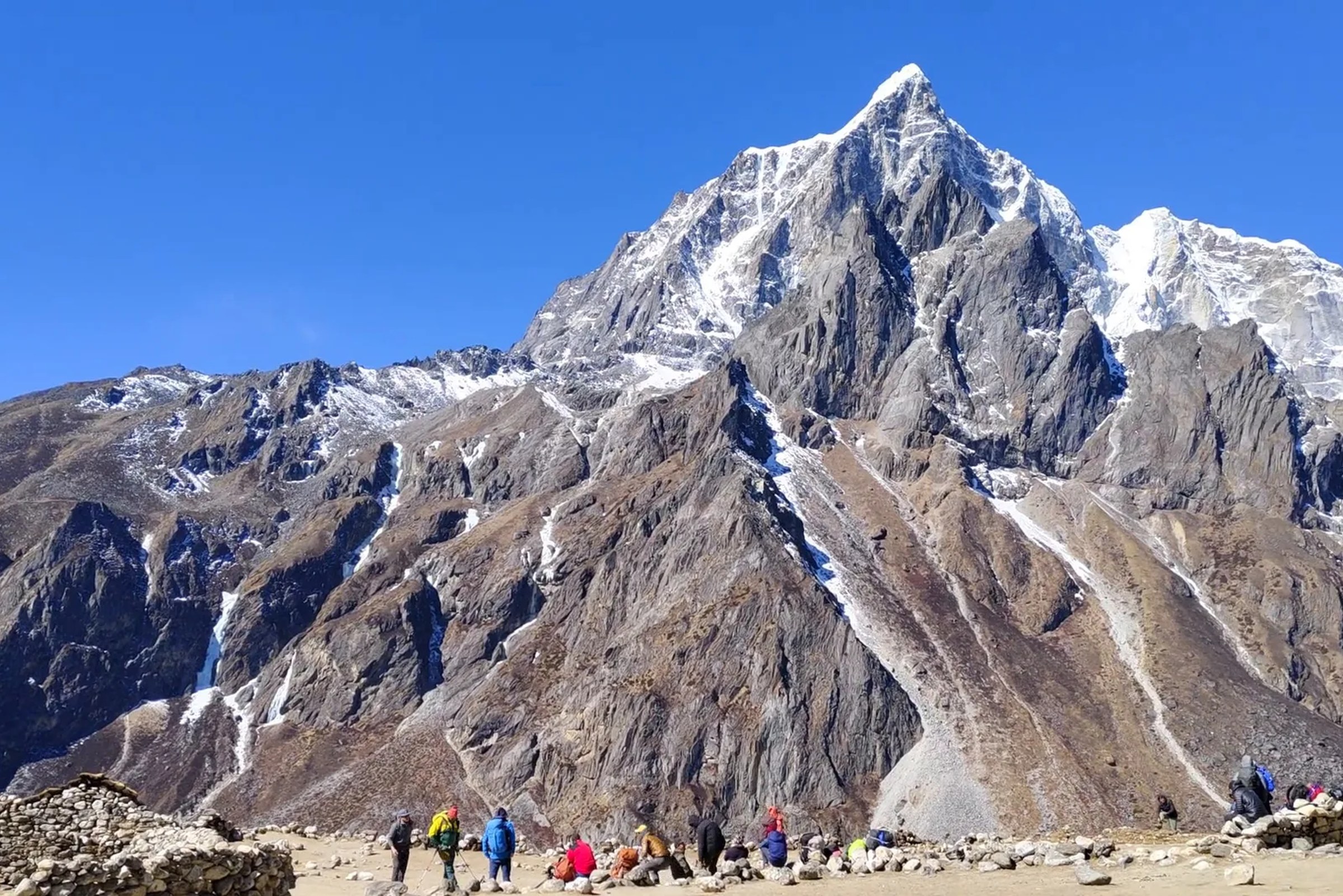
From Dingboche you turn up to Lobuche Base Camp at 5,000m, about 5 hours on day 9. Camp is a rock-strewn glacial area with the south face of the peak directly above it. It is wild and empty, yet only minutes from the teahouses of the main trail. You sleep in tents from here to the end of the climb.
Day 10 is a rest day at base camp. Nothing is asked of you except to eat, drink and sit around. On day 11 you walk up to high camp, which our altitude chart puts at about 5,400m, and the summit attempt starts from there the next night. One operator describes high camp as sitting near a small glacial lake below a big boulder.
Summit day: rock, headwall, false summit, notch
Summit day begins around 2 AM. Other operators start between 1 and 3 a.m., and one climber who went in late March 2023 left high camp at 3 a.m. in minus 25 degrees C. One head torch in his group died of the cold before they reached the glacier.
The first section is rock. It is loose, mixed ground that you climb in the dark, with your hands useful in places. Our tour notes call it a rock gully, and they warn of some scrambling on the lower part. After roughly 45 minutes the rock gives way to snow and ice, and the crampons go on.
Then comes the headwall, the crux of the day. The steepest section runs at about 45 to 50 degrees on fixed rope, and you climb it with a jumar, a mechanical ascender clipped to the rope and your harness. One operator says forearms and calves burn after about 40 minutes of it. A first-person report adds that an unroped slip on this slope has consequences, which is why you stay clipped on.
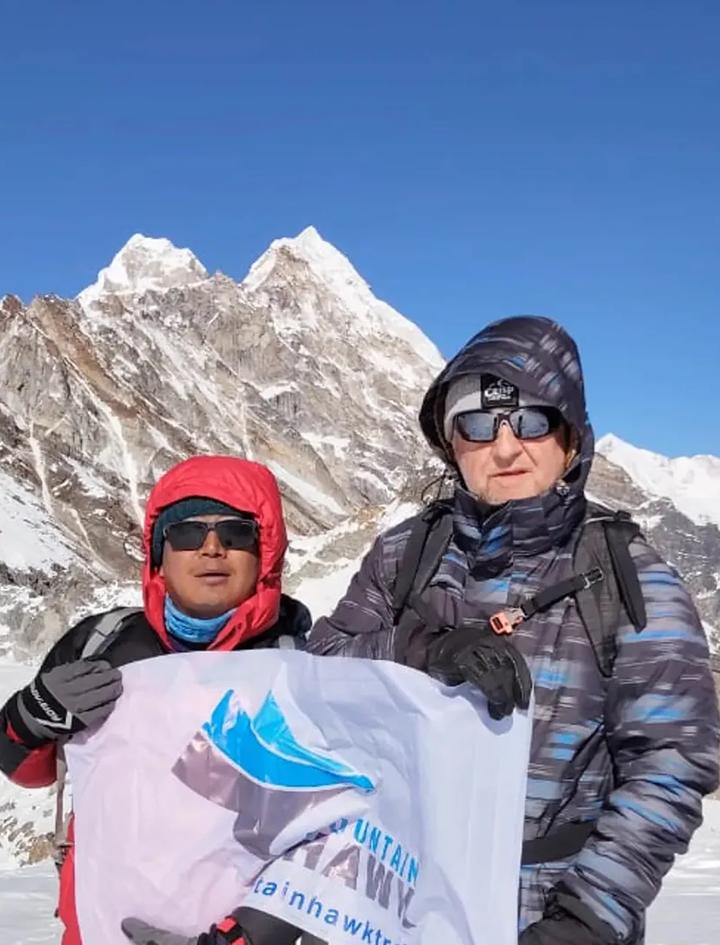
Above the headwall a snow ridge leads to the false summit. It is early morning by now, and the light is coming up. From the summit our tour notes list Everest, Nuptse, Pumori, Ama Dablam and Cho Oyu. A lot of groups stop here, and it is a respectable place to stop.
The true summit needs another effort. You drop into a notch and follow a narrower, more exposed ridge, with fixed rope in the sections that need it. The drop between the two summits can need a short rappel on the way back.
Our tour notes put the whole day at 8 to 10 hours round trip.
The descent is the part that catches people. You are tired, and the same fixed ropes now take you down. Heaven Himalaya says the way down carries more risk than the way up for that reason. Plan your energy so that you reach the false summit with something left.
How hard Lobuche East is, and who it suits
Our tour page rates the climb strenuous. Operators usually grade it PD+ on the Alpine scale, which is "peu difficile plus", or moderately difficult. Heaven Himalaya, an operator, calls it moderate to challenging and names altitude and fatigue as the main obstacles, with technical skill ranked below them. I agree with that order.
The technical part is real, though. You need to walk in crampons, climb a steep fixed rope with a jumar, and feel at ease on rock and ice in the same morning. Our notes call these skills required. If you have never worn crampons, learn on a small glacier before you come, because summit night is a poor place to learn.
Our notes also ask for prior experience above 5,000m. Base camp sits at 5,000m, and you sleep there two nights before you move up. An earlier trek above 4,500m is the best proof that your body copes with that height.
Who should not come? Anyone who has had HACE or HAPE should see an altitude-medicine doctor before booking. Anyone who has never climbed a steep slope on a fixed rope should practise that first. And anyone who wants a gentle introduction to altitude should walk the Everest Base Camp trek first and come back for the peak.
I would pick this as a first 6,000m peak for a fit trekker who likes exposure and wants varied climbing.
Acclimatization: the rest days are the plan
The trip is built on three rest days before the climb. Day 5 is a rest day at Namche Bazaar, day 8 is a rest day at Dingboche, and day 10 is a rest day at Lobuche Base Camp, the highest of the three.
Those days matter more than any pill. Nothing speeds up acclimatization except time at height, and fitness does not protect you from altitude sickness. If you feel a headache that will not clear, or you start coughing at rest, tell your guide that evening, not the next morning.
Our altitude sickness guide covers the symptoms, the descent rules and what to ask your doctor about. Read it before you fly.
Lobuche East or Island Peak
Both peaks are in the Khumbu and both are around 6,100m, with Island Peak at 6,189m. Both have an approach through Namche and Dingboche. They climb differently.
Island Peak makes you cross a glacier and climb a headwall of roughly 100 to 150m. Lobuche East starts on rock and ends on an exposed ridge past a notch. Our tour notes call Lobuche East the more technical of the two, with a rock-and-ice route against Island Peak's pure snow ridge. Some operators rank them the other way round, so choose by the kind of climbing you want rather than a verdict.
Our Island Peak climbing guide goes into the headwall and the glacier approach. If you are weighing our Island Peak climb against this one, or either against Mera, the Island Peak versus Mera Peak comparison sets the choice out.
Permits and fees
A Lobuche East climb needs a peak permit from the Nepal Mountaineering Association on top of the ordinary Khumbu entry permits. It is a separate document, and it is priced by season. This is the foreign-climber fee on the NMA's own schedule, in US dollars per person.
| Season | Months | NMA permit |
|---|---|---|
| Spring | March to May | USD 350 |
| Autumn | September to November | USD 175 |
| Winter | December to February | USD 175 |
| Summer | June to August | USD 175 |
Many pages still print USD 250, 125 and 70, which is an older schedule. If a page quotes less than the table above, check its date.
The Sagarmatha National Park fee and the Khumbu Pasang Lhamu municipality fee also apply, and our Nepal trekking permits guide lists the current figures. A short permits reference page covers the other regions. TIMS is not needed in the Khumbu.
On our trip the permits are in the price. Your guide handles the paperwork before you leave Kathmandu.
Gear
A trek kit gets you to base camp. The climb adds boots that take crampons, crampons, an ice axe, a harness, a helmet, carabiners, and a jumar and descender for the fixed rope. A full list sits on the tour page, and the rest of your clothing matches a Khumbu trek, which our Nepal trek packing list covers.
We lend a down jacket, a duffel bag and a sleeping bag, to be returned after the trip. Which pieces of climbing hardware we supply and which you bring is confirmed at booking and at the pre-trip meeting in Kathmandu.
One detail from our equipment list is easy to forget. Figure-hugging Lycra base layers can offend people in the villages, especially on women, so pack something loose to wear over them.
Best season
The climbing seasons are April to May and October to November. May has the best snow conditions on the upper route, according to our tour notes. October and November bring clear, post-monsoon air and a permit that costs half the spring price.
The temperature data we hold is for the Everest Base Camp trail, not for Lobuche high camp, so treat it as a guide to the approach only. At Gorak Shep (5,164m), October nights run from about minus 12 to minus 7 degrees C and November nights from minus 17 to minus 12. In May the same place drops to minus 9 to minus 4. High camp is higher and colder than any of those.
Lukla flights also depend on the month. In March, April, May, October and November, flights leave from Ramechhap rather than Kathmandu, a 5 to 6 hour drive. Leave a spare day or two at the end of the trip. Our Everest Base Camp trail calendar shows how the approach changes month by month.
What it costs, and how it pairs with the Everest Base Camp trek
The 18-day trip costs from USD 2,175 per person. That covers permits, a licensed guide, porters, meals and accommodation on the trek, and the flight from Lukla to Kathmandu. Travel insurance is compulsory and not included, so check that your policy covers climbing above 6,000m. Visas, international flights, tips and personal kit are extra.
Does it combine with an Everest Base Camp walk? The peak sits right beside that trail, and our day table follows it as far as Dingboche before turning up to base camp. Adding Gorak Shep and Kala Patthar is a conversation to have when you book. For the trek on its own, our 15-day Everest Base Camp trek is the standard route.
If Lobuche East makes you want a bigger peak next, the Mera Peak difficulty guide shows what the step up asks.
Frequently Asked Questions
Do you need a guide to climb Lobuche East?
Yes. The route changes with the snow, the climb uses fixed rope, and the call on the false summit and the notch belongs to the guide. Every group of ours goes with a government-licensed guide.
Is Lobuche East harder than the Everest Base Camp trek?
Yes, by a wide margin. The trek needs no ropes or crampons. The peak adds about 1,100m of climbing above base camp (5,000m to 6,119m) on rock, snow and ice, with a 2 AM start and a fixed-rope headwall.
How early does summit day start?
Around 2 AM from high camp. Operators range from 1 to 3 a.m. Plan on climbing the first hour or two by head torch, with the sun arriving near the false summit.
What happens if the weather turns on summit day?
The guide turns the group round. The false summit is the usual stopping point in bad conditions, and a clear morning at the notch can still end there if the wind is strong.
What does the NMA permit cost in autumn?
USD 175 per person. That is half the spring price of USD 350, and the same as winter and summer.