

- The season: when it opens, when it shuts down
- Month by month, what actually changes
- Weather and temperature: Darchen, Dolma La, and the lake
- Two climates, one trip
- Saga Dawa 2026 and the full moon calendar
- The Fire Horse Year: what it changes about timing
- Crowds, permits, and Darchen's small bed count
- Best time by who you are
- How far ahead to book
- Our verdict: May or September
- FAQ
The Kailash Mansarovar Yatra runs on a five-month calendar. May through September, and nothing outside that window is open to pilgrims. Inside it, the honest answer splits two ways. September brings the clearest skies, the driest trail, and the thinnest crowds of the whole year. May 2026 brings something else: Saga Dawa, the full moon that falls on May 31, arriving in the Fire Horse Year, a pairing of the Tibetan lunar and zodiac calendars that will not line up again for six decades. Which month suits you depends on which of those two things you actually want: the mountain at its calmest, or the pilgrimage at its most crowded and most charged.
Mountain Hawk Trek runs the Kailash Mansarovar Yatra overland through this same window, and everything below applies whichever route you take. What follows works month by month: the weather at Darchen and on Dolma La Pass, why the plateau stays dry through monsoon while the road to it does not, and where the Fire Horse Year changes your booking timeline rather than your itinerary.
The season: when it opens, when it shuts down
The Yatra season opens in May and closes by early October at the latest. Outside that stretch, the route simply does not function. Dolma La Pass, the 5,630m high point of the kora, sits under snow from November through April, and Lake Mansarovar freezes over. Nighttime temperatures on the plateau can drop to -25°C in the depths of winter. No operator, ours included, schedules a departure in that window, because there is nothing to depart into. The road stays open on paper, but the pass does not, and a vehicle cannot cross what a pass will not let it cross.
Within the open season, the edges are softer than the middle. Early May can still carry snow left over from winter near Dolma La, and a late-September or early-October trip is possible but treated by most operators as a genuine shoulder, not a guarantee. June through August form the reliable core, the months every fixed group departure is built around. If a booking date falls outside May to September entirely, that is not a scheduling quirk. It is the season saying no.
Month by month, what actually changes
May opens the season with the plateau still shaking off winter. Snow can linger near Dolma La, days run 10°C to 20°C, nights closer to freezing, and the light carries a clarity that later months lose to haze. This is also the month holding Saga Dawa in 2026, so the trade for that early clarity is the year's heaviest single week of foot traffic, concentrated around May 31.
June settles into the season proper. The snow at Dolma La has mostly cleared, daytime temperatures hold in a similar 10°C to 20°C band, and the Saga Dawa crowds have moved on. It is the first month that feels like the season has settled in.
July and August are the wettest months, though wet means something different here than in Kathmandu. Cloud cover increases, the mountain disappears behind haze more often, and light sleet at Dolma La becomes a real possibility even in high summer. Daytime temperatures sit around 12°C to 18°C, nights drop to freezing or just below. Both months are still walkable, and both remain the peak of the season's booking calendar, since they line up with the main northern-hemisphere travel window, but they are not where the sharpest photographs of the mountain get taken.
September is where the year turns clear again. The monsoon fades, the air dries out, and a still-warm plateau under a clean sky produces the conditions most operators and most photographers point to as the best of the year. Crowds thin as the summer travel season winds down elsewhere, even as the mountain looks its sharpest. Early October can extend the window further for pilgrims willing to risk an early cold snap that shuts things down without notice.
Weather and temperature: Darchen, Dolma La, and the lake
Three elevations matter on this trip, and each carries its own temperature curve. Darchen, the kora's starting town, sits at roughly 4,670m and is the mildest of the three, with daytime highs across the season generally between 10°C and 20°C. Lake Mansarovar, at about 4,590m, runs close behind Darchen; its water stays a hard, saturated blue through summer and turns cold to the touch even in July. Dolma La Pass, the kora's high point at 5,630m, is a different climate from either. Daytime temperatures there rarely clear the mid-teens even in June, nights sit at or below freezing across the whole season, and sleet at the pass in July or August is common enough that packing for it is not optional.
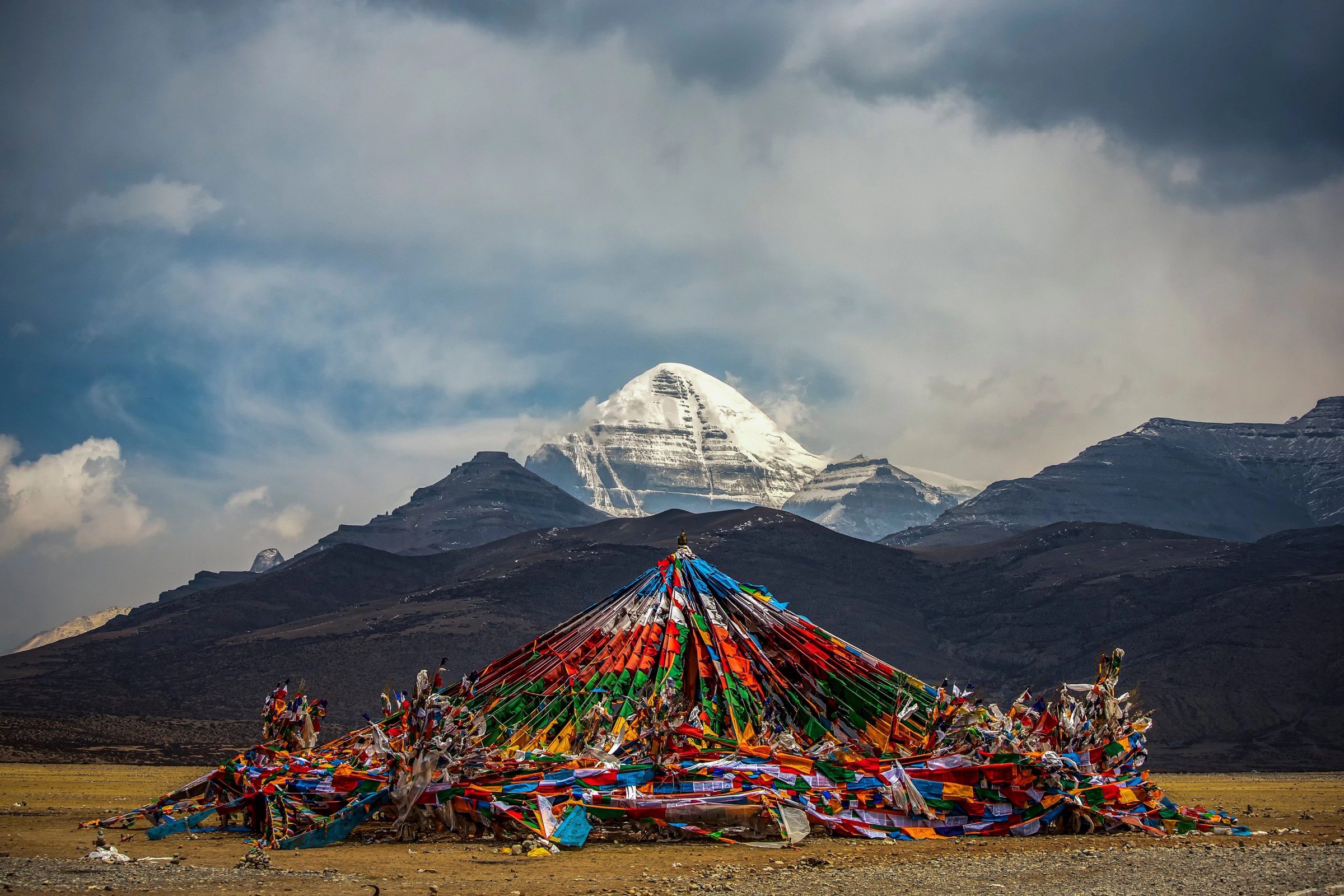
Kailash itself rises to 6,638m above all three, its snow line barely moving across the season since the summit sits well above where a Himalayan summer reaches. The gap between what Darchen feels like at 8am and what the pass feels like six hours later is the detail that catches underprepared pilgrims out. A warm morning at 4,670m says nothing about conditions three hours and nearly 1,000 vertical metres higher. Our Kailash Mansarovar Yatra difficulty guide covers what that swing does to the body at altitude, beyond what it does to a packing list.
Two climates, one trip
Ask whether the Kailash Mansarovar Yatra is safe to run during monsoon and the answer splits into two separate trips, because the plateau and the road that reaches it sit in two different climates.
Ngari, the far-western Tibetan region holding Kailash and Mansarovar, sits in the rain shadow of the Himalaya. The range blocks most of the monsoon before it reaches this far north: even at the peak of the wet season, Ngari records only around 21mm of rain in a typical July, barely enough to properly wet the ground. Roughly 80 percent of the region's thin annual rainfall falls across the whole May-to-September window, and even that total stays low by any standard other than Tibet's own. The plateau does not really have a monsoon. It has a slightly less dry stretch of an otherwise dry year.
The road getting there is a different story. Mountain Hawk Trek's overland route runs from Kathmandu to the Rasuwagadhi border crossing and on to Kerung, and that stretch sits squarely inside Nepal's monsoon belt, fully exposed to the rains that miss the plateau entirely. On July 8, 2025, a flash flood at Rasuwagadhi destroyed the Friendship Bridge connecting the two countries and closed the road for roughly 13 days. At least nine people died. Disruption on that scale is what this stretch of road can see in a heavy monsoon year, because the mountains that keep Kailash dry are the same mountains that catch every drop of rain the road has to cross.
The practical read: weather risk on this trip is front-loaded into the first and last days, not the middle. Clear the border onto the plateau and the sky problem mostly goes away, replaced by the road problem in reverse on the way home. Travelers on our Everest Base Camp overland route, which shares this same Kerung crossing, face an identical calculation.
Saga Dawa 2026 and the full moon calendar
Saga Dawa Duchen is the single holiest day of the Tibetan Buddhist calendar, marking the Buddha's birth, enlightenment, and passing on one date. In 2026 that date is Sunday, May 31, and it draws pilgrims to Kailash specifically because walking the 52km, three-day kora during Saga Dawa is held, in Tibetan Buddhist tradition, to carry extra merit beyond an ordinary kora.
The date anchors a real departure calendar. Operators across the market build fixed group departures around it, and it is the one date in the season that functions as a confirmed planning anchor rather than a rough seasonal guess. Expect the days around May 31 to carry the heaviest crowds and the tightest accommodation in Darchen of the whole year.
Beyond Saga Dawa, 2026 has four more full moons inside the trekking season: June 29, July 29, August 28, and September 26. A full moon night at Lake Mansarovar, the water lit and still, holds its own quiet pull for pilgrims who want the lunar timing without the Saga Dawa crowd. These later dates are real astronomical full moons, not confirmed departure anchors the way Saga Dawa is; no operator we could find ties a fixed group departure to any of them specifically. Treat them as a personal preference for timing your own trip, not a date the industry has already built its calendar around.
The Fire Horse Year: what it changes about timing
2026 is a Horse Year in the twelve-year Tibetan zodiac cycle, and specifically a Fire Horse Year in the rarer sixty-year elemental cycle. The previous Fire Horse Year was 1966. Tibetan Buddhist tradition holds that one kora completed during a Horse Year carries the same merit as thirteen koras in an ordinary year. That is a belief passed down through the tradition, not a historical claim, and it is presented that way here, not as settled fact.
What the Fire Horse Year changes in practice is timing pressure, not the trail itself. Demand across the whole May-to-September season runs higher than in a normal year, and several operators report booking activity moving faster this season than in any recent one. Pricing tends to firm up earlier too; the full 2026 cost breakdown covers what that does to package prices across both our overland and via-Lhasa products.
A Horse Year does not reshape which month is warmest or driest. It reshapes how early you need to act to get a seat in the month you actually want. May around Saga Dawa feels this pressure hardest, but June through September all run tighter than they would in an ordinary year.
Crowds, permits, and Darchen's small bed count
Darchen is a small town built around a large mountain, and its bed count does not stretch to match demand the way accommodation does in Namche or Kathmandu. Rooms fill first around Saga Dawa, then again through the June-to-August core season simply because that window lines up with when most of the world can travel. September, despite being the strongest month for weather, tends to book out later than July or August, since fewer travelers plan around it early.
Permits follow a similar pattern. The Tibet Travel Permit and the China Group Visa both require lead time regardless of season, and in a Horse Year that matters more, since group visa quotas and Darchen's limited beds are the two hard ceilings on how many pilgrims can be on the mountain at once, whatever demand looks like on paper.
Route choice interacts with this too. The 15-day tour via Lhasa adds extra days at altitude before the kora itself begins, which spreads acclimatization out further than the 10-day overland route does. The advantage is physiological rather than logistical, though the extra Lhasa nights also mean booking further ahead, since flights and hotel space in Lhasa carry their own seasonal demand on top of Darchen's.
Best time by who you are
For senior citizens, the operational ceiling matters as much as the calendar. India's government-run MEA route enforces a hard age cap of 70 with mandatory medical screening. The Nepal route has no government screening step; operators set their own policies, and most, ours included, ask travelers over 65 for a doctor's clearance and a frank conversation about prior altitude experience before confirming a seat. Within the season, June or September give a gentler margin than the depths of monsoon, since weather and trail conditions run more predictably. Helicopter-supported routes via Simikot exist in the market for pilgrims who cannot manage the road days, though both of our own products are ground routes by design.
For Indian pilgrims specifically, the 2026 Saga Dawa window has one detail to check before you book. Several operators have reported that permits for Indian passport holders will be suspended from May 17 to June 16, 2026, covering the entire Saga Dawa period including the May 31 full moon itself. No official Chinese government notice confirming this had surfaced before publication. If you are an Indian passport holder planning around Saga Dawa 2026, confirm the current permit rules directly with your operator before paying any deposit. That single check protects you either way: against booking a trip you cannot legally take, and against skipping a window that later turns out to be open after all.
For photographers, September is the strongest month, by a clear margin. The monsoon haze that softens the mountain's edges through July and August clears out, and dry air over a still-warm plateau gives the sharpest, most contrasted light of the year. May and June run a close second, before the season's clarity gives way to cloud. July and August are the months to plan around rather than for, if a clean shot of the mountain is the actual goal.
How far ahead to book
In an ordinary year, three to four months of lead time covers permits, the China Group Visa, and a fixed departure seat comfortably. 2026 is not an ordinary year. Between the Fire Horse Year's season-wide demand and Saga Dawa's May 31 date drawing its own separate wave of bookings, six months is the safer target, and closer to a year if the goal is a seat in the May 31 window itself.
The China Group Visa needs a minimum group of five travelers and runs on its own processing timeline, separate from the Tibet Travel Permit, so booking early does more than secure a room in Darchen. It gives your operator room to assemble that group and clear paperwork without a last-minute scramble. Later in the season, June through September, the pressure eases somewhat, though a Horse Year still means booking earlier than the same month would require in a normal year.
Our verdict: May or September
Weigh the two months against each other properly and September wins on conditions. Clearer skies, a drier trail, thinner crowds, and Dolma La at its most stable all season. If the goal is the calmest, sharpest version of Kailash and Mansarovar, September is the answer, without much need to hedge it.
May 2026 wins on meaning. Saga Dawa falls on May 31, inside the Fire Horse Year, a pairing that will not happen again for sixty years. That is not a weather argument. It is a different kind of case entirely, built on what the date means in Tibetan Buddhist tradition rather than what the sky looks like that week.
So the real question is not which month is better. It is which trip you pick. A pilgrim going for the mountain at its clearest books September. A pilgrim going for Saga Dawa itself, crowds and all, books May and plans around them rather than being surprised by them. Both are legitimate reasons to go. They are just not the same reason.
FAQ
What is the best month for the Kailash Mansarovar Yatra?
September is the strongest month for weather: the monsoon haze clears, the trail runs dry, and Dolma La Pass sits at its most stable. May's pull comes from Saga Dawa, which falls on May 31, 2026, inside the Fire Horse Year. Choose September for the calmest mountain, or May if the pilgrimage timing is the reason for the trip.
When does the Kailash Mansarovar Yatra season close for winter?
The route runs May through September, with early October sometimes possible as a shoulder window. From roughly November through April, Dolma La Pass sits under snow, Mansarovar freezes, and nighttime temperatures can drop to -25°C. No operator schedules departures in that stretch, because the pass itself is not passable.
Does it rain a lot during the Kailash Mansarovar Yatra?
Less than most pilgrims expect. Ngari sits in the rain shadow of the Himalaya, so even July, the wettest month, brings only around 21mm of rain on average. The bigger monsoon risk sits on the Nepal side, on the road between Kathmandu and the Rasuwagadhi-Kerung border crossing, which flooded badly in July 2025 and stayed closed for roughly two weeks.
When is Saga Dawa in 2026, and should I plan around it?
Saga Dawa Duchen falls on Sunday, May 31, 2026, marking the Buddha's birth, enlightenment, and passing on one day. In Tibetan Buddhist tradition, a kora completed during Saga Dawa carries extra merit. Plan around it if that meaning is the point of your trip, and expect the heaviest crowds and the tightest Darchen accommodation of the year around it.
Can Indian pilgrims join the Kailash Mansarovar Yatra during Saga Dawa 2026?
This is unsettled enough to need a direct check before you book. Several operators report that permits for Indian passport holders will be suspended from May 17 to June 16, 2026, covering the whole Saga Dawa period. No official Chinese government notice on this had surfaced before publication. If you hold an Indian passport and are planning around Saga Dawa 2026, confirm the current permit position with your operator before paying a deposit.
How far in advance should I book the Kailash Mansarovar Yatra?
Three to four months of lead time is enough in an ordinary year. 2026 is not ordinary: the Fire Horse Year is pushing demand higher across the whole season, so six months is the safer target, closer to a year for a seat in the May 31 window itself. The China Group Visa needs a minimum group of five and runs its own processing timeline, so early booking gives your operator time to assemble that group properly.