
- The six at a glance
- Which hike fits which morning
- What you can actually see from the top
- The six hikes
- Nagarjun Hill: Jamacho in half a day
- Champadevi: the shrine hill on the south-west rim
- Shivapuri: the summit with no view
- Phulchowki: the highest hill on the rim
- Nagarkot: sunrise on a hill town
- Chisapani to Nagarkot: two days along the northern rim
- Park fees, guides and water
- When to walk them
- Before a trek
- Frequently Asked Questions
- Do I need a guide for Shivapuri and the other park hikes?
- Which hike has the clearest Himalayan view?
- Can I do Nagarkot in one day?
- What is the minimum age?
- Is Phulchowki harder than Shivapuri?
- Can I hike in the monsoon?
Hiking near Kathmandu means hills. The city sits at about 1,400m inside a ring of them, and we walk six, from Nagarjun at 2,128m to Phulchowki at 2,795m. Every walk starts with a hotel pickup. None needs a technical skill.
Two things first. Four of the six are single days. The other two, Nagarkot Hiking and Chisapani to Nagarkot, last 2 days with a night away from the city, so they count as day hikes only if your day can stretch. And this page prints no prices. Each price sits on its own package page, and all six are listed on our Day Hiking page.
What follows is what each hill looks like at the top, how long it takes, how to reach it from Thamel and which one suits which morning. The numbers come from our tour pages unless a source is named.
The six at a glance
| Hike | Top height | Time on foot | Grade or climb |
|---|---|---|---|
| Nagarjun Hill | 2,128m | 3 to 4 hours round trip | Moderate, about 600m of climbing |
| Champadevi | About 2,280m | 5 to 6 hours | Moderate, 600 to 700m |
| Shivapuri | 2,732m | 6 to 8 hours | Moderate, about 1,200m |
| Phulchowki | 2,795m | 5 to 7 hours round trip | About 1,200m of climbing |
| Nagarkot Hiking (2 days) | About 2,170m | 4 to 5 hours, then 3 to 4 hours | Moderate |
| Chisapani to Nagarkot (2 days) | About 2,175m | 5 to 6 hours, then 6 to 7 hours | Moderate |
The hours are the guided pace on our tour pages. Other pages print shorter and longer ones, and a fast walker will beat ours. Phulchowki and Shivapuri are the two long climbs. Nagarjun gains half as much, which is why it fits inside one morning. That spread is the whole of Kathmandu valley hiking in one table: pick the climb you have legs for, then pick the view you want.
Which hike fits which morning
A spare day before a trek. Our Shivapuri page recommends it as a conditioning day. Kathmandu is at about 1,400m and the top is at 2,732m, so your knees and lungs feel the climb. Do it a day or two after landing, not the morning after a long flight. Phulchowki gives the same 1,200m of climbing from the south.
A family. Nagarjun and Nagarkot Hiking take children from 10. The other four take them from 12, per our tour pages. The Shivapuri page sends younger children to Nagarjun.
The widest line of peaks. Nagarkot, on a clear morning. Phulchowki comes next.
A step toward a first trek. Chisapani to Nagarkot is two long days in a row, so it asks the most. If these walks are practice for something bigger, our guide to trekking in Nepal for beginners covers the fitness side.
What you can actually see from the top
Shivapuri's summit is a forest clearing. The view is from a lookout rock a few minutes below it. The Longest Way Home, a trekking guide updated on 30 September 2026, goes further and says there are no mountain views from the peak at all. We would rather you read that here than find out at 2,732m.
Champadevi is similar. The clearing around the shrine blocks the view, and the open viewpoint is a short walk beyond it. Jamacho, the top of Nagarjun, gives a valley view and, on a good day, distant ranges. Phulchowki has the longest view of the three. On a clear day Ganesh Himal, Langtang and Gaurishankar show in the east, per the 10adventures route page updated on 15 July 2026.
Nagarkot is the famous one. Wikipedia counts eight of Nepal's 13 Himalayan ranges as visible from it, with Everest on clear days. A travel wiki warns that cloud can hide all of it even in autumn, when the air is usually clear. Every top on this page depends on the morning. Cloud builds toward afternoon, so the view belongs to the first half of the day.
One detail from the same travel wiki: the Nagarkot lookout tower stands about 4km from the village, so check which spot your hotel means by "the view".
The six hikes
Nagarjun Hill: Jamacho in half a day
The gate is Phulbari, also spelled Fulbari, near Balaju. On our tour page it is about 5km from Thamel and 15 to 20 minutes by car. The trail climbs about 600m through forest to Jamacho at 2,128m, and the round trip takes 3 to 4 hours. At the top an active Buddhist monastery stands among prayer flags, with a small stupa beside it. Monks sometimes come up for morning prayers.
Nagarjun sits inside the same national park as Shivapuri, so the same park fee applies (the fees section below has it). Deer and monkeys live in the forest, and nobody can promise you a sighting. Trekkers on the Everest trail will meet another hill called Nagarjun above Dingboche. It is a different hill. This one is half a day from your hotel.
The half day Nagarjun Hill hike is the shortest of the six.
Champadevi: the shrine hill on the south-west rim
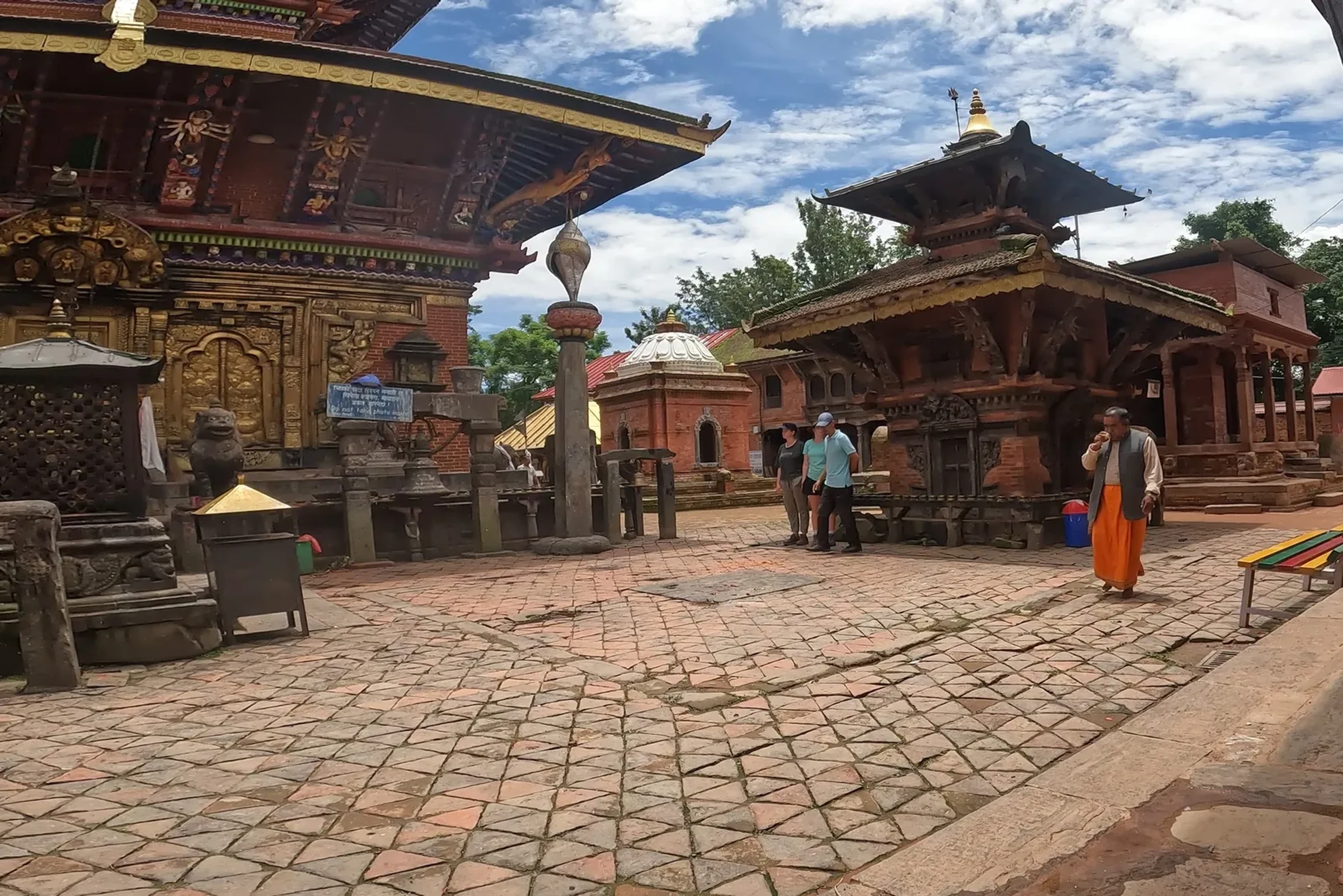
We drive 45 minutes to 1 hour to Pharping, where the climb starts at the upper edge of the village. The path runs 3 to 3.5 hours through pine forest, gaining 600 to 700m, to a small temple of the goddess Champadevi. The hill is sacred to Hindus and Buddhists, and prayer flags hang around the clearing. After the shrine the path drops for about 2 hours to Hattiban Resort, where the vehicle waits. You never retrace a step.
October to December gives the clearest air. March and April bring rhododendron into the forest. Pharping has caves tied to Guru Rinpoche, and Dakshinkali, the Kali temple, is 10 to 15 minutes past it. Animal sacrifices happen there on Tuesday and Saturday mornings, so pick another day if you would rather miss them.
The public bus route that 10adventures describes, Ratna Park to Dakshinkali and off at Khahare past Taudaha Lake, is a longer walk from a different side: 6 to 8.5 hours on its GPS log. Pharping by public transport is a gap in the sources we read, so we do not describe it. Our Champadevi day hike from Pharping uses a private vehicle.
Shivapuri: the summit with no view
The Panimuhan gate sits above Budhanilkantha, 30 to 45 minutes from the city by car. The Longest Way Home says public minivans leave from outside the Nepal Airlines building through the day and usually stop at Budhanilkantha, then it is about 45 minutes on foot to the gates.
The climb has three legs on stone steps. The gate to Nagi Gumba takes about 1.5 hours. Nagi Gumba to Baghdwar takes 1.5 to 2 hours, and Baghdwar to the top 40 minutes to an hour. Nagi Gumba is a nunnery given to Tulku Urgyen Rinpoche in the early 1960s, damaged in the 2015 earthquake and rebuilt. Baghdwar is a spring with a Shiva statue, held to be the source of the Bagmati River. Near the top stands a statue of the holy man Shivapuri Baba, and the shell of an old army post is slowly going back to the trees.
Nobody should drink from the Baghdwar spring, though locals do. The tea shop at Nagi Gumba may be shut, and there is no reliable food on the trail, so carry 2 to 3 litres of water. Saturdays are crowded with Nepali families. We pick a weekday where the calendar allows.
Shivapuri is the second-highest hill on the valley rim. The Shivapuri day hike through Nagi Gumba takes children from 12.
Phulchowki: the highest hill on the rim
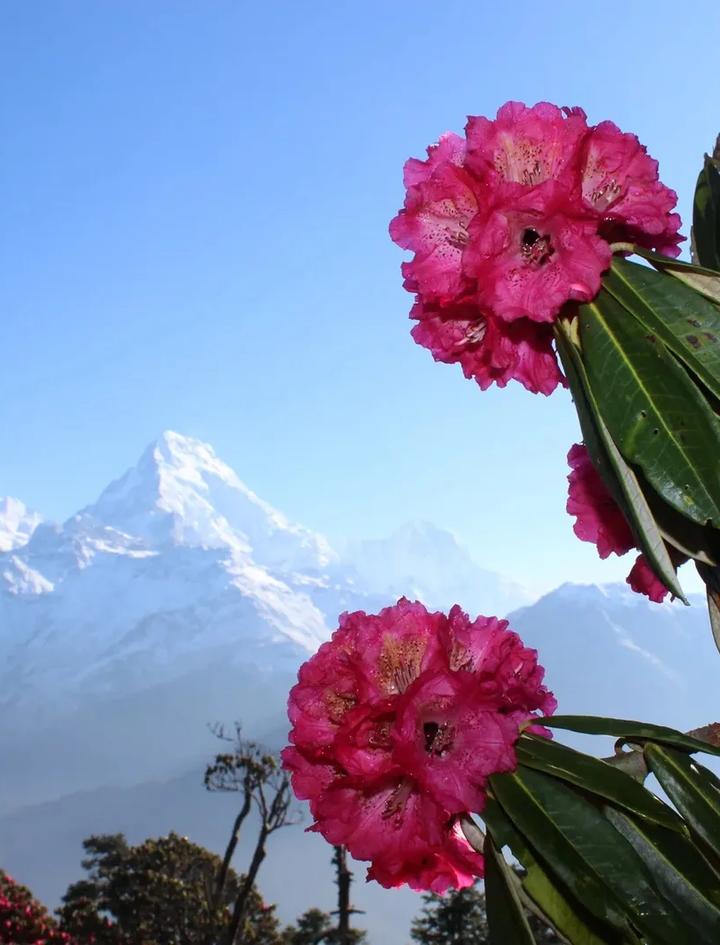
The walk starts at Godawari Botanical Garden on the southern edge of the valley. It climbs about 1,200m, 3 to 4 hours up and 2 to 3 down, through one of the densest rhododendron forests near the city. March to May is the bloom. The 10adventures route page calls the last 600m over roughly 5km one of the most exhausting stretches, and you register at an army checkpost near the top. The summit has a small shrine and a communications tower. A month-long festival runs at the shrine in March and April.
Phulchowki is 2,795m on our tour page. Other pages print 2,750 to 2,782m, so expect to see both numbers. On the way up an army canteen sells tea and snacks, and 10adventures says there is no other food on the trail.
For a bus from Thamel, Nepal Traveller (9 August 2026) says take one to Lagankhel in Patan, then a minivan to Godawari. 10adventures names a different first leg, Gongabu to Satdobato. A taxi from central Kathmandu takes about an hour. Phulchowki from Godawari is the long day: the longest climb of the six, level with Shivapuri.
Nagarkot: sunrise on a hill town
This is the first of the two overnights. On day 1 we drive to Sankhu and walk across farmland, past the sacred Salinadi river and into forest, for 4 to 5 hours to Nagarkot. The night is in a hotel with a mountain view. Day 2 starts before dawn for the sunrise, then the path drops through pine forest to Changu Narayan, a UNESCO World Heritage temple, for 3 to 4 hours. Then a vehicle takes you back to your hotel.
Nagarkot is about 30km east of Kathmandu, 1 to 1.5 hours by road (Wikipedia says 32km). It was an old fort called Mandapgiri, later a summer retreat for the royal family. A day trip is possible, but you miss the sunrise, which is the reason to go.
A travel wiki, undated, lists a public bus at under Rs 100 taking about two hours via Bhaktapur, and a taxi at Rs 2,000 to 3,000 one way. Treat those fares as old. For the walk from Sankhu, 10adventures says to take a bus from Ratna Park, 17km. The two day Nagarkot hike ends in the valley's old temple country, and our heritage sites tour covers the other World Heritage sites.
Chisapani to Nagarkot: two days along the northern rim
The second overnight is a short trek in all but name. Sundarijal is about 15km from the city, 45 minutes to 1 hour by car. Day 1 climbs 5 to 6 hours on a forest trail with stone steps and tangerine cloth ribbons tied to branches as markers, through Shivapuri Nagarjun National Park. Lunch is at Mulkharka, a Tamang village where the valley opens out behind you. The trail crests a ridge at Borlang Bhanjyang and drops to Chisapani, about 2,150m, for a night in a lodge.
Day 2 is longer, 6 to 7 hours over more than 20km, and it is the day we like better. The route passes a small lake called Nagamati Dhaap, lunch at Jhule, tea at Kattike Bhanjyang and a last climb into Nagarkot. The vehicle back takes 1.5 to 2 hours.
Other operators sell this walk as three days, with a Nagarkot sunrise and the walk down to Changu Narayan as the third. Ours ends at Nagarkot on the second afternoon. That missing third day is the second day of our Nagarkot hike, so if you want the sunrise, take both. Chisapani fills on weekends, so we book the lodge ahead. Chisapani to Nagarkot over two days suits an active beginner who can walk six hours twice running.
Park fees, guides and water
The park's own fee table (snnp.gov.np, which prints no date for it) lists NPR 1,000 per foreign visitor per person per day per entry. SAARC nationals pay NPR 600 and Nepali citizens NPR 100. Foreign and SAARC visitors carry the note "nature guide must accompany". A car, jeep or taxi pays NPR 350 per entry. The Longest Way Home, updated on 30 September 2026, prints the same three person fees.
That table covers Shivapuri, day 1 of Chisapani to Nagarkot and Nagarjun, which joined the park in 2009. For those three our price includes the park ticket and a licensed guide who walks with you the whole way. Champadevi, Phulchowki and Nagarkot sit outside the park. Our pages put any local fee at the Champadevi hill, the Godawari Botanical Garden entry and the Changu Narayan entry inside the price. Official fee pages for those three did not turn up, so we print no rupee figures for them. Champadevi's page also says no national park, conservation area or TIMS permit applies.
Boots with grip matter more than anything else on stone steps. Poles help on the way down. Carry water, because you cannot count on buying any.
When to walk them
March to May and September to November suit every hike on this page. December and January are clear and cold. In the monsoon the forest hikes are poor. Steps go slick, leeches come out and cloud closes the views. Nagarkot's climate normals make the point: 477.9mm of rain in August, 473.7mm in July and 9.1mm in November, its driest month (Wikipedia).
Start early whatever the month. Best Heritage Tour's April 2026 guide advises being at the viewpoint by about 10 AM, because clouds often build in the afternoon. Our Shivapuri page says the same about Langtang. For the wider seasonal picture, read season by season across Nepal.
Before a trek
These hikes test fitness. They do not acclimatize you. The Wilderness Medical Society rule, as our Everest altitude article quotes it, counts sleeping altitude above 3,000m, and every top here is lower. Nagarkot and Chisapani are overnights at about 2,150 to 2,175m, still under that line. For how the real rules work, read how sleeping altitude is counted on the Everest trek.
What a rim hike does tell you is whether your knees survive 1,200m of stone steps, and whether your boots rub. The tested packing checklist explains why boots are the one item to break in before you fly. A hot spot at Nagi Gumba is a cheap lesson.
Pokhara has its own short hikes, covered in our Pokhara day hikes guide. All six Kathmandu walks sit together on the Day Hiking page, next to those.
Frequently Asked Questions
Do I need a guide for Shivapuri and the other park hikes?
Yes for the three inside the national park. The park's fee table says foreign visitors must be accompanied by a nature guide. Our licensed guide walks with you on all six hikes.
Which hike has the clearest Himalayan view?
Nagarkot, on a clear morning. Phulchowki is the next best. Cloud can hide either one, so go early and expect to be disappointed once in a while.
Can I do Nagarkot in one day?
Yes, but you miss the sunrise, which is the point of staying overnight. Chisapani to Nagarkot is not a one-day walk: it is 5 to 6 hours and then 6 to 7 more.
What is the minimum age?
10 for Nagarjun and Nagarkot Hiking, and 12 for Shivapuri, Champadevi, Phulchowki and Chisapani to Nagarkot, per our tour pages. Younger children do better on Nagarjun.
Is Phulchowki harder than Shivapuri?
Not on the climb: both gain about 1,200m. Phulchowki is 5 to 7 hours round trip. Shivapuri is 6 to 8 hours, with a lunch stop and a nunnery on the way. Both are long days on stone and dirt.
Can I hike in the monsoon?
You can, but we suggest other months for the forest hikes. Leeches, slick steps and cloud are the cost, and Nagarkot gets 477.9mm of rain in August.